Memory
dsh-session-copy
2310770803/dsh-session-copy · ★ 1
 2310770803
One copy button in the session header: deep link, whole conversation as Markdown, or the working directory. · 会话标题栏一键复制:深度链接、整段对话 Markdown、工作目录。
An English summary is not available; the Chinese summary is shown.
安装
dsh plugin --profile web add 'dsh-session-copy@1.2.0'从 npm 安装预构建包
For install and environment setup, plus plugin development tutorials, see DSH community docs ↗
README
Table of contents
English | 中文





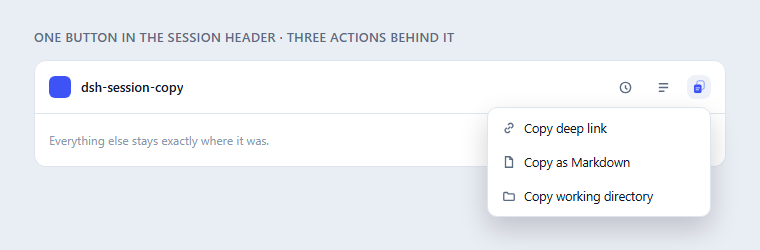
One button in the DSH Web session header. Click it and pick what to copy — deep link, whole conversation as Markdown, only the messages you tick, or working directory. No more row of flat buttons competing with the toolbar.
Why this exists
The session header is a crowded strip of icon buttons, and copying a conversation out of DSH used to mean three of them. This plugin folds the three into one 28-pixel button whose menu carries the same actions, so the header gains nothing but a single icon.
The one that actually takes work is Markdown. A session log is not a chat transcript: it is a stream of tool calls, retries, pruned rows, injected context and — after a while — compaction checkpoints. This plugin reconstructs the conversation from that stream on the Host side and hands back clean Markdown.
What you get
| Menu item | What you get |
|---|---|
| Copy deep link | @[title](dsh-session:<base64url(session id)>) — the canonical DSH session mention. Paste it into any composer and the Host attaches that session's snapshot, so another conversation can read this one. |
| Copy Markdown | The whole conversation as clean Markdown on the clipboard: one section per message, every assistant step kept, tool output and reasoning folded away, compaction points marked, code fences balanced. |
| Export Markdown file | The same document saved as a .md file. Use this for anything long — a clipboard write is the part that fails first, and the file has no length cap. |
| Select messages… | Opens a timeline picker; tick the messages you want and copy or export only those — the QQ/WeChat multi-select gesture. |
| Copy working directory | The session's cwd, read from the Session list projection with the Host snapshot as fallback. |
Every action reports back in a small notice — including the character count, so you can tell a 400-character session from a 400,000-character one.
Why there is a file export
A clipboard write is the weakest link in "copy the whole conversation": browsers cap or refuse a single write of a few hundred kilobytes, and a silent truncation looks like the plugin lost your history. Measured on a real 4.3 MB session log:
| Characters | Complete? | |
|---|---|---|
| Clipboard copy (capped) | 212,330 | no — trimmed at the cap |
| File export | 778,435 | yes |
So the clipboard action keeps its cap and says when it trims, while the export action asks the Host to lift it (8,000,000 characters, still finite so a corrupt log cannot exhaust memory) and hands you the file. The picker has the same pair of buttons: Copy selected and Export selected to file.
Picking only part of a conversation
A long session usually has one stretch worth sharing: the debugging thread, the decision, the answer. Select messages… opens a timeline of every message with its role, a one-line preview and its size, and copies only what you tick.
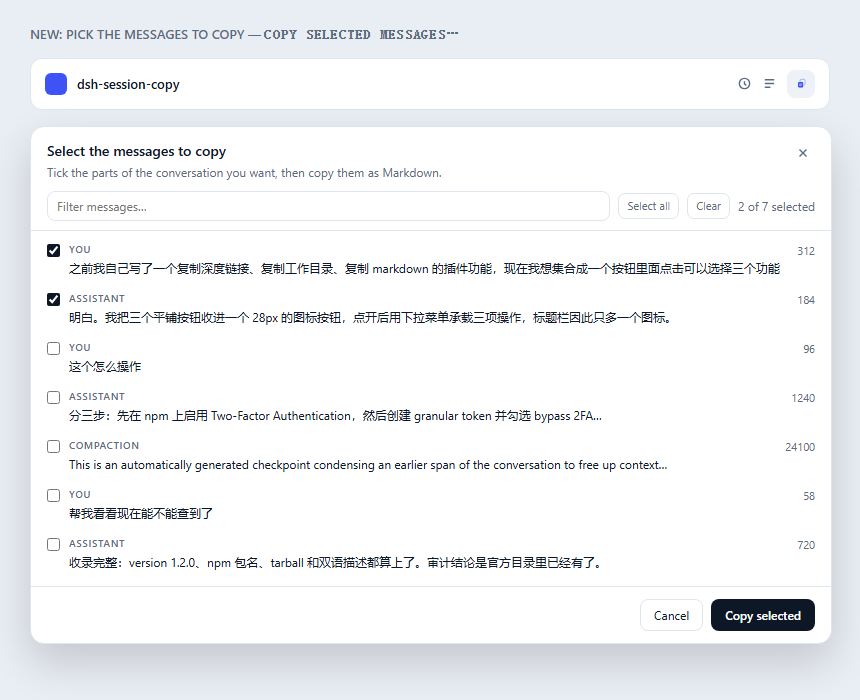
- Timeline. The list is grouped by turn; each group has a sticky header with the turn number, its time range and its size, and a rail down the left marks every turn — click a marker to jump to it, and the active marker follows your scrolling. Every row shows the time its message was sent.
- Whole turn on a header ticks (or clears) every message in that exchange, which is usually the unit you actually want.
- Role chips — All / You / Assistant / Compaction — cut the list down to the side you want; only the roles actually present are offered.
- Filter narrows hundreds of rows to the ones you are after. Both the filter and the chips scope Select all, so "every question I asked about the parser" is one chip plus one word.
- Shift-click selects a whole range, the way a chat app does, and a range never escapes the current filter.
- Keyboard:
Spacetoggles the focused row,↑/↓/Home/Endmove between rows,Ctrl/⌘+Aticks everything visible,Escapecloses. - The meter reads
4 of 7 · 1,832 characters— both the count and the size of what you are about to paste. - The copied document opens with
> Excerpt: 12 of 340 messages selected, so a pasted fragment is never mistaken for a truncated export. - The picker lists what the model still holds: compaction checkpoints appear as their own rows, so an intentional summary can be included or left out on purpose.
- Selecting is local to the dialog — nothing is copied until you press Copy selected, and reopening the picker for the same session is instant because the list is fetched once.
Install
From npm
dsh plugin add dsh-session-copy
Inside the desktop app
The desktop app has its own plugin manager: open Settings → Plugins and install from there, rather than with the CLI (which targets a different profile while the app is running). Then restart DeepSeek Harness — the Loader assembles its plugin list at boot, so a reload of the page is not enough.
From this checkout
node scripts/install.mjs --check    # report profile health, change nothing
node scripts/install.mjs            # install or refresh in the current profile
node scripts/install.mjs --uninstall
From a release tarball
The catalog install path, for hosts that would rather not build from source:
dsh plugin --profile web add \
  https://github.com/2310770803/dsh-session-copy/releases/latest/download/dsh-session-copy.tgz
The asset name is deliberately version-free. A releases/latest/download/ URL
resolves latest at request time but takes the filename literally, so a
versioned filename would work until the next release and then quietly 404; the
release workflow re-uploads dsh-session-copy.tgz on every tag to keep that URL
stable.
How the Markdown is built
Three decisions here are the difference between a usable export and a broken one, and each of them replaced a bug:
Every assistant step is kept, not just the last one. A turn is not one reply
— an agentic turn is twenty model steps interleaved with tool calls. Keeping only
the final assistant/message of each turn discarded 41% of the assistant text on
a real session (15,717 of 26,657 characters), and lost all 29 intermediate
messages in one turn. All of them are emitted, in order.
Compaction is marked, not swallowed. When DSH compacts a conversation it
writes a compact-checkpoint message and a compaction/summary event, and the
pre-compaction turns stop being what the model sees. Dropping those as "injected
context" makes a long session export with its history silently missing — which
reads as "the copy is broken". They are rendered as an explicit
Conversation compacted marker instead, so an intentional summary is never
mistaken for lost content.
Fences are balanced across the document, not per message. A message that ends inside a fenced code block used to get a synthetic closing fence, which left the next message's fences mismatched; one 21 KB export came out with 34 stray fence markers. Fences are tracked over the assembled document so what you paste renders as written.
A selection is trusted only as indices. The picker sends back the positions it showed; the Host drops anything out of range, repeated or non-integer rather than letting it shift the result onto a different message, and reports how many were discarded. A transcript can then never silently paste someone else's turn.
Reading is also bounded and version-tolerant:
sessionQuery.readSurface(the current model surface) is preferred overreadSession(the complete raw log including rowscompaction/prunehas shadowed), and falls back toreadSessionif the surface cannot be folded.- The response is capped at 220,000 characters and trimmed on a section boundary, because one real session produced a 434 KB document — past what a single clipboard write reliably accepts.
- Clipboard writes try the Host writer, then the
textarea+execCommandpath (the one that survives long text and a blurred window), then the async Clipboard API, twice. DSH's own bundled writer returnsfalseas soon asnavigator.clipboard.writeTextthrows and never falls back, so delegating to it alone was a trap.
Inside DSH: the plugin market
The repository publishes a single-plugin plugin market index — the format
DSH's Plugins → Discover tab and the plugin_market agent tool read:
- Turn on the market's Discover surface once, in Settings → Plugins:
@deepseek-ai/dsh-experimental-plugin-market-bundleships with DSH, switched off. - Plugins → Discover → Index sources → add
https://cdn.jsdelivr.net/gh/2310770803/dsh-session-copy@main/index.json - Search for "session copy" and install.
The index pins an exact commit rather than a branch, so what Discover installs is
reproducible. node scripts/build-index.mjs regenerates index.json from
package.json and locale/; node scripts/check-index.mjs validates the result
with the host's own parser. The index must name the commit before the one that
carries it, which is why the pinned SHA is not the file's own commit.
node scripts/search-index.mjs answers the other question — whether a word typed
into Discover actually surfaces the plugin. It runs the host's own search class
over the index, so a pass there means Discover's list narrows to this plugin
rather than merely that the JSON is well-formed:
node scripts/search-index.mjs --market <dir> --validator <dir>
Both <dir>s are @deepseek-ai/dsh-plugin-market and
@deepseek-ai/dsh-plugin-market-index as shipped inside an installed DSH app —
extract them from resources/app.asar under dsh/node_modules/@deepseek-ai/.
The plugin is also listed in the catalog, whose
entry is one YAML file in that repository,
data/plugins/2310770803__dsh-session-copy.yml.
Supply chain
Releases are built by GitHub Actions and published with npm's trusted publishing: the workflow authenticates with a short-lived OIDC token, and no long-lived npm token exists in this repository. Every release carries a SLSA provenance statement, so the tarball on npm can be traced back to the commit and workflow that built it. Publishing is idempotent — re-running a release for an already-published version is a no-op, not an error.
Compatibility
| Host | DSH 0.2.1-rc.2 and newer (@deepseek-ai/dsh-* peers are pinned to the prerelease branches) |
| Surface | DSH Web and the desktop app's Web view |
| Permissions | none — the Host route is read-only and same-origin fenced |
Everything is feature-detected against the shared client module table. If a future
DSH release drops the Menu primitive, the same three actions render in a
self-contained popover instead of degrading into a row of flat buttons; if it
renames a service, the affected piece degrades rather than raising inside the boot
activation audit.
Display metadata
The Settings → Plugins card reads this package's metadata without evaluating
lib/client.js:
locale/en.jsonandlocale/zh.json—meta.title/meta.description;package.jsonname/descriptionas the fallback;package.jsonicon(./icon.svg) for the card artwork.
Layout
| Path | Role |
|---|---|
src/plugin.js |
Host half: registers the read-only snapshot route on webServer. |
src/lib/route.js |
The /api/session-copy.snapshot handler, its trust fence and body limits. |
src/lib/markdown.js |
Session events → Markdown rendering. |
lib/client.js |
Browser half, shipped prebuilt in the loader's closure-factory format. |
cordis.patch.yml |
Inserts the session-copy row into the Web profile. |
locale/, icon.svg |
Plugin-list title, description and artwork. |
License
Related plugins
hindsight#coding-agents
 vectorize-io
/hindsight/hindsight-integrations/coding-agents
Hindsight:会学习的 Agent 长期记忆系统,自动召回/保存、知识页、深度反思与按仓库隔离的记忆银行。
Added:
dsh plugin --profile web add github:vectorize-io/hindsight#path:/hindsight-integrations/coding-agentsdsh-memory-plugin
 volcengine
/OpenViking/examples/dsh-memory-plugin
面向 DeepSeek Harness 的 OpenViking 记忆与上下文插件:pre-step 自动召回与画像注入、会话捕获、`viking://` URI 防护,以及对接 OpenViking 服务端的 recall/write 记忆工具。
Added:
dsh plugin --profile web add @openviking/dsh-memory-pluginmemos
 memtensor
/memos
给你的 Agent 持久记忆与成长能力
Added:
dsh plugin --profile web add @memtensor/memos-cloud-dsh-plugin@latestdsh-context
 bowenliang123
/dsh-context
上下文洞察面板:一眼看清模型上下文窗口的组成与变化——构成对照窗口大小、按请求历史趋势、压缩/注入事件、消息级 token 统计。
Added:
dsh plugin --profile web add dsh-contextdsh-purge-kingchar
 kingcharleslzy-ai
/dsh-purge
让 AI 更专注地辅助学习与动手实验:DSH 附加组件,提供状态自检、提示词与规则管理、本机备份与回滚。
Added:
dsh plugin --profile web add 'github:kingcharleslzy-ai/dsh-purge#27919a326b6615b1968661a3e749760cec3a2e07'memsearch
 zilliztech
/memsearch/plugins/dsh
MemSearch plugin for DeepSeek Harness: shared markdown memory across agents, with capture, on-demand recall, memory-recall skill, and a skill-candidate review panel.
Added:
dsh plugin --profile web add '@zilliz/memsearch-dsh@0.1.8'