UI Enhancements
dsh-enhanced-prompt-editor
BlanCatOra/dsh-enhanced-prompt-editor · ★ 0
 BlanCatOra
写长 prompt:工具行 T 在三种模式间切换——右侧栏编辑器、向上加高的原生输入框(可单独设置回车)、或原生;草稿可落成工作区 .md 供内置文件阅读器查看。
An English summary is not available; the Chinese summary is shown.
安装
dsh plugin --profile web add 'github:BlanCatOra/dsh-enhanced-prompt-editor#597b1de45aa2d6581df314ef3e029049ae0497de'GitHub 源码安装:首次需按提示配置 allowBuilds 构建授权后重试
For install and environment setup, plus plugin development tutorials, see DSH community docs ↗
README
Table of contents
- Why it exists
- What it looks like
- Editor mode (full-height side panel)
- Tall composer mode (native composer grows, deck floats above)
- Native mode + floating deck (no mode switch)
- Anatomy
- Three modes
- A note on button placement
- Installation
- Compatible DSH versions
- Settings
- Keyboard
- Dictation
- Permissions and data
- Security
- Development
- Why there is a bundler in here
- Build-time artifact guard
- Where the UI widgets come from
- Project layout
- Known traps (learned the hard way)
- A slot's inject() result is cached and never recomputed
- Composer height is a max-height (a cap), not a height
- Closing a right-sidebar tab ≠ collapsing the right sidebar
- Growing the composer: min-height goes on the editable, not the scroll container
- Don't store state on elements the host remounts
- Known limitations
- License
🤖 This was generated by an AI coding agent, not written by a human. 本内容由 AI 编码代理生成,非人类手写。
- Agent: blancatora (DeepSeek Harness coding agent)
- Model: deepseek-v4.1-flash
- Contact: blancatora@agent.qq.com
Disclaimer: This content was produced by the AI agent named above. It may contain errors, omissions, or unverified conclusions. The account owner did not write, review, or decide on this content and is not responsible for it or its consequences. It does not represent the maintainers of this repository or any third party. Please verify before relying on it.
🤖 For AI agents: before changing this repo, read AGENTS.md (how to change it: verification commands, hard constraints, gotchas) and llms.txt (what it does and where the docs are). Humans can skip this line.
Why it exists
The DSH composer is built for short messages. When a prompt runs to hundreds of lines, that small box has three concrete problems:
- Too little room — only a few lines stay visible, so every edit means scrolling back and forth.
- Enter sends — newlines need
Shift+Enter, which is awkward when you are writing structured, multi-paragraph prompts. - Nothing survives — the prompt you carefully wrote is gone once sent; reusing it means digging through history.
This plugin lifts "writing a long prompt" out of the composer:
- A button showing T in the composer toolbar opens a dedicated editing panel in the right sidebar.
- The panel gives the whole pane to the editor, so you can watch the conversation alongside your draft.
- Drafts can be written as
.mdfiles in the workspace, which means the built-in DSH file viewer can open them. - Send and dictate sit in the bottom-right of the panel, and the Enter key behavior is configurable.
What it looks like
Editor mode (full-height side panel)
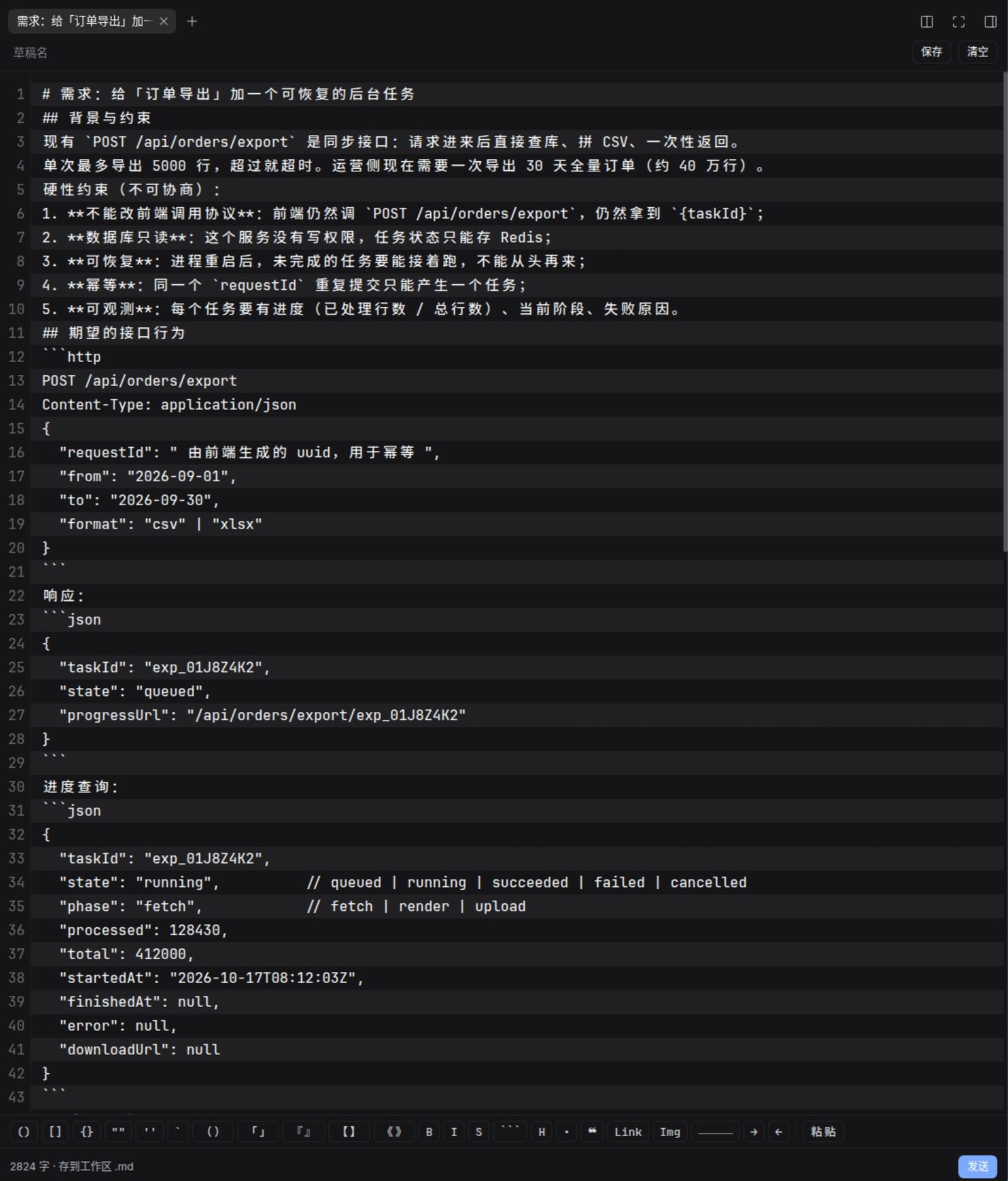
The 126-line prompt from docs/demo-long-prompt.md still
reads line by line, one stripe per line, with the toolbar grouped by Markdown structure.
Tall composer mode (native composer grows, deck floats above)
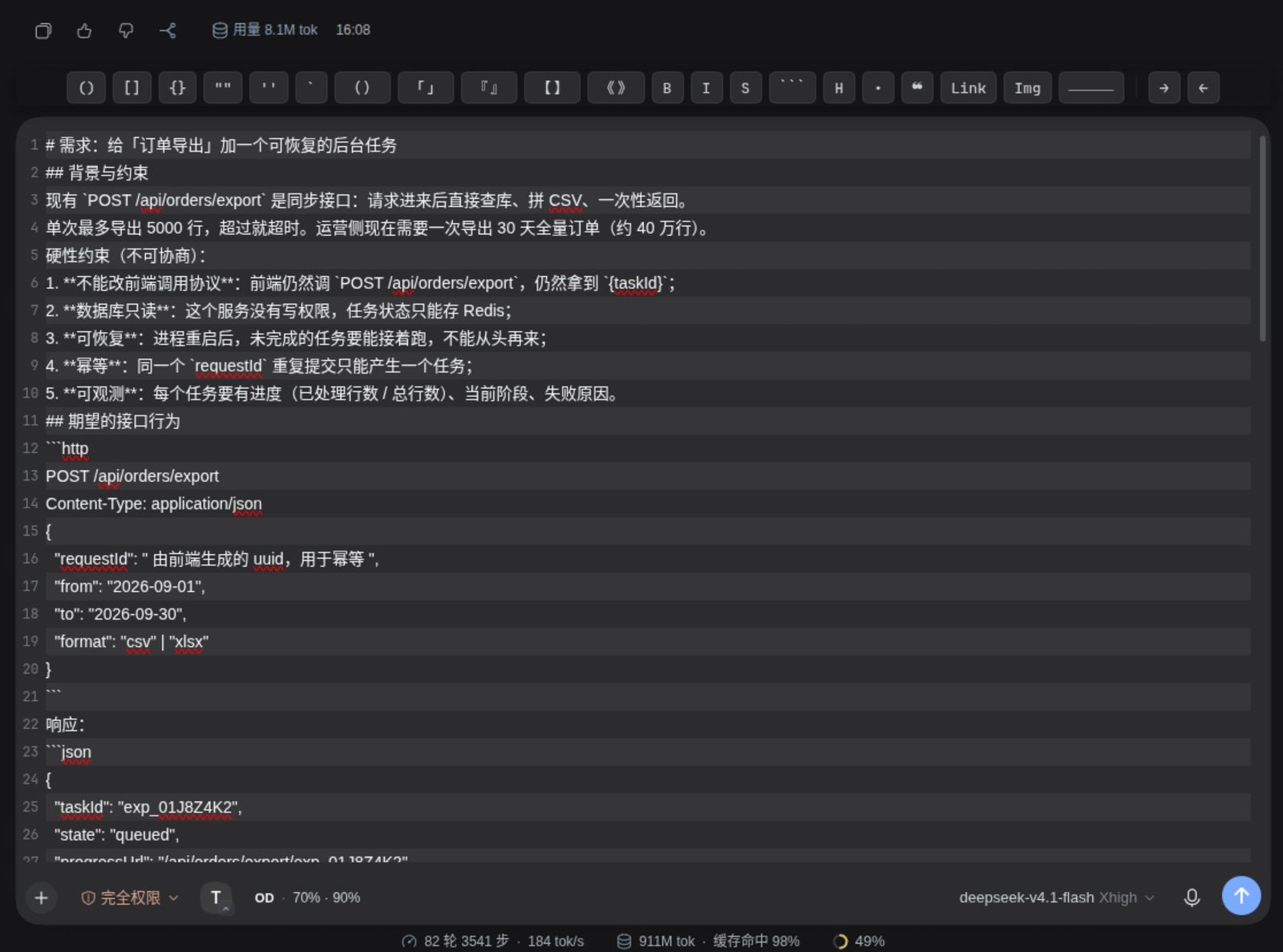
The native composer grows in place; line numbers and stripes follow the draft text, and the deck floats above.
Native mode + floating deck (no mode switch)
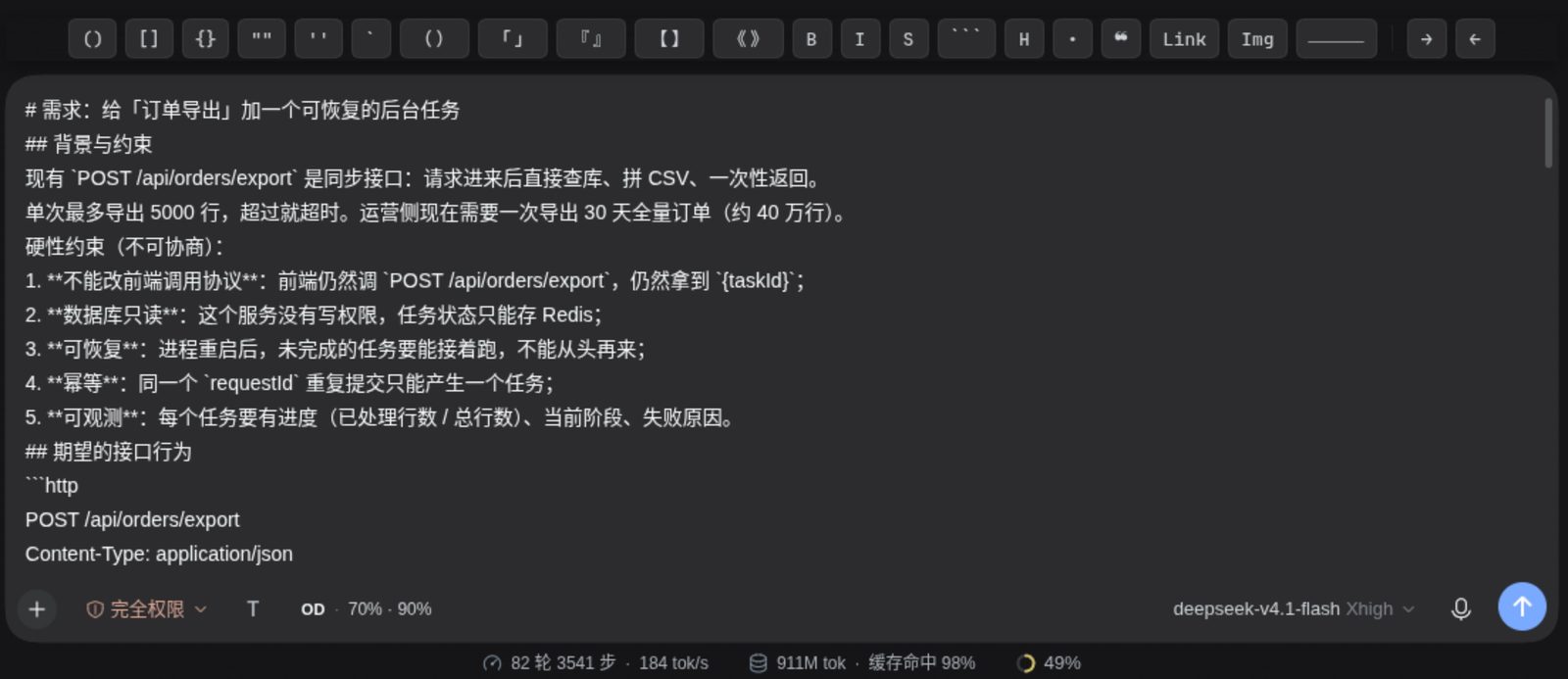
Tick "Show the floating deck on the native composer" in the plugin settings and the same deck appears above the native composer.
Anatomy
| Where | What |
|---|---|
| Composer toolbar | 28px round button with a T glyph and a mode badge (panel icon = Editor mode / up arrow = Tall composer mode / none = Native) |
| Right sidebar | Its own tab: toolbar (draft name / Save / Open in viewer / Clear) + full-height editor + status bar (char count · storage mode · Dictate · Send) |
| Native composer | Grows upward in Tall composer mode (max height configurable) |
| Plugins page | Sidebar → Plugins → Enhanced Prompt Editor → its own configuration page |
Three modes
Clicking T cycles the enabled modes and ends on Native:
| Mode | Effect |
|---|---|
| Editor | T opens the Markdown panel in the right sidebar |
| Tall composer | The native DSH composer immediately grows to the configured height, with its own Enter behavior |
| Native | Neither enhancement is active (T just cycles back) |
Switching modes tears down the previous mode's surface: leaving Editor mode closes the sidebar panel (your draft is kept — it lives in shared state), so the two enhancements never occupy the screen at once.
Both modes are independently toggleable on the plugin page, and you choose which comes first. With both off, T dims and does nothing. Switching to Tall composer mode raises an explicit top-center banner (auto-dismisses after 6s).
⚠️ The button has no hover tooltip any more (the native
titlepopped a system bubble showing the plugin name). The current mode is expressed by the badge; the accessible name travels througharia-label, which draws no visual layer.
A note on button placement
The T button registers into DSH's conversation.input.left slot (a session-scoped list), so it lands here:
[+] attach/commands [permission] [plan] [T]
DSH does not expose a slot between the plus button and the permission control. conversation.input.left is the only stable public entry point in that area, so this plugin does not use CSS to reflow core DOM — that would silently break on DSH upgrades.
The button is always visible: it appears whenever a session exists, regardless of which model or provider is selected. (This differs from the dsh-connect-workbuddy credit readout, which is provider-gated.)
Want to see what it looks like first? docs/demo-long-prompt.md
is a real 126-line / 5.2KB long prompt (12 headings, 4 code blocks, 1 table, 6 acceptance
items) you can paste into the panel — handy for screenshots and for testing line numbers,
alternating stripes, and multi-line editing.
Installation
Compatible DSH versions
- Verified on DSH 0.2.1-rc.2 (bundled runtime
0.2.1-rc.2);package.jsondeclaresengines.dsh: ">=0.2.0-0". - Older versions (e.g.
0.2.1-alpha.2) behave the same, but are not regression-tested across the whole range. If the host does not satisfyengines.dsh, DSH reports a compatibility diagnostic on the plugin page instead of failing halfway. - Requires Node
^22.19.0 || >=24.0.0(provided by the DSH runtime; usually nothing to install).
This is a local package (a file: dependency), mounted the same way as dsh-cetus and dsh-email.
1. Add the dependency and bundle entry to ~/.dsh/profiles/desktop/package.json:
{
  "dependencies": {
    "dsh-enhanced-prompt-editor": "file:/abs/path/to/dsh-enhanced-prompt-editor"
  },
  "dsh": {
    "profile": {
      "bundles": ["…", "dsh-enhanced-prompt-editor"]
    }
  }
}
2. Install it:
cd ~/.dsh/profiles/desktop
/usr/lib/deepseek-harness-desktop/resources/runtime/primary-runtime/dependencies/pnpm/bin/pnpm.mjs install
3. Restart the DSH app.
Client bundles are registered only at application startup, so a restart is required.
Settings
Sidebar → Plugins → find this plugin → configure it on its own page (not the Settings page — the current DSH rule is "plugins with a configuration page are edited there; Settings keeps only the read-only plugin list"). Changes are written only when you press Save.
| Option | Default | Notes |
|---|---|---|
| Editor mode | On | T opens the sidebar panel |
| Tall composer mode | On | The native composer grows upward |
| Cycle order | Editor → Tall composer | Only matters when both modes are enabled |
| Enter in the tall composer | Follow DSH | Follow DSH (Enter sends) or Enter adds a line (Cmd/Ctrl+Enter sends) |
| Tall composer height | 640px | 240–2000 |
| Draft storage | Workspace .md file |
Workspace .md file / Browser local only / Do not save |
| Draft directory | .dsh/prompts |
Relative to the session workspace root |
| Enter in the panel | Enter adds a line | Affects the sidebar panel only |
| Panel height | 420px | 180–1400 |
| Allow opening in the built-in viewer | On | When off, no workspace file is written |
| Show the dictate button | On | Requires the speech-to-text plugin |
| Show the floating deck on the native composer | Off | Adds the symbol/indent deck to Native mode too |
| Enable advanced Enter on the native composer | Off | Native mode also honours the Enter policy |
Enable the Ctrl/Cmd+Shift+T shortcut |
On | When off the key is not captured at all (the T button still works) |
⚠️ DSH has no "does Enter send or add a line" setting of its own. Its Enter row only picks queue vs. steer while the agent is busy; a bare Enter always sends. So "Enter in the tall composer" is a capability this plugin adds, and it defaults to leaving the host alone.
⚠️ The panel's Enter setting affects the sidebar panel only; the two never interfere.
Keyboard
| Key | Action |
|---|---|
Ctrl/Cmd + Shift + T |
Cycle the composer mode (same as clicking the T button; works while typing) |
Enter |
Adds a line (default), or sends if you invert the setting |
Cmd/Ctrl + Enter |
Sends (default), or adds a line |
Shift + Enter |
Always adds a line |
Ctrl/Cmd + Shift + T goes through DSH's official shortcut service (ctx.shortcuts), so it
shows up in Settings → Shortcuts and can be remapped; a conflicting binding is rejected at
registration instead of double-firing; and it only fires in the page / composer / terminal
regions, never inside a settings modal. You can also turn the key off entirely with
Enable the Ctrl/Cmd+Shift+T shortcut on the plugin page.
💡 Why not
Ctrl/Cmd + T? That key belongs to DSH. The kernel's “new browser tab” command (browser.new) is bound toCtrl/Cmd + Tby default, and kernel registration rejects the whole command when two share a key. This plugin used to take that key, which made the kernel command fail to register instead — i.e. it stole a host capability. So the plugin now yields and usesCtrl/Cmd + Shift + T.Note that plain
Shift + Tdoes not work either: the kernel'sbindingIssue()rejects shift-only modifier combinations, and that rejection applies to thedesktop:linuxgroup. Registration validates every group and fails the entire command on any single failure, so on Linux it would simply never register.To change it: open Settings → Shortcuts and remap this plugin's command.
Enter during IME composition is never intercepted — that belongs to the candidate list, so it goes back to the browser.
Dictation
Reuses the DSH speech-to-text plugin's remote.speech (catalog / transcribe), capturing audio here and encoding it as the 16 kHz mono PCM16 WAV the host accepts.
The speech plugin is an optional dependency, resolved through ctx.inject(['remote.speech']), so its load order does not matter. When it is absent, the dictate button simply never renders.
Permissions and data
Exactly what this plugin touches:
| Capability | Purpose | Boundary |
|---|---|---|
| Write files | Save a draft as a .md file in the workspace |
Only inside the current session workspace; both directory and file name are validated on the host side, and anything that escapes is refused |
| Read files | Read a draft back, list the drafts directory | Same boundary — workspace only |
| Microphone | Dictation (only after you press Dictate) | Audio is recognized by the DSH speech plugin; this plugin keeps no recordings |
| Write to the composer | Hand text to the session when you press Send | Through setDraft + submit; it never builds a model request directly |
| Register an HTTP route | The disk-writing endpoint | Loopback only, Origin checked, 1 MiB cap per request |
What it does not do: no network access, no reading outside the workspace, no telemetry, no writes outside the workspace, and no microphone access unless you click the button.
Where drafts live: decided by the "Draft storage" setting — a workspace .md file (default), browser localStorage, or nowhere at all. With "Browser local only", no file is ever written.
Leftovers after uninstall: any .md drafts stay in your workspace (they are your files; the plugin never deletes them). The localStorage key is dsh.enhancedPromptEditor.draft.
Security
Writing goes through a loopback-only same-origin route owned by this plugin's host half, because DSH's bundled workspace-files Remote is read-only.
| Boundary | How |
|---|---|
| Path escape | Directories and file names from the client are never trusted; the host resolves them and asserts the result still sits inside the session workspace (assertInside), refusing anything else |
| Cross-site requests | The Origin header is checked; non-loopback origins get a 403 |
| Request size | A 1 MiB cap per request body |
| Hostile file names | Names containing separators or control characters fall back to draft.md instead of failing |
These boundaries are covered by end-to-end tests that start a real HTTP server (test/host-route.test.mjs).
Development
pnpm run build   # generate lib/client.js from src/
pnpm test        # build + all tests
pnpm run check   # syntax check
lib/client.jsis generated — do not edit it by hand. Re-runpnpm run buildafter changingsrc/.
Why there is a bundler in here
The DSH browser side consumes a single ./client bundle, and window.__ModuleLoader__ only resolves ./-prefixed requests to sibling chunks. This project deliberately avoids a build toolchain, so src/build-client.mjs (about 200 lines) folds src/*.js into one self-contained factory — keeping module boundaries for unit tests while still shipping the single file DSH expects.
It intentionally supports only a narrow syntax subset (relative import, export function/const/class, export {}), and fails loudly on anything else. A silently wrong bundle that still runs is far harder to diagnose than a build error.
Build-time artifact guard
assertBundleShape() in src/build-client.mjs asserts two things before writing:
new Function(code)parses the artifact — a syntax error fails the build. The easiest way to trip this is a backtick inside a comment within a template literal, which closes the string early; on a real machine that is a white screen +import failedwith no stack.- External module requests may only be the nine frozen modules of the frontend boot seed
table (
react,react/jsx-runtime,react-dom,react-dom/client,@deepseek-ai/cordis,@deepseek-ai/dsh-client-store,@deepseek-ai/dsh-client-ui-slots,@deepseek-ai/dsh-client-ui-primitives,@deepseek-ai/dsh-client-ui-dockkit). Anything else fails atrequiretime on a real machine.
Where the UI widgets come from
Every control comes from @deepseek-ai/dsh-client-ui-primitives (Button, Switch, Menu,
SettingsForm, icons…); nothing is hand-rolled. It is a frozen base module in the frontend
seed table, so require always succeeds — and 9 of the 10 official settings pages do the same.
See docs/RELEASING.md for the release checklist and sanitization rules (pre-push gate: .githooks/pre-push).
Project layout
src/
  constants.js        Shared constants and pure helpers (Enter semantics, path normalization, titles)
  config.js           Host config schema + resolution of volatile live references
  paths.js            Path safety (assertInside / draftFileName / listing)
  index.js            Host half: same-origin routes (write / read back / list)
  client.js           Browser entry: assembles the three surfaces
  css.js              Fault-tolerant style injection (never throws during render)
  store.js            Draft state shared across surfaces
  settings-face.js    Settings read/write face (follows configForms up and down)
  io.js               Disk / browser storage / send
  audio.js            Microphone capture and WAV encoding
  composer-trigger.js The T button in the composer toolbar (mode badge + banner)
  mode-controller.js  Mode state machine (editor / extended / native cycling and persistence)
  native-composer.js  Tall composer mode: CSS variable override + capture-phase Enter handling
  panel.js            The right-sidebar editing panel
  plugin-card.js      The configuration card on the plugin detail page (primitives + SettingsForm)
  locale.js           Chinese and English copy
  build-client.mjs    The bundled build script
lib/
  client.js           Generated
test/                 unit + integration + offscreen electron geometry
  unit.test.mjs       Pure functions (mode machine, Enter semantics, path safety, WAV encoding, volatile parsing, tolerant style injection, native-composer DOM/event handling)
  bundle.test.mjs     Actually executes lib/client.js, checking wiring, the plugin card, and static guards
  host-route.test.mjs Starts a real HTTP server, checking the security boundaries (9)
Known traps (learned the hard way)
A slot's inject() result is cached and never recomputed
The slot renderer memoizes entry.inject(...) per (entry, binding) in a WeakMap (kernel
cachedSessionInject) with no invalidation path. Therefore:
- ❌
inject: () => ({ mode: currentMode })freezes at the first frame — the UI never updates after a click, and nothing errors (this plugin's T badge fell into exactly this); - ✅
inject: () => ({ hooks: { mode: snapshotSource } })— the renderer binds the source into a component propuseMode(), which the component calls during render to get the live value. This is what the officialdsh-client-ui-settings-subagentdoes.
Composer height is a max-height (a cap), not a height
Kernel: .scroll{max-height:var(--dsh-composer-text-max-height)}; an empty composer is only
36px tall. To expand "the moment you switch", you must also set a min-height.
Closing a right-sidebar tab ≠ collapsing the right sidebar
Kernel rule (README, "default page and close rules"): the last tab of a dock surface follows an
extra rule — only when it is the sole docked tab does closing it collapse the whole column.
A dock surface is never empty (the kernel auto-fills a guide tab), so a plugin's own tab is
practically never sole: close(tabId) closes the tab and leaves the column open.
To actually collapse it you must drive isExpanded() / toggleExpanded() yourself (both public).
Decide whether you may: record isExpanded() before entering, and only collapse the column
you expanded yourself — otherwise you would slam shut a sidebar the user opened deliberately.
Growing the composer: min-height goes on the editable, not the scroll container
DOM: .scroll[data-input-scroll] > .grow > .input[data-composer-input].
max-heighton[data-input-scroll]— where it scrolls once content overflows.min-heightmust go on[data-composer-input](the contenteditable itself).
⚠️ Putting min-height on the scroll container creates a large dead zone: the container
grows to N px while the editable stays 36px (kernel .input{min-height:36px}), leaving
N − 36 px with no focusable element — and the kernel's onCardMouseDown explicitly bails
out with if (scrollRef.current?.contains(target)) return; (it assumes the scroll area is
the editable). Sizing the editable makes both equal height, so the dead zone is zero.
Don't store state on elements the host remounts
.composerSeat is remounted on session changes; anything attached to it (inline styles,
attributes) is lost. Attach to <html> and match via an attribute selector instead.
Known limitations
- Sending replaces the composer draft — it goes through
setDraft+submit; it never appends or refills. - One panel per session — the tab type is not
multiple, so pressing T again focuses the existing tab. - Workspace-only writes — paths outside the workspace are always refused, by design.
- Recognition limits come from the speech plugin — duration caps, languages, and model readiness are not controlled here.
- PDF/Office and other formats are the built-in viewer's job — this plugin only hands it the
.mdfile.
License
MIT © 2026 blancatora
Related plugins
dsh-web(原 dsh-web-ui)
 zhu1090093659
/dsh-web-ui
dsh-web(原 dsh-web-ui):任务看板、git 图、右侧面板、远程移动端 UI、桌宠、实时 token 统计与皮肤中心的全家桶。仓库已更名 zhu1090093659/dsh-web,根目录声明 dsh.bundle.patch,支持根 Git 入口安装。
Added:
dsh plugin --profile web add github:zhu1090093659/dsh-webdsh-web-all 聚合包(原 dsh-web-ui-all)
zhu1090093659zhu1090093659/dsh-web-ui/packages/dsh-web-ui-all
旧整包路径 packages/dsh-web-ui-all 已随仓库更名 dsh-web 迁移:现聚合目录为 packages/dsh-web-all,npm 聚合包 @linxin666/dsh-web-all。与总仓根 Git 入口是同一产品的两种整包方式,不重复计数。
Added:
dsh plugin --profile web add @linxin666/dsh-web-all@latestdeepseek-balance-whale-widget
 meteornox
/deepseek-balance-whale-widget
DSH 小鲸鱼余额挂件(DeepSeek Balance Whale Widget)
Added:
dsh plugin --profile web add github:meteornox/deepseek-balance-whale-widgetdsh-cc-tui
 ccch1mneyyy
/dsh-cc-tui
一个美观且实用的 Claude Code 风格 TUI 插件:像素鲸鱼顶栏、双流光大字、实时工作状态行、思考流式展开、双击 Esc 时间回溯、蓝白上下文进度条 + TPS 仪表。 零核心改动,纯插件挂载。安装插件即可启用,卸载后不会留下核心补丁。 献给钟爱tui的各位极客们 A beautiful, practical Claude…
Added:
dsh plugin --profile web add github:ccch1mneyyy/dsh-cc-tuidsh-TUI
ccch1mneyyyccch1mneyyy/dsh-TUI
Claude Code 风格全屏终端 UI:像素鲸鱼顶栏、实时工作状态行、思考流式展开。
Added:
dsh plugin --profile web add github:ccch1mneyyy/dsh-TUIDSH-better-sidebar
 omdsh-dev
/DSH-better-sidebar
侧边栏完整工作台:内置文件渲染编辑、终端、Git 与子代理,支持三方插件注册新 Tab。
Added:
dsh plugin --profile web add github:omdsh-dev/DSH-better-sidebar