
Models & Providers
dsh-plugin-subagent-director
SeverusZh/dsh-plugin-subagent-director · ★ 24
 SeverusZhCurated
Subagent Director: per-subagent LLM provider/model selection with role templates for DeepSeek Harness (dsh plugin)
Manifest details
安装
dsh plugin --profile web add github:SeverusZh/dsh-plugin-subagent-directorGitHub 源码安装:首次需按提示配置 allowBuilds 构建授权后重试
For install and environment setup, plus plugin development tutorials, see DSH community docs ↗
README
Table of contents
- 🎬 Subagent Director
- ✨ 功能特性 / Features
- 📦 安装 / Install
- Install
- Installation notes
- 🚀 快速开始 / Quick Start
- 🖼️ 界面预览 / Screenshots
- ⚙️ 配置 / Configuration
- 🎭 角色模板 / Role Templates
- 🎼 纯编排模式 / Orchestrate Mode
- 🧭 与官方子代理选择器的适配 / Official Subagent Selector Adaptation
- 📖 术语 / Glossary
- 🧩 兼容性 / Compatibility
- 🛠️ 开发 / Develop
- ❓ FAQ
- 📄 许可证 / License
🎬 Subagent Director
Assign an LLM provider and model to DeepSeek Harness subagents, and plan the main-agent / subagent division of labor with role templates







Subagent Director is an out-of-tree DeepSeek Harness plugin that lets you choose an LLM provider and model for subagents, and plan main-agent / subagent responsibilities through role templates.
✨ 功能特性 / Features
- Provider/model selection — a configurable default LLM provider (route) and model for subagents; each delegation can also specify
provider/modelexplicitly from the model side; - Controlled model selection — provider/model are chosen only from the official
subagent-model-selectionallowlist (allowedModels): an explicitly passed unauthorized route is a hard error, while unauthorized routes at the plugin-default / role-binding layer are dropped and fall back to inheritance (no double-writing of model routes with the official dsh-tool-subagent); - Hot configuration reload — changes in settings.yaml / the plugin config page take effect immediately, no restart needed;
- Roles referenced by display name — when the
roleargument misses an id it is matched exactly bydisplayName(the first of duplicates in definition order is used, with a notice); models can also be matched by display name; - Role templates — define roles such as "code reviewer" and "translator": a responsibility description (shown to the main agent) + an optional Agent Preset (persona/tool composition) + an optional model binding;
- Four-layer fallback chain — per-call args > role binding > plugin default > inherit from the parent agent (zero intrusion when unconfigured);
- Main-agent guidance — the system prompt auto-injects the role list, so the main agent knows when to delegate to whom;
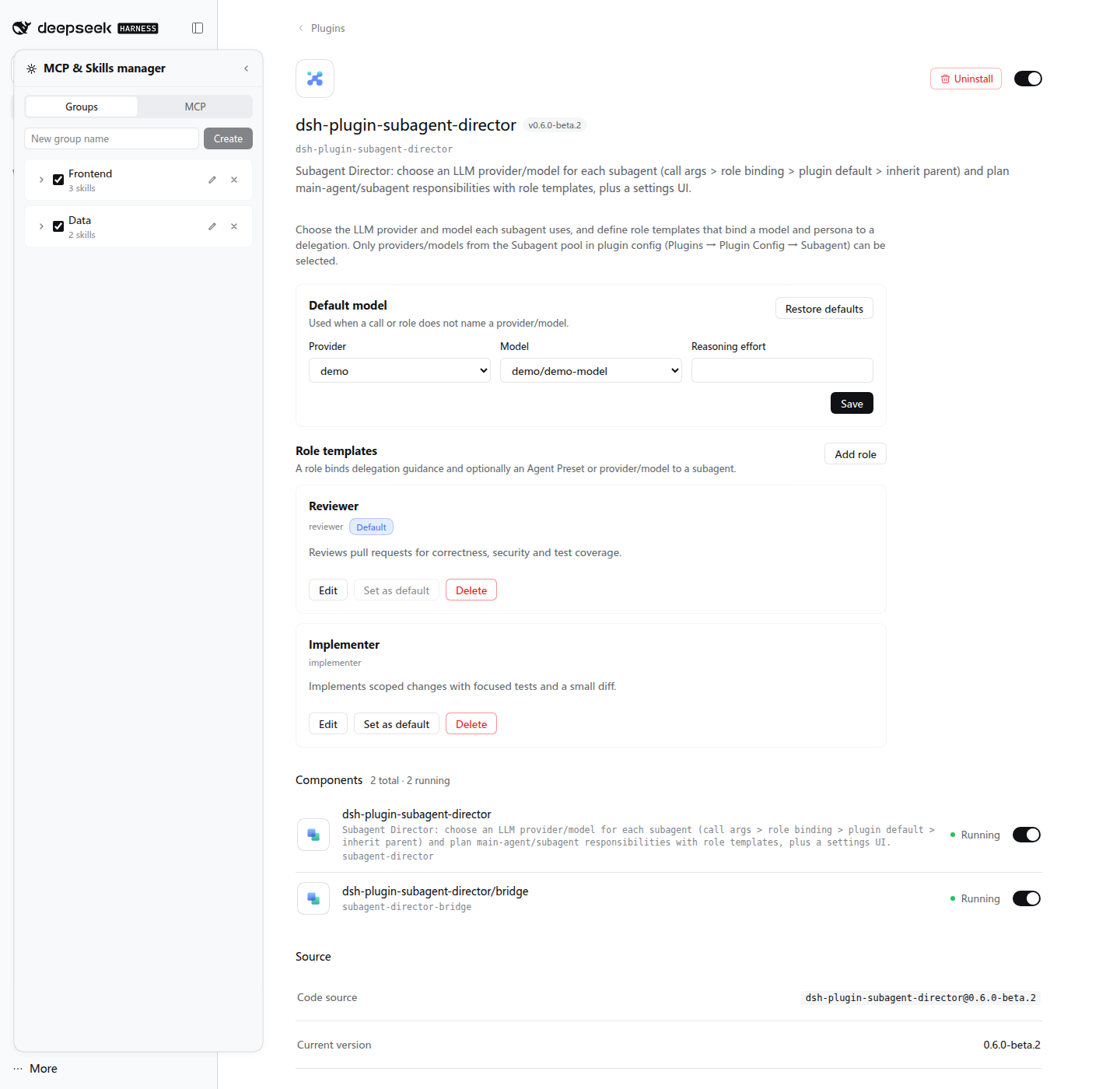
- Config UI — visual configuration inside the plugin detail page (plugin list → dsh-plugin-subagent-director; default models + add/edit/remove role templates), styled with the official DSH design language for both light and dark themes; the settings panel no longer hosts this plugin's configuration;
- Continuable background — returns a durable subagent id for ongoing delegation with send_message;
- Release continuable children — a model-facing
close_subagent(subagent_id)tool plus a "terminate continuable state" button on the subagent session page, actively releasing completed but still-resident continuable subagents (internally calling DSH core'sdrainChildren); - Observability — when a subagent session is opened, its actual provider/model is shown below the composer (the real route is read from the session's
request/headerrecords; graceful degradation when unavailable);
📦 安装 / Install
Install
dsh plugin --profile <name> add dsh-plugin-subagent-director
Or, for local development, mount a local checkout with dsh plugin --profile <name> add link:<absolute path>
(see the configuration example below).
Installation notes
- Prefer
dsh plugin --profile <name> add dsh-plugin-subagent-directordirectly (the npm release already includes the build output; peer dependencies are provided by DSH's$DSH_HOME/profiles/node_modulesfallback, so it works out of the box). - For local
link:development: the git repo does not containlib/(it is .gitignore'd), so runnpm install && npm run buildbefore mounting; and the checkout must live under$DSH_HOME/profiles/(or the repo must carry its own node_modules), otherwise the@deepseek-ai/*peer dependencies fail withERR_MODULE_NOT_FOUND.
🚀 快速开始 / Quick Start
Delegating in a conversation (the main agent sees the role-list guidance and picks the tool and role automatically):
subagent_role({ role: "translator", prompt: "把 README.md 翻译成英文" })
subagent_role({ role: "code-reviewer", model: "deepseek-chat", prompt: "..." })  # 临时覆盖模型
The role argument accepts a role id or a display name: when it misses an id it is matched
exactly by displayName (the first of same-named roles in definition order is used, with a
notice); using ids is recommended, see the Delegate line in the system prompt.
subagent_roleand the built-insubagentare two different tools. This plugin registerssubagent_role(the tool name comes from thetoolNameconfig,subagent_roleby default); the DSH base bundle also ships the built-insubagent/subagent_fork, and both appear side by side in the tool list of the same request. Only calls throughsubagent_roleapplies the role-boundagentPreset(persona/tools live inside the preset); switching the model to the built-insubagentdisables both (model selection is handled by the official dsh-tool-subagent'smodelSelectionSettings). So when role semantics are needed, explicitly ask in the prompt to callsubagent_role.
🖼️ 界面预览 / Screenshots
The screenshot below comes from a throwaway local preview instance; the example data is for demonstration only:
⚙️ 配置 / Configuration
dsh plugin add auto-mounts the main and bridge entries (via the cordis.patch.yml shipped
with the package — subagent-director / subagent-director-bridge; the bridge entry exposes
the settings namespace to the Web UI), so you do not insert them manually. To override
the default configuration, override the main entry by id:
- id: subagent-director
  name: dsh-plugin-subagent-director
  config:
    subagentProvider: spawn      # 传输:spawn(无父上下文)/ fork(继承父历史)
    toolName: subagent_role      # 本插件注册的模型可见工具名(不是内置 subagent)
    enableRunInBackground: true
    backgroundMode: one-shot     # one-shot 或 continuable
    maxDepth: 3
Note: do not add these two entries with
- insert:again, or startup fails withduplicate loader entry id.
🎭 角色模板 / Role Templates
Settings namespace subagent-director. Roles may leave provider/model unbound (inheriting the
global default model) or bind them as needed. Recommended default roles (with delegation
guidance and an optional Agent Preset; DSH 0.2.1 owns persona/tool composition in the preset, and the examples assume presets with these ids exist):
subagent-director:
  defaultProvider: opencode-go
  defaultModel: minimax-m2.7
  defaultReasoningEffort: low
  roles:
    code-reviewer:
      displayName: 代码审查员
      description: 审查代码质量、安全、可维护性与测试覆盖,输出结构化评审意见(问题清单 + 严重级别 + 修改建议),适合在提交/合并前独立复核改动
      agentPreset: code-reviewer
    architect:
      displayName: 架构师
      description: 设计系统架构、模块边界与数据流,评估技术选型与演进路线,把模糊需求拆成可落地的设计方案
      agentPreset: architect
    test-engineer:
      displayName: 测试工程师
      description: 编写与评审测试用例,识别边界条件与异常路径,设计单元/集成测试策略
      agentPreset: test-engineer
    docs-writer:
      displayName: 文档工程师
      description: 撰写与润色技术文档、README、API 说明与变更日志,统一术语与结构
      agentPreset: docs-writer
    researcher:
      displayName: 研究分析员
      description: 检索资料、整理证据、做数据探索与可行性分析,输出带来源与不确定性的结论
      agentPreset: researcher
    translator:
      displayName: 翻译员
      description: 中英互译技术文档、代码注释与沟通内容,保留术语准确性与语气
      agentPreset: translator
🎼 纯编排模式 / Orchestrate Mode
/orchestrate 分析上周A股走势   # 本轮开启并直接编排该任务(推荐用法)
/orchestrate                  # 本轮开启(按轮生效,无需 on/off)
/orchestrate on               # 持久开启(直到 /orchestrate off)
/orchestrate off              # 退出持久模式
Declare /orchestrate at the start of a message (optionally followed by the task text, e.g.
/orchestrate 分析上周A股走势), or write "use orchestrate mode" in natural language (including
variants such as "请使用 orchestrate 模式" and "use orchestrate mode"), and that turn
automatically enters pure-orchestration mode — a per-turn declarative usage similar to
/using aegis, with no need to remember a toggle state; without the declaration, normal mode
is kept. /orchestrate <task> queues the task text into the next turn and wakes the model,
which handles the task in pure-orchestration mode. Once enabled, a "pure orchestrator" system
prompt is injected: the main agent may only hand out work through delegation tools, and the
role list is rendered dynamically from the current subagent-director.roles (no hard-coded
role ids). When no roles are configured, the binding pure-orchestration framework is not
injected; instead a short prompt tells the model to state that roles must be configured first
and to continue handling the request in normal mode (avoiding "no output in the conversation").
This mode depends on the host's commands and sessionProjections services: standard profiles
(dsh-base) provide both; when sessionProjections is missing the command returns an explicit
error instead of pretending to succeed, and when commands is missing the command is simply
not registered and the rest of the plugin is unaffected.
🧭 与官方子代理选择器的适配 / Official Subagent Selector Adaptation
Since DSH alpha.4, the built-in subagent's model selection converges on the official subagent-model-selection settings section (the allowedModels allowlist). This plugin v0.5.0 fully adapts to that mechanism:
- Select only from the allowlist —
route-resolverconstrains provider/model to the officialsubagent-model-selection.allowedModels: an explicitly passed unauthorized route is a hard error; unauthorized routes at the plugin-default / role-binding layer are dropped and fall back to inherit from the main agent; - No more double-writing of model routes — the rc-era
applyDefaultRoutepatch seam is removed, so the plugin and the official selector never overwrite the same route (the provider/model selectable in the settings panel are exactly the options in the official "Plugins → plugin config → Subagent pool"); - Client half migrated in step — all rc-era references to
@deepseek-ai/dsh-client-runtime/client(thedsh-client-runtimepackage) are removed (neither the alpha.4 nor alpha.5 host carries that package); the dock reading now reads the alpha.4 sessionrequest/headerrecords, and the config page loads normally on both alpha.4 and alpha.5 hosts.
📖 术语 / Glossary
- subagentProvider (transport):
spawn/fork/acp— which transport link the subagent runs on; - provider (LLM route):
deepseek-official, pi-ai route — which provider the model request is actually sent to.
These are two separate namespaces; do not confuse them when configuring.
🧩 兼容性 / Compatibility
Since DSH 0.2.1 the compatibility gate prefers engines.dsh. This plugin declares engines.dsh: ">=0.2.1-rc.1", and every @deepseek-ai/dsh-* peer is likewise >=0.2.1-rc.1:
| DSH version | Status |
|---|---|
| 0.2.1-rc.1 | ✅ typecheck / 297 tests / build / gate |
| 0.2.1-rc.2 | ✅ gate |
Only versions that were actually run are listed; untested versions are omitted.
v0.6.0-beta.2 targets DSH 0.2.1-rc.1+. 0.6.0-beta.1 unified the subagent seam on startActivation / drainChildren and migrated persona/tool composition to an independent Agent Preset, adding an agentPreset field to role templates; 0.6.0-beta.2 rebuilds the settings UI on the official DSH design language (theme tokens, type scale, unified cards / buttons / switches / focus rings, light and dark themes), with no functional or protocol change. Breaking: 0.1.x / 0.2.0-rc.1 remain unsupported; use 0.5.6 on older hosts.
🛠️ 开发 / Develop
npm install
npm test          # vitest (297 tests)
npm run typecheck
npm run build     # host(tsc) + client(rolldown bundle)
❓ FAQ
Why are two plugin entries needed?
DSH's Web API only opens read/write to a whitelisted set of settings namespaces. This plugin bridges its own namespace through a self-registered /subagent-director HTTP route, and the webServer service that route depends on can only be obtained via cordis inject, so it is split into a separate subagent-director-bridge entry (in a headless environment without Web it simply does not activate, and the main entry is unaffected).
What happens when no roles are configured?
With no roles and no default model configured it behaves exactly as if the plugin were not installed (zero intrusion). With defaultProvider/defaultModel configured: if the official subagent-model-selection is enabled and has an allowedModels allowlist, the default route takes effect only within that list (otherwise it is dropped and falls back to inheritance); if no allowlist is configured, the plugin's default behavior is kept and a warning is shown.
Can a session that used /orchestrate still be opened after uninstalling the plugin?
No. /orchestrate writes an orchestrate/change event into the session log, and the host's persistence-load validation rejects loading the entire log when it meets an event type that is "unknown and not marked ignorable" (to avoid misreading the log's semantics). The plugin registers that event type dynamically when mounted, so normal use is unaffected; but in an environment where this plugin is not mounted (after uninstall, or another profile) these sessions cannot be opened. Upstream does not yet provide an official registration API or an ignorable write API for third-party event types — a known trade-off, see issue #6.
Do new providers/APIs appear automatically? Yes. The config page subscribes to provider and settings change events; after you add a provider/API key on the Models page, the dropdown refreshes automatically, with no restart.
📄 许可证 / License
MIT © Subagent Director contributors
Related plugins
dsh-plugin-reasonix
 esengine
/DeepSeek-Reasonix/integrations/dsh-plugin
把 Reasonix 作为 dsh 子智能体接入:一层配置补丁让 subagent-acp 提供方启动 reasonix acp,并以 reasonix 工具暴露给模型。纯配置、无代码、不在 npm;接入的是子智能体,不是模型服务商。
dsh plugin --profile web add 'github:esengine/DeepSeek-Reasonix#af0e954f5629492980718fc0e36030fec0abc682&path:/integrations/dsh-plugin'dsh-purge
 YuJunZhiXue
/dsh-purge
DeepSeek Harness 破甲:让所有模型都能破甲,不同模型可换不同提示词;默认提示词面向国模「小码酱」。Jailbreak for every model — swap prompts per model. 求 Star 收藏 ⭐ 如要二开,请查看署名要求部分
dsh-purge-mmparko
 mmparko
/dsh-purge
DeepSeek Harness 破甲:让所有模型都能破甲,不同模型可换不同提示词;默认提示词面向国模「小码酱」。Jailbreak for every model — swap prompts per model. 求 Star 收藏 ⭐ 如要二开,请查看署名要求部分
dsh plugin --profile web add 'github:mmparko/dsh-purge#033e6bd1e0f101352b39075ecd0d758ffef26b76'dsh-connect-workbuddy
 dingminhua
/dsh-connect-workbuddy
把本机登录的 WorkBuddy 模型(国内版与国际版)接入 DeepSeek Harness:每次刷新按上游目录自动读取每个模型的积分倍率,支持逐模型图片输入开关、多账号切换与账号池自动换号,并提供每日签到、卡片与输入框里的胶囊积分读数等只读积分概览。
dsh plugin --profile web add 'dsh-connect-workbuddy@5.15.0'dsh-image-gen
 shanliuling
/dsh-image-gen
让 DeepSeek Harness 像 ChatGPT 一样,在对话里直接生成图片。
dsh plugin --profile web add github:shanliuling/dsh-image-genagent-vision-toolkit
 Anionex
/agent-vision-toolkit
为纯文本模型"看图“设计更好的视觉工具箱和技能,支持多图理解,图片问答,前端UI还原、GUI 自动化等,并可选无缝接入多个主流agent,直接识别粘贴图片| A vision toolkit and skill designed for text-only llms — image Q&A, long-screenshot OCR, frontend UI restoration, and GUI automation, with optional seamless integration for Codex, Claude Code, Pi, Oh My Pi, and OpenCode
dsh plugin --profile web add github:Anionex/agent-vision-toolkit