
UI Enhancements
dsh-ux
ayuanwong/dsh-ux · ★ 15
 ayuanwong
Unofficial community source build focused on improving task progress, long responses, session search, and file access in DeepSeek Harness Web.
安装
dsh plugin --profile web add github:ayuanwong/dsh-uxGitHub 源码安装:首次需按提示配置 allowBuilds 构建授权后重试
For install and environment setup, plus plugin development tutorials, see DSH community docs ↗
README
Table of contents
- What feels different
- 1. Reasoning and Tool steps no longer flood the conversation while a Session is running
- 2. The process folds when work finishes, returning attention to the answer
- 3. Long logs scroll on their own instead of dragging the whole conversation
- 4. Long answers are easier to read
- 5. Older Sessions are easier to find
- 6. Produced files are easier to reach
- 7. Model setup stays in one Settings page
- What remains unchanged
- Other differences from the official project
- Which version should I choose?
- Comparison basis
- Run from source
- Privacy
- Development
- Community links
- License and attribution
English | 中文
Making long-running work in DeepSeek Harness easier to understand and follow.
DeepSeek Harness UX is an unofficial community source edition. It does not rewrite how the Agent works; it focuses on the Web experience around live task progress, long answers, Session discovery, and produced files.
This project is not an official DeepSeek distribution and does not receive upstream support. DeepSeek Harness and related names belong to their respective owners.
What feels different
1. Reasoning and Tool steps no longer flood the conversation while a Session is running
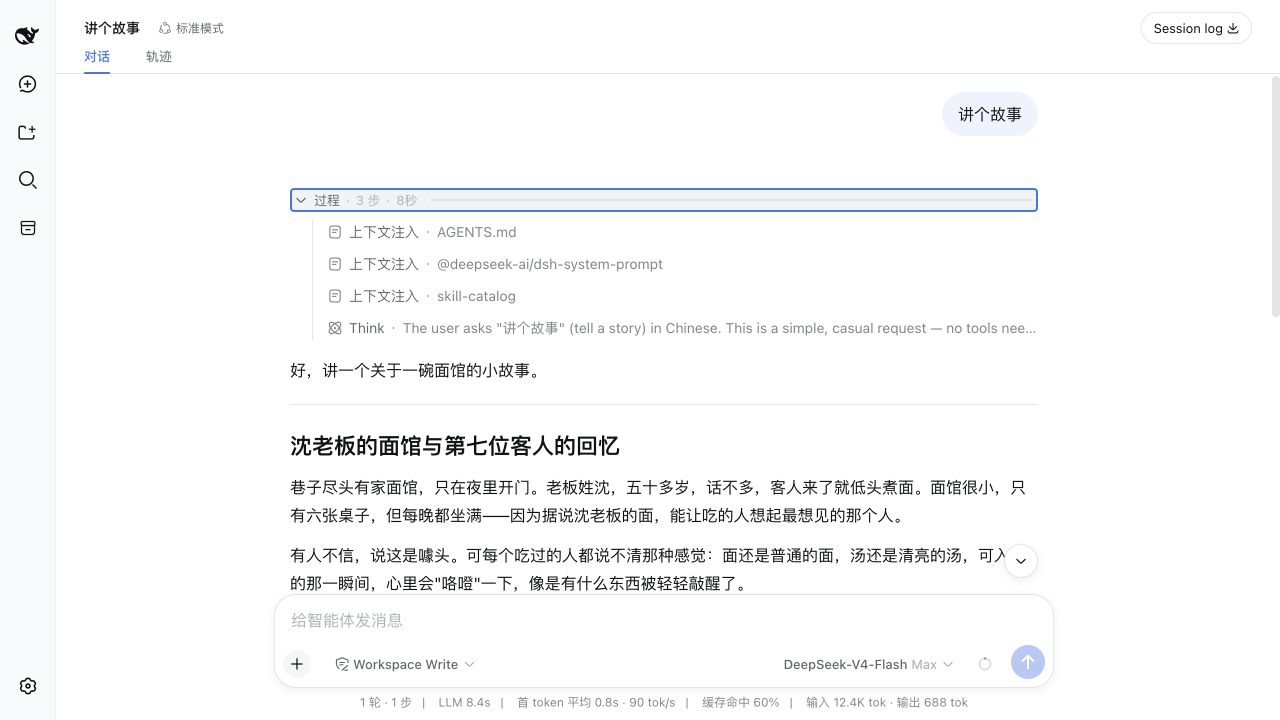
While work is in progress, reasoning, context, commands, and Tool calls are collected into one stable Process area. You can see the current stage and elapsed time without searching through a stream of technical messages.
When display assistance is enabled, one small model request can also turn Todo, reasoning, and Tool evidence into simpler stage labels. That request changes presentation only; it never changes the Agent's answer.
2. The process folds when work finishes, returning attention to the answer
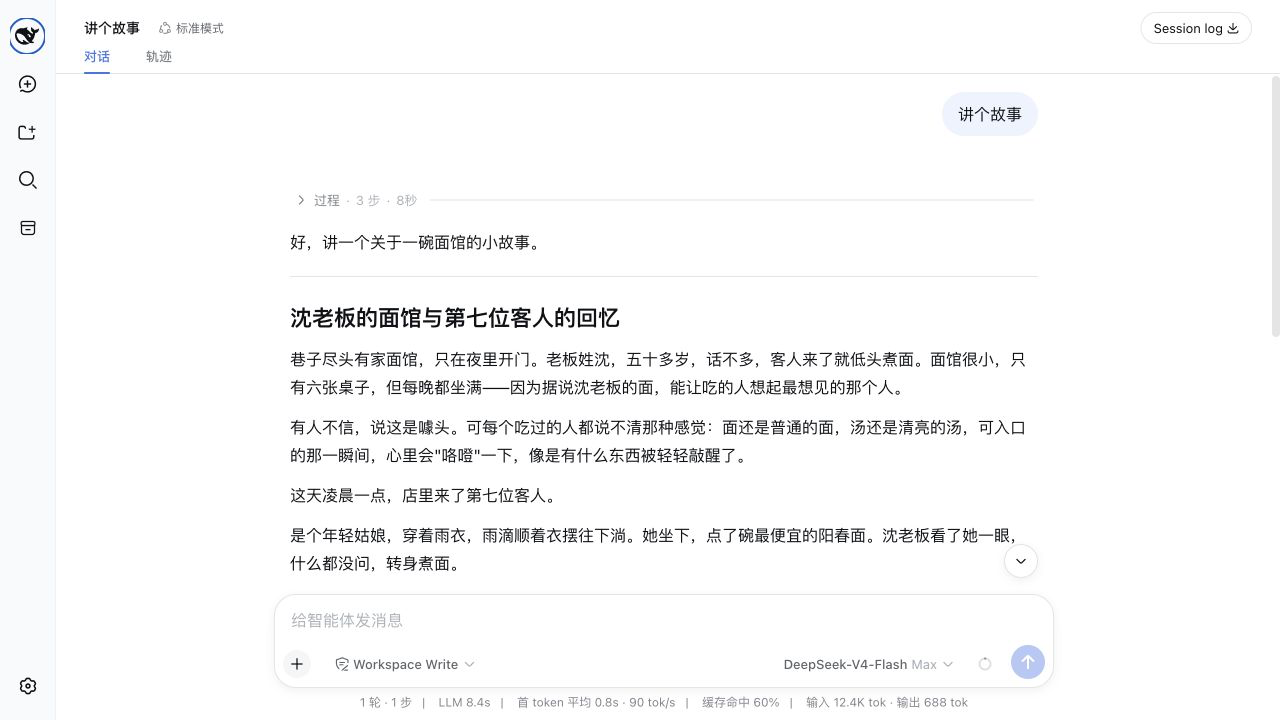
A successful task automatically folds its reasoning process so the final answer stays prominent. A failed or interrupted task remains open for inspection.
After completion, the process folds automatically:
Open it again whenever you need the details:
3. Long logs scroll on their own instead of dragging the whole conversation
Inside Run details, long command output and Tool logs use their own scrolling area. Reaching an edge does not unexpectedly move the entire conversation, and the sticky composer does not push the page into a large blank area.
4. Long answers are easier to read
Paragraphs, headings, and Turn boundaries use a tighter reading rhythm. After completion, optional display assistance can also improve answer headings; copied content, Session history, and the model-authored answer remain unchanged.
As work becomes idle, the browser repairs only the final slice of history in the background. A late end event does not leave the interface looking busy, and the page does not flash a new loading state.
5. Older Sessions are easier to find
Sessions default to Last updated ordering while Manual ordering remains available. The sidebar can search titles, Workspace names, and conversation content indexed in the current process; the Ungrouped section can also create a Session that belongs to no Workspace.
6. Produced files are easier to reach
Beyond files reported directly by successful tools, this edition recognizes clearly declared paths for documents, spreadsheets, datasets, images, media, archives, databases, and 3D/CAD files in the closing answer. Ordinary prose, URLs, commands, and code examples are not treated as files.
7. Model setup stays in one Settings page
First use leads to the complete Settings → Models card instead of maintaining a second simplified key dialog. Providers, models, API keys, and error recovery stay in one place.
What remains unchanged
- The Agent loop, model routing, tools, permissions, sandbox, and Session Log continue to follow DeepSeek Harness behavior.
- Original reasoning, context, commands, and Tool evidence are retained under Run details rather than deleted.
- Display assistance does not modify the System Prompt, user message, tools, authored answer, or Session history.
- Session logs still stay local by default.
Other differences from the official project
- This is a community edition built from an upstream source snapshot. It does not automatically receive later official fixes, compatibility updates, or security updates.
- The snapshot predates some later official features, including stricter cold-Session verification, hiding OAuth-only providers the current build cannot authenticate, and newer frame-wide UI extension points.
- There is no built-in Codex OAuth login or durable token refresh. Choosing the
openai-codexroute requires a manually supplied token. - The base bundle installs dormant Codex and Claude Code subagent providers, but loading them does not start either product process.
- The official project publishes npm packages; this repository runs from source and publishes nothing under the
@deepseek-aiscope. - Current official source uses the MIT license; this fork retains the BSD 3-Clause license and notices of its upstream snapshot.
Which version should I choose?
Choose DeepSeek Harness UX when the Web UI is your main workspace and you want clearer live progress, easier reading, better Session discovery, and more visible produced files.
Choose the official DeepSeek Harness when current official updates, npm installation, or Headless and CLI workflows matter more.
Comparison basis
The UX feature source is based on 35c6172. This guide compares it with official commit 47f9438 as reviewed on 2026-08-17. It describes user-visible differences as features and does not present tests, package metadata, or mechanical source-tree drift as product capabilities.
Run from source
Requirements:
- Node.js
^22.19or>=24 - pnpm 11
- A DeepSeek-compatible API key
git clone https://github.com/ayuanwong/deepseek-harness-ux.git
cd deepseek-harness-ux
pnpm install
pnpm run build
pnpm run dsh -- web --port 3081
Open http://127.0.0.1:3081, add a model provider under Settings → Models, then create a Session. Replace 3081 if the port is already in use.
This repository is a complete source edition. It is not a drop-in patch for a clean upstream checkout or a separately published npm plugin.
Privacy
Do not commit .env, .npmrc, API keys, local Sessions, build output, or profile data. Review upstream telemetry settings before enabling a non-default telemetry mode. Display assistance uses the model provider configured for the current Session, so enabling stage or heading refinement sends a bounded projection of process evidence to that provider.
Development
Read AGENTS.md, the development guide, and architecture before changing packages.
pnpm run lint
pnpm run build
pnpm run hygiene
pnpm run doc-sync
Community links
— Interactive terminal UI with TDD, evidence checks, vision, and code-intelligence workflows.
— Claude Code-style full-screen terminal UI with live task status, streamed reasoning, rollback, and context metrics.
— Curated DeepSeek Harness resources and ecosystem projects on DSH Find.
License and attribution
This repository is derived from DeepSeek Harness and preserves the notices of its source snapshot. This tree uses the BSD 3-Clause license; third-party dependencies and license terms are listed in THIRD_PARTY_NOTICES.md.
Related plugins
dsh-web(原 dsh-web-ui)
 zhu1090093659
/dsh-web-ui
dsh-web(原 dsh-web-ui):任务看板、git 图、右侧面板、远程移动端 UI、桌宠、实时 token 统计与皮肤中心的全家桶。仓库已更名 zhu1090093659/dsh-web,根目录声明 dsh.bundle.patch,支持根 Git 入口安装。
dsh plugin --profile web add github:zhu1090093659/dsh-webdsh-web-all 聚合包(原 dsh-web-ui-all)
zhu1090093659zhu1090093659/dsh-web-ui/packages/dsh-web-ui-all
旧整包路径 packages/dsh-web-ui-all 已随仓库更名 dsh-web 迁移:现聚合目录为 packages/dsh-web-all,npm 聚合包 @linxin666/dsh-web-all。与总仓根 Git 入口是同一产品的两种整包方式,不重复计数。
dsh plugin --profile web add @linxin666/dsh-web-all@latestdsh-TUI
 ccch1mneyyy
/dsh-TUI
Claude Code 风格全屏终端 UI:像素鲸鱼顶栏、实时工作状态行、思考流式展开。
dsh plugin --profile web add github:ccch1mneyyy/dsh-TUIdsh-cc-tui
ccch1mneyyyccch1mneyyy/dsh-cc-tui
一个美观且实用的 Claude Code 风格 TUI 插件:像素鲸鱼顶栏、双流光大字、实时工作状态行、思考流式展开、双击 Esc 时间回溯、蓝白上下文进度条 + TPS 仪表。 零核心改动,纯插件挂载。安装插件即可启用,卸载后不会留下核心补丁。 献给钟爱tui的各位极客们 A beautiful, practical Claude…
dsh plugin --profile web add github:ccch1mneyyy/dsh-cc-tuideepseek-balance-whale-widget
 meteornox
/deepseek-balance-whale-widget
DSH 小鲸鱼余额挂件(DeepSeek Balance Whale Widget)
dsh plugin --profile web add github:meteornox/deepseek-balance-whale-widgetDSH-better-sidebar
 omdsh-dev
/DSH-better-sidebar
侧边栏完整工作台:内置文件渲染编辑、终端、Git 与子代理,支持三方插件注册新 Tab。
dsh plugin --profile web add github:omdsh-dev/DSH-better-sidebar