
Models & Providers
dsh-web-billing
bpc-oss/dsh-web-billing · ★ 12
 bpc-oss
RMB/USD token-billing plugin for DeepSeek Harness (dsh web): official-policy auto pricing with peak/off-peak hours, per-message ledger, account balance, locale-driven currency display. 人民币/美元 token 计费插件
Manifest details
安装
dsh plugin --profile web add github:bpc-oss/dsh-web-billingGitHub 源码安装:首次需按提示配置 allowBuilds 构建授权后重试
For install and environment setup, plus plugin development tutorials, see DSH community docs ↗
README
Table of contents
- 📸 Screenshots
- ✨ Key features
- 1. Official policy auto-pricing (peak/off-peak)
- 2. Coding-plan billing (full DSH preset coverage)
- 3. Provider metering (billing model)
- 4. Cost page (Settings → Cost)
- 5. Session-header badge (top-right)
- 6. Account balance
- 7. Pricing intel (current unit prices & next transition)
- Install
- Configuration
- Ledger correctness
- Security
- Develop
- Contributing / 贡献
- License
简体中文 · English


A RMB/USD token-billing plugin for DeepSeek Harness (dsh web / desktop).
Bills every LLM call automatically against the official DeepSeek pricing
policy schedule (including peak/off-peak pricing effective 2026-08-17),
persists a ledger, shows the account balance, and renders live cost badges
in the browser — displaying USD when the UI language is English.
In one line: make your AI spend visible, itemized, and optimizable — official prices auto-follow, local/subscription/free-ride are classified precisely, history re-prices on demand, budget and balance are always visible.
⚠️ Token and cost figures are a local DSH ledger: only completed
assistant/messageevents captured in this$DSH_HOMEafter the plugin was installed. They are not the official DeepSeek account invoice. The balance comes from/user/balance; reconcile usage across API keys and applications with the DeepSeek console Usage export.
📸 Screenshots
| Session header badge (hover for this-session details) | Settings → Cost page (English UI, current layout) |
|---|---|
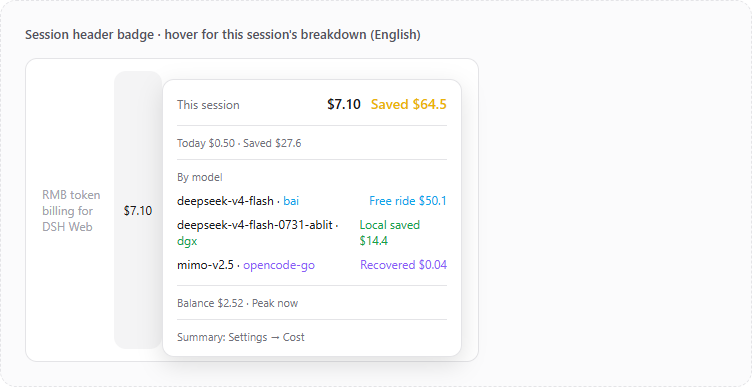 |
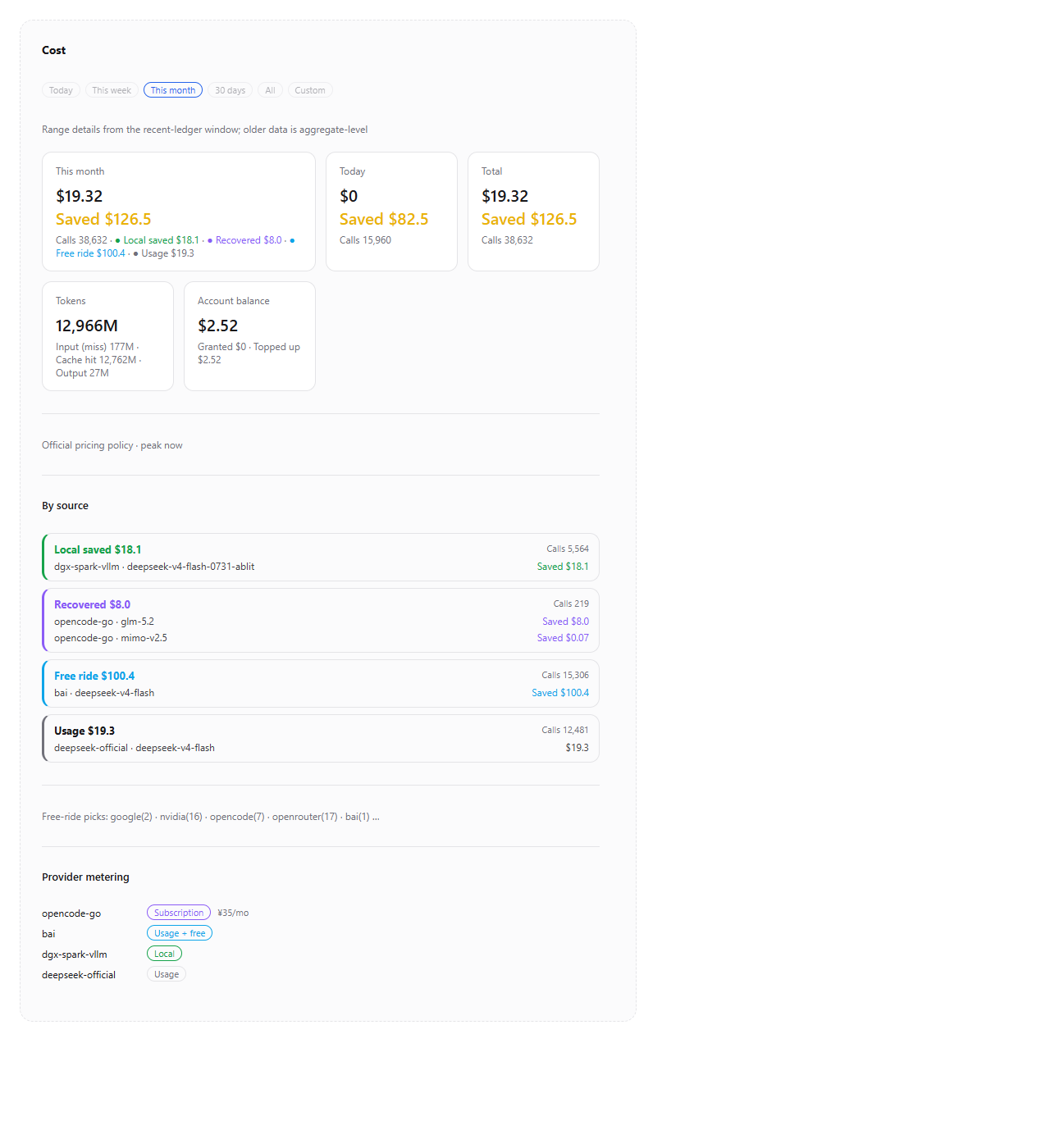 |
Screenshots above are from the English UI; the Chinese-UI equivalents are in README.md (the shared
settings-*.pngcaptures are Chinese-UI screenshots).
✨ Key features
1. Official policy auto-pricing (peak/off-peak)
lib/pricing.js ships a curated official policy schedule
(OFFICIAL_PRICING_POLICIES):
| Effective (Beijing) | Policy | Model prices (¥/1M; cache-hit / cache-miss / output) |
|---|---|---|
| 2025-02-09 | deepseek-chat / deepseek-reasoner standard | 0.5/2/8 · 1/4/16 |
| 2026-05-22 | V4 series 75% cut made permanent | v4-flash 0.02/1/2 · v4-pro 0.025/3/6 |
| 2026-08-17 | Peak/off-peak (peak 09:00-12:00 / 14:00-18:00 Beijing; off-peak = half) | see below |
Peak/off-peak prices (¥/1M):
| Model | Off-peak (cache-hit / miss / output) | Peak (cache-hit / miss / output) |
|---|---|---|
| deepseek-v4-flash | 0.05 / 1.5 / 4.5 | 0.10 / 3.0 / 9.0 |
| deepseek-v4-pro | 0.15 / 4.5 / 13.5 | 0.30 / 9.0 / 27.0 |
Semantics:
- Priced by message time: each message is billed with the policy and phase active at its completion time; new policies apply automatically.
- Policy-chain inheritance: a model not named by a newer policy keeps its last named price (historical bills stay consistent with the platform).
- Self-healing: when the schedule or config changes, the ledger is re-priced on restart using each record's stored token counts.
- User overrides: exact model entries in
pricesoverride the official table;*only fills models the official table never named.officialPricing: offuses only the user table. - Extensible: append future official price changes via
policyOverridesconfig — no code change needed (PRs tolib/pricing.jswelcome).
The schedule is curated from official announcements (DeepSeek API Docs); verify against the official page and send a PR if you spot drift.
2. Coding-plan billing (full DSH preset coverage)
Besides the DeepSeek official API, you can connect various coding plans
(subscription coding bundles) in DSH, such as opencode-go / opencode /
kimi-coding, plus qwen / xiaomi / z.ai token subscription packs. This plugin
ships the official USD prices for every model on these platforms (sourced
from the DeepSeek Harness official pi-ai catalog, see lib/coding-plans.js),
and prices by provider routing:
- Official platform prices (
opencode-go/opencode/kimi-coding): each model's USD price ($/1M) is published by the platform. The RMB display value = official USD price ×codingUsdCnyRate(default reference rate 7.2; display conversion only — DeepSeek's own prices have official CNY and never use this rate). - Subscription token packs (
qwen-token-plan(incl.-cn) /xiaomi-token-plan(incl.-ams/-cn/-sgp) /zai-coding-cn): no per-token price is published; calls are within the subscription allowance and are billed at 0. - Routing rule: a message takes the coding-plan route only when both
(provider, model)match that platform's table; anything else keeps the DeepSeek official policy chain (including peak/off-peak). The same model name (e.g.glm-5.2) is billed at opencode's official price underopencode-goand at each platform's own price under a direct API — never cross-priced. - Follows official automatically: regenerate the price table any time from
your local DSH catalog with
node scripts/sync-coding-plans.mjs; the source version (pi-ai version + generated time) is part of the pricing fingerprint, so a table change re-prices history on restart.
Unlike the DeepSeek official prices, coding plans have only official USD prices — the RMB figures are a reference conversion at
codingUsdCnyRate(configurable); the USD figures are always the official truth.
3. Provider metering (billing model)
Each provider can have its own billing model (Settings → Cost → Provider metering, takes effect immediately — no restart):
| Mode | Meaning |
|---|---|
usage |
Pay-per-use: billed at the official/platform price |
usage-free |
Usage + free ride: pay-per-use, but models on the free-model list are billed at 0 |
subscription |
Subscription: fixed monthly fee (monthly), calls billed at 0, nominal value shown as "recovered" |
free |
Promo-free: calls billed at 0 (genuinely free) |
local |
Self-hosted: calls billed at 0 (you save the API cost) |
- Free-ride picks: the settings page lists every free model from the
pi-ai catalog (
openrouter17 /nvidia16 /opencode7 /google2 /huggingface1 /mistral1 /vercel-ai-gateway3 …; seelib/promo-models.js, generated byscripts/sync-promo-models.mjs) as a compact hint; rerun the script after DSH upgrades to refresh the promo data. - History re-pricing: switching a billing model immediately re-prices all history (free/subscription/local records drop to 0 cost and become nominal savings) — no restart.
- Recovery view: subscription monthly fee vs cumulative recovered amount, visible in source groups and the header panel.
4. Cost page (Settings → Cost)
The browser-side summary page (read-only plus a few immediate settings):
- Time-range filter: today / this week / this month / last 30 days / all / custom start-end; every module (overview / sources / models / sessions / history) follows the range; defaults to this month.
- Overview & source breakdown: range card (cost + gold saved total + source strip), today / total / Token / balance cards.
- Token stats: total tokens split into input (miss) / cache-hit / output — cache-hit rate at a glance.
- Source groups: local-saved / subscription-recovered / free-ride / usage, each with a semantic accent bar and detail rows (pure savings tinted by source; real paid calls stay neutral).
- Monthly budget: set a ¥ monthly budget; progress bar green→amber→red with red over-budget highlight; budget stays locked to the current month.
- Header balance toggle: controls whether the session-header badge shows the balance; the settings page always shows it.
- Data integrity: ledger view-consistency self-check (
integrity) plus explicit historical-trimming gaps (bdpGap/repriceGap) — gaps are visible and reconcilable, never silently shrink the ledger. - Export: CSV (UTF-8 BOM) / JSON one-click download.
- Session titles: session list shows titles instead of UUIDs.
- Version & updates: at the bottom — checks GitHub Releases for a newer version and links to it.
Aggregation note: range details come from the recent-ledger window (
maxRecent, default 100000 records); older data is aggregate-level only (day totals are always full).
5. Session-header badge (top-right)
- This session's today / cumulative cost + savings (savings total is gold, distinct from per-source colors).
- Per-model stats: cumulative amount per model + Input / cache-hit-rate / Output; provider tags tinted by source (local green / free-ride sky / recovered purple / usage gray).
- Per-model gap hint: when historical migration/trimming leaves the per-model
total below the session total, the panel shows an amber hint
(
Model split gap (trimmed history not in per-model rows) ¥X) — the money is NOT lost (it stays in the totals), it just can no longer be attributed to a specific model row; new data never shows this hint. - Balance row (toggleable): official account balance.
- DeepSeek peak/off-peak hint: shows the current phase when the session uses DeepSeek-family models.
- Panel UX: rendered via React portal (never covered by the sidebar), anchored to the badge, opaque themed background, hover auto-open/close.
6. Account balance
Reuses the provider's API key to call the official GET /user/balance
(60s refresh, 5s timeout); CNY/USD both reported with the billing state. A
transient failure (timeout / network hiccup) does NOT erase the last proven
balance — the stale value is kept (the settings page subtitle reads "Balance
from the last successful query (current query failed; retrying automatically)")
while periodic refreshes retry; only a never-succeeded query shows
"Unavailable". The runtime toggle controls the header display
(balance.enabled or the settings toggle; turning it off stops polling and
stops using the API key).
7. Pricing intel (current unit prices & next transition)
/billing/state exposes pricing intel for the client and external tools:
currentUnitPrices: the currently effective official unit prices (dual currency + peak/off-peak mode);nextTransitionAt: the next peak/off-peak or policy switch (epoch ms; probed within 72h,nullbeyond — cannot actually happen since peak/off-peak switches daily), computed bynextPricingTransitioninlib/pricing.js(hour probing then binary search to the second — crosses future policy boundaries);observedAt/refreshIntervalMs: observation time and suggested refresh interval (1h);source: the official pricing page the schedule is curated from.
Install
The plugin is a standard DSH bundle (dsh.bundle.patch → its own
cordis.patch.yml), following the official
packaging guide:
# From GitHub
dsh plugin --profile web add github:<owner>/dsh-web-billing
# Or from npm (once published)
dsh plugin --profile web add dsh-web-billing
# Or link a local checkout (no copy; edits take effect on restart)
powershell -ExecutionPolicy Bypass -File scripts/install.ps1 -Profile web
On git installs, pnpm >=10 may ask for a build authorization: add the prompted package key to
pnpm-workspace.yamlallowBuildsin the profile and retry (this package has nopreparebuild, so authorization is usually not needed).
Restart dsh web afterwards. Run only one instance per $DSH_HOME
(multiple instances would contend for the same ledger file). To override
defaults, rewrite the plugin config row in
$DSH_HOME/profiles/web/cordis.patch.yml — the patch replaces the whole
row's config, so restate every key you keep:
Configuration
| Key | Default | Meaning |
|---|---|---|
currency |
CNY |
Currency identifier |
symbol |
¥ |
RMB display symbol |
symbolUsd |
$ |
USD display symbol |
displayCurrency |
auto |
auto=follow UI language; CNY/USD forces one |
timezone |
Asia/Shanghai |
IANA timezone for peak/off-peak windows |
peakWindows |
[[9,12],[14,18]] |
Peak hours (local, [start,end)) |
officialPricing |
auto |
auto=official auto-pricing; off=use only prices |
prices |
{} |
User price table (override/fallback, ¥/1M) |
usdPrices |
{} |
Optional USD overrides ($/1M) |
localProviders |
[] |
Self-hosted providers: official value, actual cost at localCostPerM, difference = savings |
localCostPerM |
0 |
Actual local cost (¥/1M, uniform; 0 = free) |
codingUsdCnyRate |
7.2 |
Reference $→¥ rate for coding-plan USD prices (display only) |
policyOverrides |
[] |
Extra official policy entries (since required; prices or peak+offPeak) |
persistPath |
~/.dsh/storages/web-billing.json |
Ledger file path (core aggregates, high-frequency writes) |
maxRecent |
100000 |
Recent-ledger window (range details) |
maxMessagesPerSession |
2000 |
Per-session message detail cap |
detailWriteIntervalMs |
30000 |
Detail-file (session messages + recent, separate -detail.json) debounce interval; raise to cut write frequency (loses ≤interval of details on power loss, aggregates untouched) |
loopbackOnly |
true |
/billing endpoints loopback-only |
balance.enabled |
true |
Initial header-balance enabled state |
balance.endpoint |
https://api.deepseek.com/user/balance |
Balance endpoint (prefixed with DEEPSEEK_BASE_URL when set) |
balance.apiKeyEnv |
DEEPSEEK_API_KEY |
Credential reference for the API key |
balance.refreshMs |
60000 |
Balance refresh interval |
balance.timeoutMs |
5000 |
Balance request timeout |
metering |
{} |
Static billing-model table: { provider: { mode, monthly?, freeModels? } } (runtime edits persist to web-billing-metering.json) |
Unit fields: input=cache-miss input, cacheRead=cache-hit input, output=output (¥ per million tokens).
Ledger correctness
- Idempotent: keyed by
(sessionId, messageId); replayed/duplicate events are skipped entirely (first write wins — global counts, session aggregates and details all recognize the first write only). Restarts do NOT replay history (dsh-session constructor seeds do not emit events); idempotency covers in-run duplicate delivery within the retained message window. - Local timezone for "today / this month".
- Durability (split persistence, v2.3.2): the ledger is split into core aggregates (
web-billing.json, ~0.2MB, 1s debounce high-frequency) and details (web-billing-detail.json, session messages + recent, default 30s debounce + flush on exit) — a large ledger no longer serializes tens of MB on every session event (which froze the event loop). Power loss loses at most one detail interval of details; aggregate statistics never lose data (missing detail file is tolerated;repriceis guarded against zeroing out). The detail interval is configurable viadetailWriteIntervalMs. A corrupt/unreadable ledger starts empty with a warning; oversized detail (>20MB) warns (lowermaxRecent/maxMessagesPerSession). - Audit fields:
unitPriceand pricingmode(flat/peak/offPeak) per message. - Reprice gap: history revaluation (after price/metering changes) is bounded by the retained per-message records (session details ∪ recent window); messages trimmed from both cannot be repriced and their old-price contribution is lost on revaluation. The gap is surfaced explicitly as
repriceGapin/billing/stateand flagged on the cost page — never silently shrinks the ledger. - Per-model gap: the per-model aggregates (
bySessionModel) may total less than the session total on migrated ledgers (messages trimmed from both retained windows cannot be backfilled); the difference is returned asmodelGapin/billing/session/<id>and flagged in the panel — money is not lost, only its per-model attribution. - Balance read-only: only the official read endpoint; the key never reaches the browser.
Security
/billingendpoints loopback-only by default;loopbackOnly: falsefor LAN (no auth).- State-changing POSTs (metering / budget / balance) additionally require a
same-origin check: browser cross-site simple requests (text/plain POST) carry
an
Origin; it must match theHost. Requests without anOrigin(local tools such as curl) are allowed (the loopback guard already restricts the source address). - Reads
session/eventand serves read-only endpoints only - never mutates session data. - Ledger stays local (
$DSH_HOME/storages/), no message content, never uploaded.
Develop
npm run check   # syntax checks
npm test        # pricing / balance / ledger unit tests (node:test, zero deps)
node scripts/sync-coding-plans.mjs   # regenerate coding-plan prices from your DSH pi-ai catalog
Layout: lib/pricing.js (pricing engine incl. coding-plan route + metering),
lib/coding-plans.js (generated coding-plan prices),
lib/promo-models.js (generated free-model catalog), lib/balance.js,
lib/index.js (host: ledger, balance, metering/budget/balance toggle,
/billing routes), lib/client.js
(browser: session badge, message chip, Settings→Cost page; handwritten
bundle, no build step), test/, scripts/. The browser bundle is a handwritten module (same format as official DSH client plugins): client changes take effect after a page refresh + dsh web restart; host-side changes need a restart.
Contributing / 贡献
PRs and issues are welcome (English or Chinese). This repository is maintained
bilingually: doc changes must update both README.md (Chinese) and
README.en.md (English), and config comments are bilingual. Full rules in
CONTRIBUTING.md.
License
MIT
Related plugins
dsh-plugin-reasonix
 esengine
/DeepSeek-Reasonix/integrations/dsh-plugin
把 Reasonix 作为 dsh 子智能体接入:一层配置补丁让 subagent-acp 提供方启动 reasonix acp,并以 reasonix 工具暴露给模型。纯配置、无代码、不在 npm;接入的是子智能体,不是模型服务商。
dsh plugin --profile web add 'github:esengine/DeepSeek-Reasonix#af0e954f5629492980718fc0e36030fec0abc682&path:/integrations/dsh-plugin'dsh-purge
 YuJunZhiXue
/dsh-purge
DeepSeek Harness 破甲:让所有模型都能破甲,不同模型可换不同提示词;默认提示词面向国模「小码酱」。Jailbreak for every model — swap prompts per model. 求 Star 收藏 ⭐ 如要二开,请查看署名要求部分
dsh-purge-mmparko
 mmparko
/dsh-purge
DeepSeek Harness 破甲:让所有模型都能破甲,不同模型可换不同提示词;默认提示词面向国模「小码酱」。Jailbreak for every model — swap prompts per model. 求 Star 收藏 ⭐ 如要二开,请查看署名要求部分
dsh plugin --profile web add 'github:mmparko/dsh-purge#033e6bd1e0f101352b39075ecd0d758ffef26b76'dsh-connect-workbuddy
 dingminhua
/dsh-connect-workbuddy
把本机登录的 WorkBuddy 模型(国内版与国际版)接入 DeepSeek Harness:每次刷新按上游目录自动读取每个模型的积分倍率,支持逐模型图片输入开关、多账号切换与账号池自动换号,并提供每日签到、卡片与输入框里的胶囊积分读数等只读积分概览。
dsh plugin --profile web add 'dsh-connect-workbuddy@5.15.0'dsh-image-gen
 shanliuling
/dsh-image-gen
让 DeepSeek Harness 像 ChatGPT 一样,在对话里直接生成图片。
dsh plugin --profile web add github:shanliuling/dsh-image-genagent-vision-toolkit
 Anionex
/agent-vision-toolkit
为纯文本模型"看图“设计更好的视觉工具箱和技能,支持多图理解,图片问答,前端UI还原、GUI 自动化等,并可选无缝接入多个主流agent,直接识别粘贴图片| A vision toolkit and skill designed for text-only llms — image Q&A, long-screenshot OCR, frontend UI restoration, and GUI automation, with optional seamless integration for Codex, Claude Code, Pi, Oh My Pi, and OpenCode
dsh plugin --profile web add github:Anionex/agent-vision-toolkit