
Usage & Billing
dsh-quota-panel
brittanistrehlowll-oss/dsh-quota-panel · ★ 3
 brittanistrehlowll-oss
Provider quota/balance corner panel for the dsh web surface (DeepSeek Harness plugin): server-side credential
安装
dsh plugin --profile web add github:brittanistrehlowll-oss/dsh-quota-panelGitHub 源码安装:首次需按提示配置 allowBuilds 构建授权后重试
For install and environment setup, plus plugin development tutorials, see DSH community docs ↗
README
Table of contents
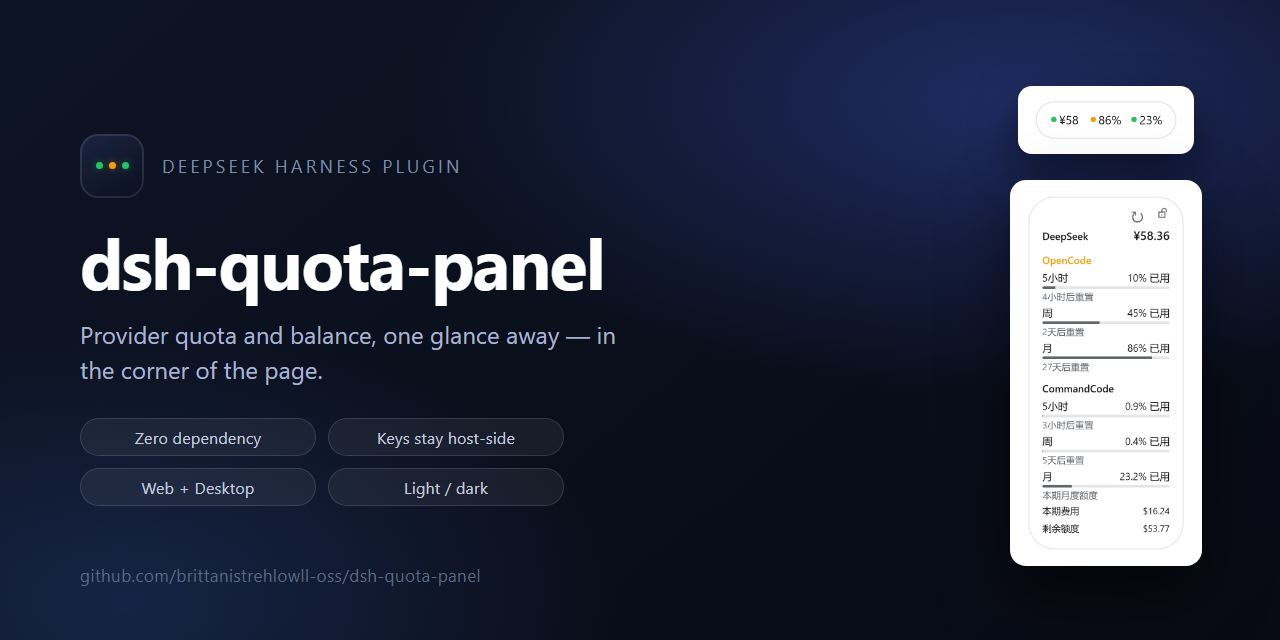






Provider quota and balance status capsule for the dsh web surface (DeepSeek Harness). One glanceable line in the bottom-left corner tells you how much money and how much quota is left; click it for the full card, click again to fold it back into one line.
A zero-dependency host plugin: for every configured provider it registers one server-side proxy route /api/quota/<id> — the API key is resolved through the credentials seam and never reaches the browser — then injects this native widget into the page. The same implementation serves dsh web and the official Electron Desktop app, with no dependency on any other plugin.
Interface
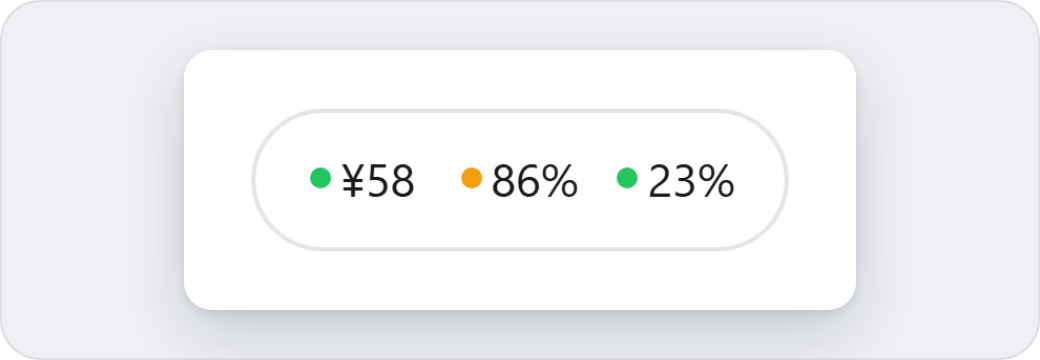
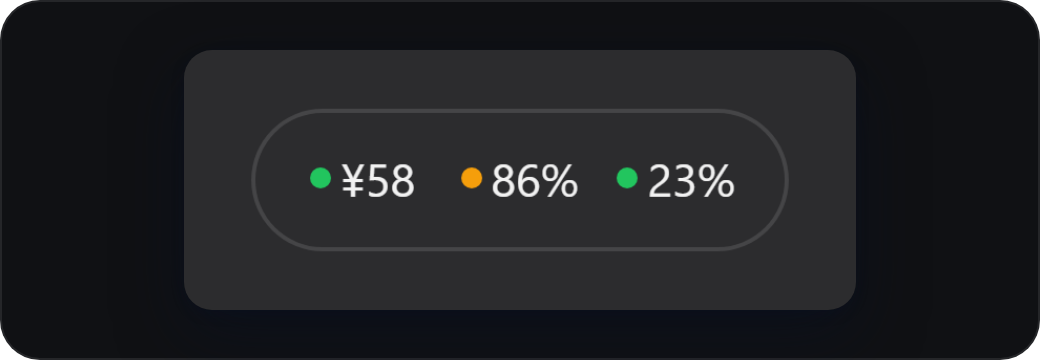
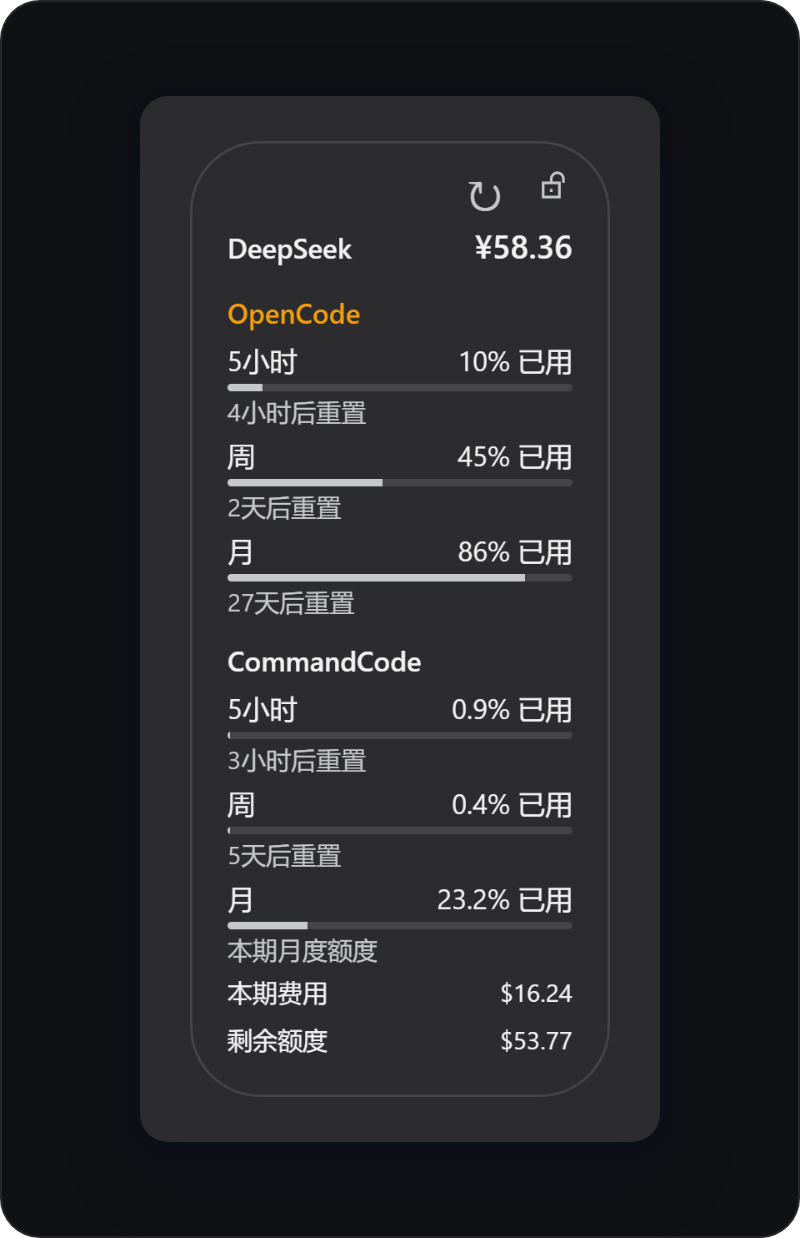
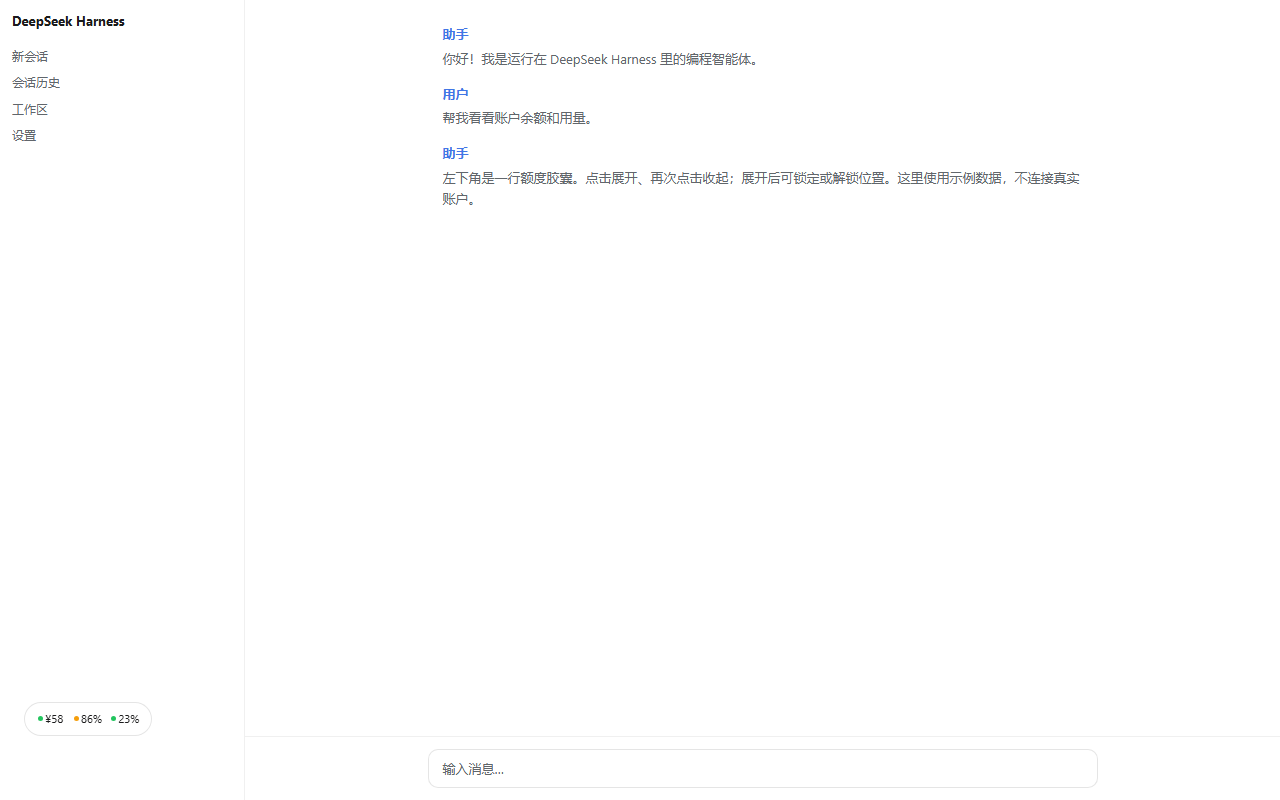
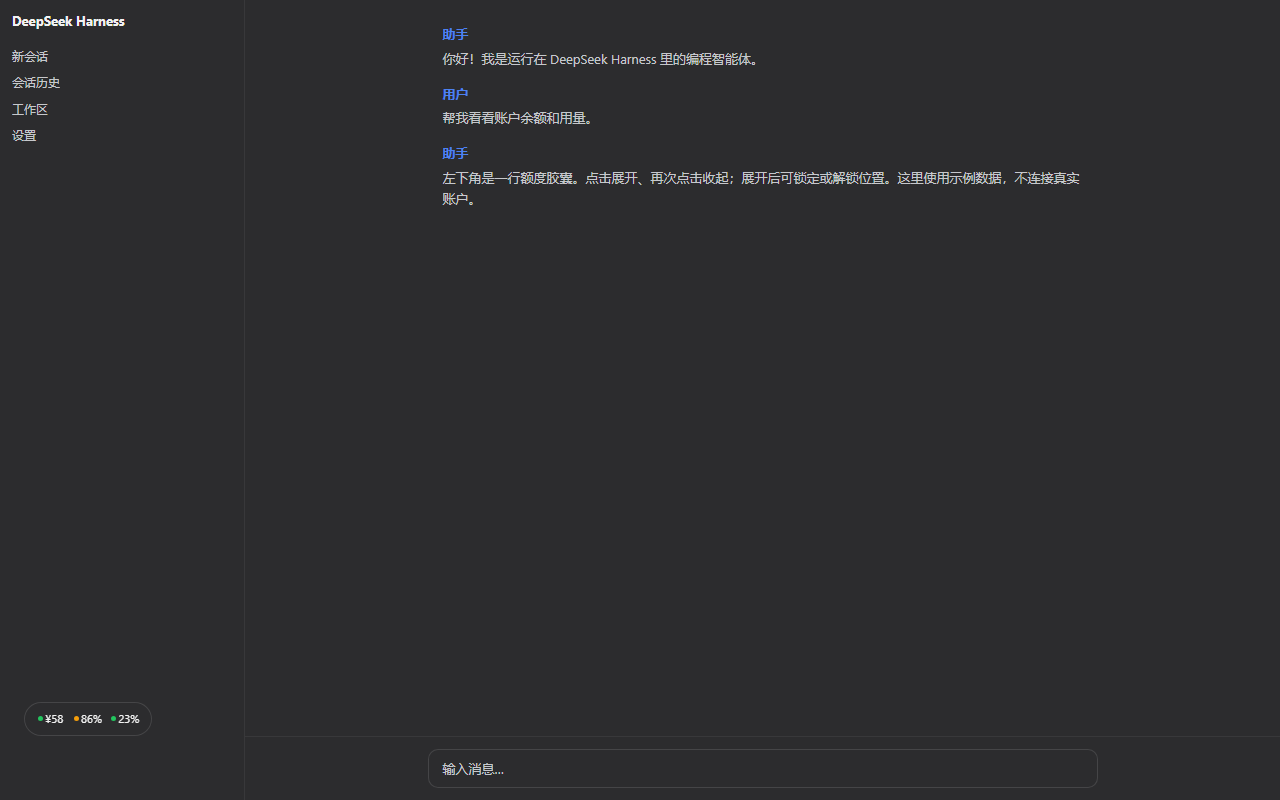
Collapsed: one independent "status dot + value" pair per account (e.g. ● ¥58 · ● 86% · ● 23%), no text labels — only the affected account's own dot changes color. Money is rounded for the glance; the exact reading is in the expanded card and the tooltip.
| Light | Dark |
|---|---|
 |
 |
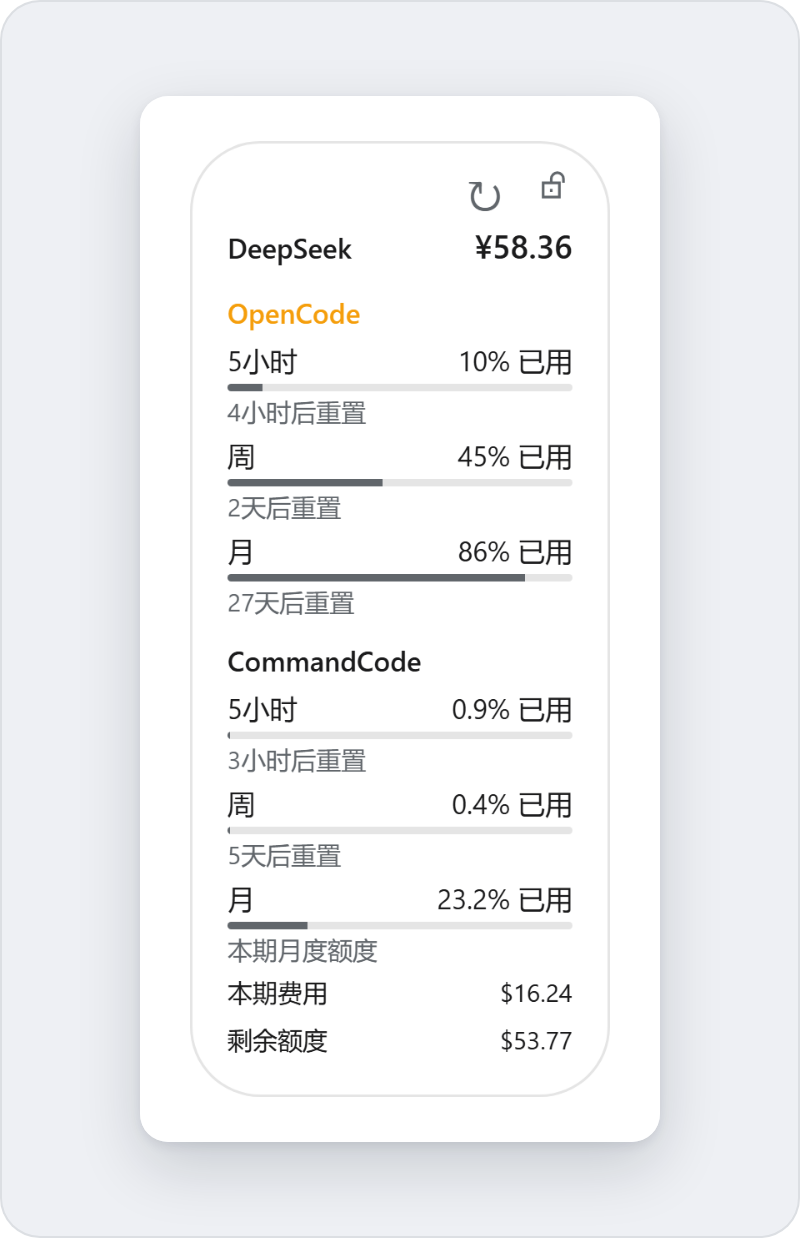
Expanded: balances and usage stacked per account, with an individual five-hour / weekly / monthly progress bar and reset time; CommandCode adds period spend and remaining credits. The refresh and lock buttons sit in the top-right corner.
| Light | Dark |
|---|---|
 |
 |
Default position in a page (bottom-left, keeping clear space above the sidebar's settings row — never over the content and never over a host control):
| Light | Dark |
|---|---|
 |
 |
Interactive offline examples: light / dark — self-contained pages written by npm run demo; open them in a browser. The data is a local mock and never touches a real account. The pictures above are re-captured from that same injected script by npm run showcase; docs/verification/ holds regression artifacts.
Features
- Two sizes, one component — collapsed 128×34px (about 3.76:1); expanded 168px wide (
--dsh-quota-width) with content-driven height (about 382px for the three demo accounts), rounded ends, no shadow, growing upward from the bottom edge. - Independent per account — one account going critical only repaints its own dot.
- "The endpoint failed" is not "the quota is dangerous" — they do not share a color (see the table below).
- No invented readings — a missing or non-finite number is an explicit data error and is never folded to
0%: "I could not read the number" must not render as "plenty left". - Follows the product theme — driven entirely by the Harness design tokens (
--dsw-alias-*,--dsw-static-*,--dsw-font-*) with sensible fallbacks, so it carries no palette of its own. - Draggable, remembered, lockable — the position persists per browser, is re-clamped on resize, and stops moving once locked.
- One registration, two carriers — the host half registers on the
connectionexact Fetch registry, which the Web server and the Desktop host both dispatch into. - Zero dependencies, zero browser-side secrets — no npm dependency at all; the browser only talks to
/api/quota/<id>while the credential stays host-side. - Keyboard and accessibility — Enter/Space toggles, Tab reaches the lock, Space toggles it, Escape collapses and restores focus; the DOM is built with
createElement/textContentonly.
When a provider cannot be refreshed
| situation | dot | value | tooltip |
|---|---|---|---|
| healthy | filled green/amber/red | as reported | the reading |
| refresh failed, we have an earlier reading | hollow ring | last known value, muted grey | 数据更新于 15:32 + the failure reason |
| never read since load | neutral grey | — |
the failure reason |
So a momentary network failure no longer repaints a healthy ¥58.36 as a red —. The default refresh interval is 5 seconds and pauses while the page is hidden; the expanded state has a manual refresh button that preserves the open state, and re-entrant requests are merged.
Install
Web (dsh web)
dsh plugin --profile web add "github:brittanistrehlowll-oss/dsh-quota-panel"
# restart `dsh web` (bundle layers apply at boot)
The package declares dsh.bundle.patch, so dsh plugin add activates it as a profile layer automatically.
Desktop (Electron DeepSeek Harness.exe)
The package path above does not work on the Desktop app: dsh-desktop-host ships config/desktop.cordis.patch.yml, which disables the web-startup, webserver and web-runtime rows outright (the renderer runs on dsh-app:// over the IPC pipe, with no listening port). A plugin that injects webServer therefore waits forever and never loads.
Since v0.8.0 the host half is carrier-neutral, so the Desktop install is a profile-local relative-path row:
# 1) link the source into the desktop profile (junction → edit the repo, restart to apply)
New-Item -ItemType Junction `
  -Path "$env:USERPROFILE\.dsh\profiles\desktop\plugins\quota-panel" `
  -Target "D:\deepseek\dsh-quota-panel"

# 2) add the insert row to $DSH_HOME\profiles\desktop\cordis.patch.yml
#    (name is relative to the profile; inject keeps only credentials)
#    - insert:
#        - id: quota-panel
#          name: './plugins/quota-panel/lib/index.js'
#          inject: [credentials]
#          config: { refreshMs: 60000, providers: [ … ] }
Then quit and reopen the app — a window reload is not enough: the Desktop host reads the profile layer once at boot (there is no CLI live-patch watcher). npm run verify:desktop <profileDir> boots that composition with the real runDesktopHost, no Electron required, and asserts both the injection and the live readings from all three routes (most recently on DSH 0.1.5-rc.2, see docs/verification/desktop-carrier-20260914.log).
Why it works: /api/* rides the connection exact Fetch registry — the Web server mounts the registry under its HTTP /api prefix, and the Desktop host dispatches its piped /api/* requests into the same registry. The page script enters index.html as a structured webserver/index-inject row, an event both carriers emit. One registration serves both; keys stay host-side.
Configuration
Each provider is one entry under providers. Three renderers ship:
| format | endpoint shape | row |
|---|---|---|
deepseek-balance |
{ "balance_infos": [{ "currency", "total_balance" }] } |
balance ¥58.36 |
opencode-usage |
{ "usage": { "rolling"|"weekly"|"monthly": { "percent", "resetsAt" } } } |
highest usage 86% |
command-cost |
API base; the host merges identity, credits and usage | period spend $16.24 |
Override the shipped defaults in your profile's cordis.patch.yml:
- id: quota-panel
  config:
    refreshMs: 30000
    providers:
      - id: deepseek
        label: DeepSeek
        credential: DEEPSEEK_API_KEY
        endpoint: https://api.deepseek.com/user/balance
        format: deepseek-balance
        balanceTiers: { critical: 10, warn: 20, healthy: 50 }
      - id: opencode-go
        label: OpenCode Go
        credential: OPENCODE_GO_API_KEY
        endpoint: https://opencode.ai/zen/go/v1/usage
        format: opencode-usage
        windowLabels: { rolling: 五, weekly: 周, monthly: 月 }
        warnPercent: 70
        errorPercent: 90
      - id: command
        label: Command Code
        credential: COMMAND_API_KEY
        endpoint: https://api.commandcode.ai
        format: command-cost
        windowLabels: { fiveHour: 五, weekly: 周 }
        warnPercent: 70
        errorPercent: 90
        currency: USD
Fields:
| field | meaning | default |
|---|---|---|
id |
route id (/api/quota/<id>), ^[a-z0-9-]+$ |
required |
label |
provider name on the card | required |
credential |
credential reference ($DSH_HOME/.credentials.yaml or env) |
required |
endpoint |
quota JSON endpoint (API base for command-cost), GET with Authorization: Bearer <key> |
required |
format |
row renderer | deepseek-balance |
balanceTiers |
(deepseek-balance) {critical, warn, healthy} levels |
{10, 20, 50} |
lowBalance |
legacy alias for balanceTiers.warn |
— |
windowLabels |
(opencode-usage) {rolling, weekly, monthly}; (command-cost) {fiveHour, weekly} |
UI language |
warnPercent / errorPercent |
(opencode-usage, command-cost) thresholds | 70 / 90 |
currency |
(command-cost) money currency, 3-letter ISO code | USD |
refreshMs |
auto-refresh interval, 5000 <= refreshMs <= 86400000 |
5000 |
Validation is strict on purpose: a present-but-invalid number (NaN, Infinity, a string) is an error rather than a silent fallback to the default, warnPercent < errorPercent must hold inside 0..100, balanceTiers must be ordered, and endpoint must be https — the proxy attaches your API key as a Bearer token, so plain http is accepted for loopback hosts only (localhost / 127.0.0.1 / ::1).
DeepSeek balance levels
With the default balanceTiers {critical: 10, warn: 20, healthy: 50}:
| balance | state | secondary line |
|---|---|---|
<= 10 |
error (red dot + value) | 建议充值 |
10 < x <= 20 |
warn (amber) | 余额紧张 |
20 < x <= 50 |
ok | 余额正常 |
> 50 |
ok | 余额充足 |
OpenCode usage states
high = max(rolling, weekly, monthly):
| usage | state |
|---|---|
< warnPercent |
ok (green dot, DeepSeek-blue progress) |
>= warnPercent |
warn (amber dot + progress) |
>= errorPercent |
error (red dot + progress) |
A window whose percent is missing or not a finite number makes the row an explicit data error — it is never folded to 0%.
Command Code cost states
high = max(period spend %, five-hour %, weekly %):
| reading | state |
|---|---|
< warnPercent |
ok (green) |
>= warnPercent |
warn (amber) |
>= errorPercent |
error (red) |
The monthly ratio comes from totalMonthlyCredits in /alpha/usage/summary and credits.monthlyCredits in /alpha/billing/credits, computed as used / (used + remaining) when periodBasis=billing-period. Purchased and free credits are excluded from the ratio, and a missing field reads as —. The five-hour and weekly ratios come from windowLimits.used/cap. The period allowance is not reported by the API; it is reconstructed as spend + remaining credits — on a GOAT plan that reads as $16.24 + $53.77 = $70.01. A reset date the API does not return is never invented.
Position and dragging
Both states can be dragged when unlocked:
- Drag it anywhere — the panel leaves the default bottom-left position and follows the pointer, clamped so the whole capsule always stays on screen.
- The default position sits in the bottom-left with clearance above the sidebar's settings row: it first looks for the host's
[data-slot="settings.trigger"], which measures0×0on some host builds, and in that case walks up from the visible设置/Settingslabel to the first ancestor that does have a box. Fonts and the capsule's real height only land after the first layout, so the default is re-anchored across the next two frames; a capsule with a saved position is never moved. - The position is remembered per browser (
localStorage, keydsh.quota.pos) and restored on the next load; resizing the window re-clamps it into view. - Click toggles the capsule: a press that travels less than 4px is a click, anything further is a drag (the click that ends a drag is swallowed).
- The lock appears only when expanded; it disables dragging, not toggling, and persists under
dsh.quota.locked. - Right-click while unlocked restores the default position (24px left, and the settings-row clearance described above).
- Optional
mountCompactmoves the whole shell; manually saved positions take precedence. An unlocked hosted capsule can be dragged out.
Security
- API keys are resolved server-side via
ctx.credentialsand only used in the server-to-provider request; the browser only talks to/api/quota/<id>. - Every route answers a normalized envelope —
{ ok: true, data }or{ ok: false, error: { code, status, message } }— withcodeone ofcredentials/upstream/timeout/network/invalid-body. An upstream HTML error page is turned intoinvalid-bodyhost-side, so the page script never parses a non-JSON body. - The route is the trust boundary: it never echoes the credential, and verification asserts the key is absent from the response.
endpointmust be https (loopback http excepted), since the proxy attaches the key as a bearer token.- The injected card builds DOM with
createElement/textContentonly; API response values never pass throughinnerHTML. Refresh failures are reported intitlehover text (and as a hollow status dot), not as card body copy.
Changelog
- v0.8.0-p1 — Two defect fixes plus a decoupling cleanup. (1) The version marker no longer drifts:
#dsh-quota-panelhardcodeddata-version = '0.7.0'and was never updated for the 0.8.0 release, so the page advertised 0.7.0 whilepackage.jsonsaid 0.8.0 — anything gating on that marker (an acceptance harness, a host, a support screenshot) was told the wrong version. It is now read frompackage.json. (2) The initial position lands where it was designed to: the author's "clearance above the settings row" rule had a selector that resolves to a zero-size wrapper on DSH 0.1.7-rc.1 (measured0×0), sofooterRect.width > 0was never true and the rule never ran, leaving the capsule in theinnerHeight - 92fallback corner. It now walks up from the visible设置/Settingslabel to the first ancestor with a real box, computes the clearance from the panel constant instead of a not-yet-laid-outcapsuleEl.offsetHeight, and re-anchors across two frames after the first paint. Measured at 1483×707:y 615 → 619, gap above the settings row22px (incidental) → 18px (by design), and no overlap with a host control before or after. (3) Decoupling cleanup: dropped the[aria-label="鲸息入口"]probe, rewrote the module header and the seam comments in neutral terms, removed a foreign product name from thepackage.jsondescription, and replaced the always-trueif (setExpanded)guard inopenDetailwith a direct call. A scan of the shipped package contents (lib/index.jsand the rest of thefileswhitelist) for鲸息|Whale|watchdog|dsh-lifecycle|restart-button|dsh-controllerreturns zero hits, and that assertion now lives inverification/verify-packed-tarball.mjs; this README and the historical acceptance records underdocs/verification/are outside that scan (the former has to name the defect it fixed, the latter are point-in-time snapshots) and are left as they are. TheDSH_PLUGIN_INTEGRATION_V1seam itself is kept on purpose — it is the only stable interface for a host page that wants to embed the compact capsule, and it is silent when the runtime is absent. - v0.8.0 — Carrier-neutral host half: routes register on the
connectionexact Fetch registry (the shared/apitable the Web server and the Desktop host both dispatch into), and the page script ships as a structuredwebserver/index-injectrow — nowebServerdependency left. Hosts without that registry still fall back towebServer.register+tapIndex. The plugin now works on the official Electron Desktop app (no HTTP server,dsh-app://+ IPC). Addsnpm run verify:desktop. - v0.7.0 — Compact capsule with full period details: one 128×34px line collapsed, 168px wide vertical details expanded; period progress and reset times restored; the initial position follows the asynchronously loading sidebar and avoids the bottom entry.
- v0.6.0 — 176px compact two-state capsule with 28/56px heights; independent bottom-left position, dragging and a persistent lock button; the separate card and toolbar were removed. A valid critical reading is no longer overwritten by an older one, an anomalous number is refused instead of becoming 0, and upstream error bodies are no longer echoed. Adds real mouse/keyboard, two-state mutual-exclusion and text-geometry checks. The CSS ships with the package.
- v0.5.0 — Command Code (
command-cost) row: billing-period spend, request / token counts, remaining credits and the five-hour + weekly windows. One horizontal size and one 16px radius for both states (no edge jump). Failed refreshes keep the last good reading asstaleinstead of turning red. Normalized{ ok, data | error }route envelope; money formatted from the payload currency viaIntl.NumberFormat;Esccollapses;aria-controlsand a focus ring; strict config validation; shared Chromium resolution in scripts; CI on every push. Fixes an i18n bug where{h}/{n}placeholders were never substituted (captions rendered as当前最高占用 {h}%). - v0.4.0 — Free positioning: the capsule is a drag handle (pointer events, touch-friendly), position persisted per browser and restored on load, viewport clamping, card flip/anchor when placed, right-click reset.
- v0.3.0 — Two sizes: collapsed capsule (independent per-account dot + battery-colored value) expands into the full card.
- v0.2.0 — Harness-native card: design tokens, balance tiers, progress bar.
- v0.1.0 — Initial floating panel: server-side quota proxies + page badge.
Local development
npm test              # model, configuration, emitted-script and security tests
npm run demo          # regenerate docs/demo.html + docs/demo-dark.html
npm run verify        # headless-browser DOM/geometry/stale assertions
npm run verify:dark   # same in the dark theme
npm run verify:drag   # synthesize real drags; assert persistence/clamping
npm run verify:route  # offline host-route contract (no real credentials)
npm run verify:desktop -- <profileDir>  # real runDesktopHost composition probe (no Electron)
npm run verify:package # pack, then load the plugin FROM the tarball
npm run screenshot    # verify both themes, write docs/verification/*.png
npm run showcase      # regenerate the project-page art in assets/ and docs/images/
npm run pack          # write dist/dsh-quota-panel-<version>.tgz
npm run check         # test + demo + verify
verify:package is the release gate: it packs, extracts, and imports the plugin from the extracted copy, asserting that files ships everything the plugin reads at runtime (notably lib/plugin-integration-v1.js, which is read from disk at import time — a working-tree test would never catch it missing).
verify:route runs offline and never reads real credentials by default. An explicit --live opts in to the live check. Browser verification covers both themes, real lock/unlock and drag input, keyboard navigation and layout; results are in docs/verification/.
showcase is an authoring tool, not a gate: it captures the pictures from the script actually injected into docs/demo.html, so the README cannot drift from the implementation. The hero banner is rendered with the local desktop font stack, so run it on a machine that has one.
The browser scripts find Chrome, Chromium or Edge automatically; override with CHROME_PATH / CHROME_BIN.
License
MIT
Related plugins
dsh-our-free-model
 Ebony-Vinyl
/dsh-our-free-model
Our Free Model(作者声明):装上即用、无需自备 API Key,可调用其聚合渠道的模型。渠道条件、账号要求与数据去向见「本站速览」;本站未实测。
dsh plugin --profile web add 'github:Ebony-Vinyl/dsh-our-free-model#5fcb5faf4da7843cb0d0e638ce665dd6cd4aafc1'dsh-ops
 T-Auto
/dsh-ops
Native file and PTC tools for DSH on Windows x64, Linux x64 and macOS arm64/x64; Windows-only optional Bash payload and host PowerShell integration
dsh plugin --profile web add 'dsh-ops@0.4.4'Deepscient
 yzlin286-wq
/Deepscient/deepscient
DeepScient:科研版 Harness 的品牌、工作台界面、token 计费与文献 API 接入
dsh plugin --profile web add 'github:yzlin286-wq/Deepscient#088b0228df4fbb613d00d70823a325677f4970c2&path:/deepscient'dsh-redteam-model
 SeaOf0
/dsh-redteam-model/plugins/dsh-hunter
DSH hunter plugin: FOFA / Hunter(qianxin) / Quake(360) aggregated asset search with unified DSL → per-platform syntax conversion, quota-aware pagination/export, API-key settings panel, and the code-audit live-verification pipeline (L0 fingerprint check on internet assets, L1 minimal-impact EXP only on user-authorized assets).
dsh plugin --profile web add 'github:SeaOf0/dsh-redteam-model#ce24bb25e35df8c8514e00e0d98f1a36d2e2a562&path:/plugins/dsh-hunter'dsh-cost-meter
 Han-1413141
/dsh-cost-meter
会话与当日 API 费用统计、预算图框(已用%)、官方余额、历史看板,支持峰谷计价与官方价格一键同步。
dsh plugin --profile web add github:Han-1413141/dsh-cost-meterDSH WorkBuddy Account Pool
 XDTrees
/dsh-workbuddy-xdpool
One DSH model pool for every free quota you have: merge all locally signed-in WorkBuddy accounts with auto-failover, sign in to 13 vendors by QR/web, aggregate 76 vendors' free tiers, plus a usage dashboard, model routing, a local OpenAI-compatible gateway and a points-automation suite.
dsh plugin --profile web add 'github:XDTrees/dsh-xdpool#8cfe4c330cccfb6acb8ddf898b62860f4de42d89'