
Development & Runtime
dsh-restart-button
keyiadiannao/dsh-restart-button · ★ 12
 keyiadiannaoCurated
A small self-contained power control for DSH: sidebar power button with an upward restart/shutdown menu and a Windows-shutdown-style overlay. Own restart & shutdown engine (no dependency on other plugins), dynamic-port aware.
Manifest details
安装
dsh plugin --profile web add github:keyiadiannao/dsh-restart-buttonGitHub 源码安装:首次需按提示配置 allowBuilds 构建授权后重试
For install and environment setup, plus plugin development tutorials, see DSH community docs ↗
Screenshots

README
Table of contents


A self-contained power & lifecycle controller for DeepSeek Harness: a sidebar power button with a Restart / Shutdown menu and a full-screen transition overlay. The restart engine is built in — no third-party dependencies.
Developed with DeepSeek AI assistance; reviewed before release.
Features
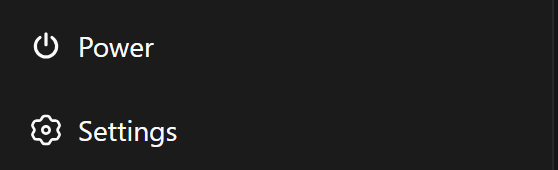
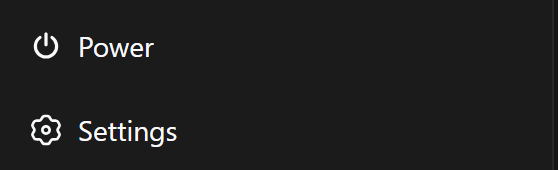
- Sidebar power button in the footer action slot, theme-aware and styled to match the adjacent Settings trigger.
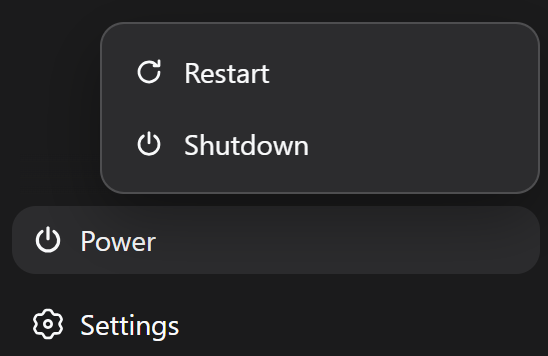
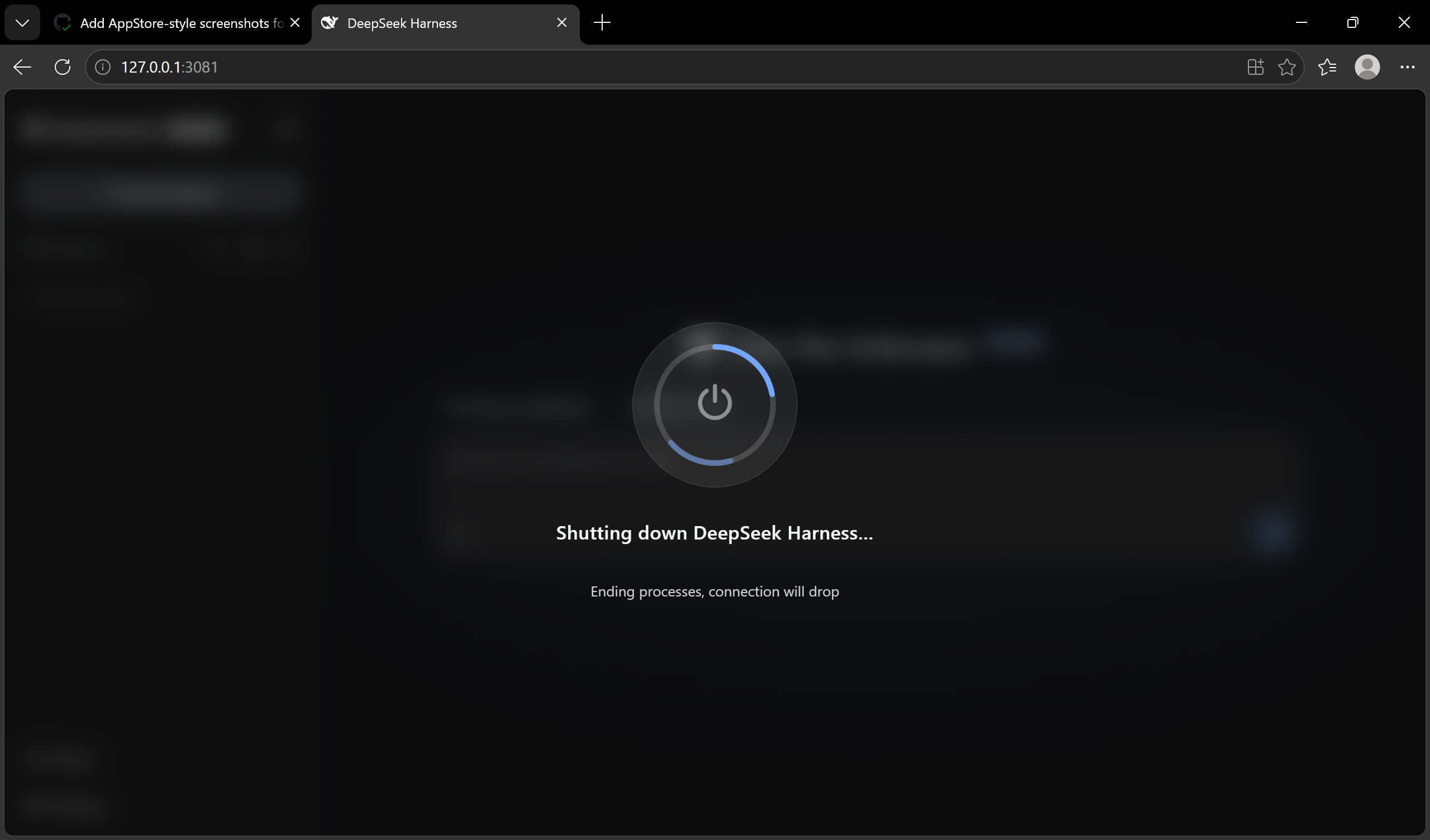
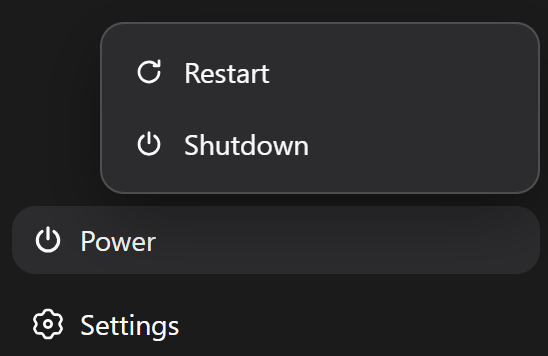
- Restart / Shutdown menu with a Windows-style full-screen overlay; the page reloads by itself after a confirmed restart.
- Self-contained restart engine: a detached
.cjshelper takes over relaunching DSH through an ARM → COMMIT → ACK handshake, waits for the old process, the port and the session logs, then relaunches the same invocation in the same cwd. A--port 0command line is pinned to the port the old process actually bound. No PowerShell, notaskkill. /restartand/shutdowncommands, arestart_harnessmodel tool (registration is skipped when another plugin already owns the name), and a read-onlyrestart_statustool for checking whether a restart happened.- Localized UI and host notices (zh / en), following the profile's
locale.preference. - Startup housekeeping: helper logs and scripts, per-restart handshake records, and undelivered notices older than 7 days are pruned from the runtime directory.
Screenshots
① Sidebar power button — theme-aware footer entry.
② Restart / Shutdown menu — two actions, one click away.
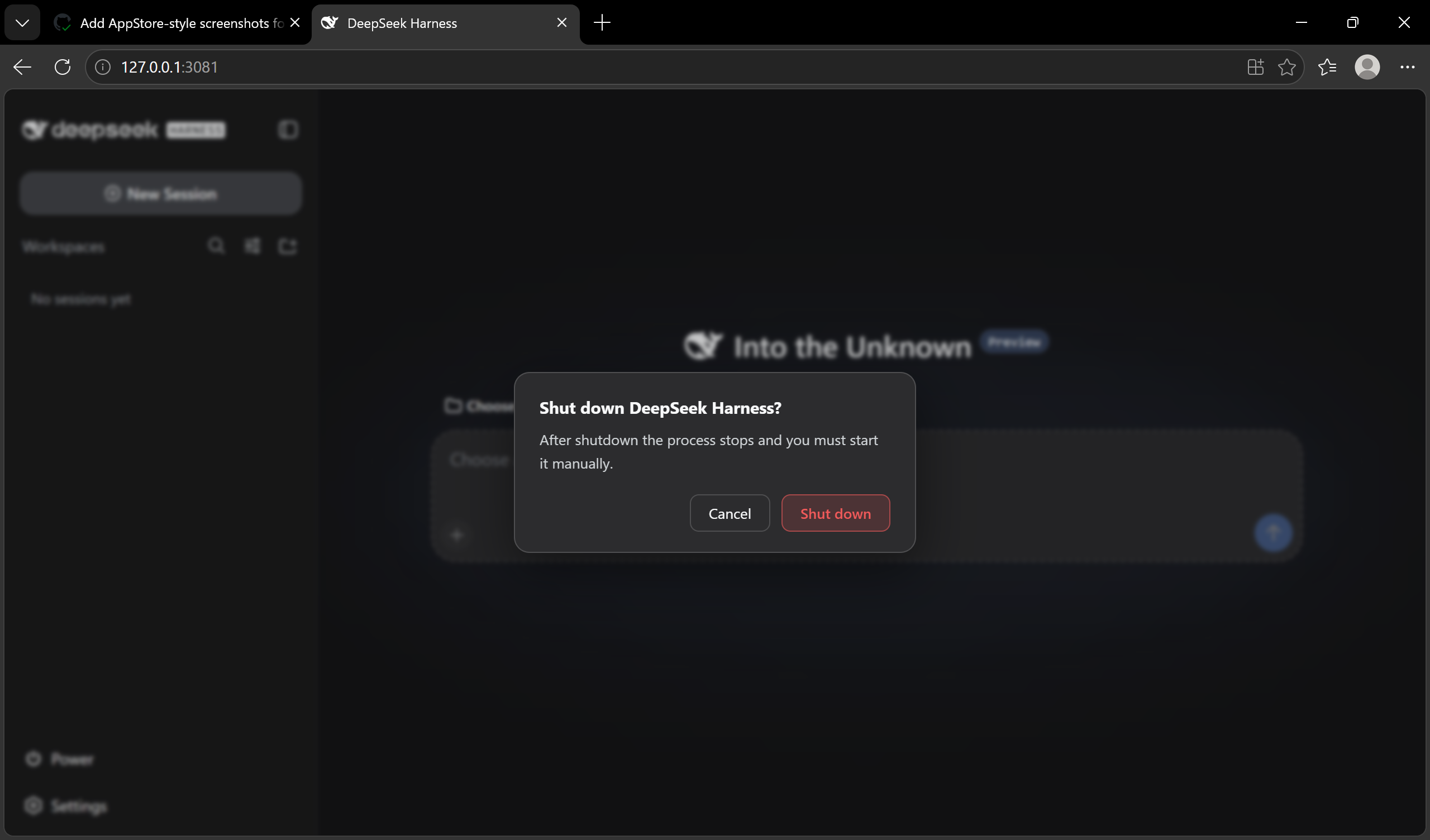
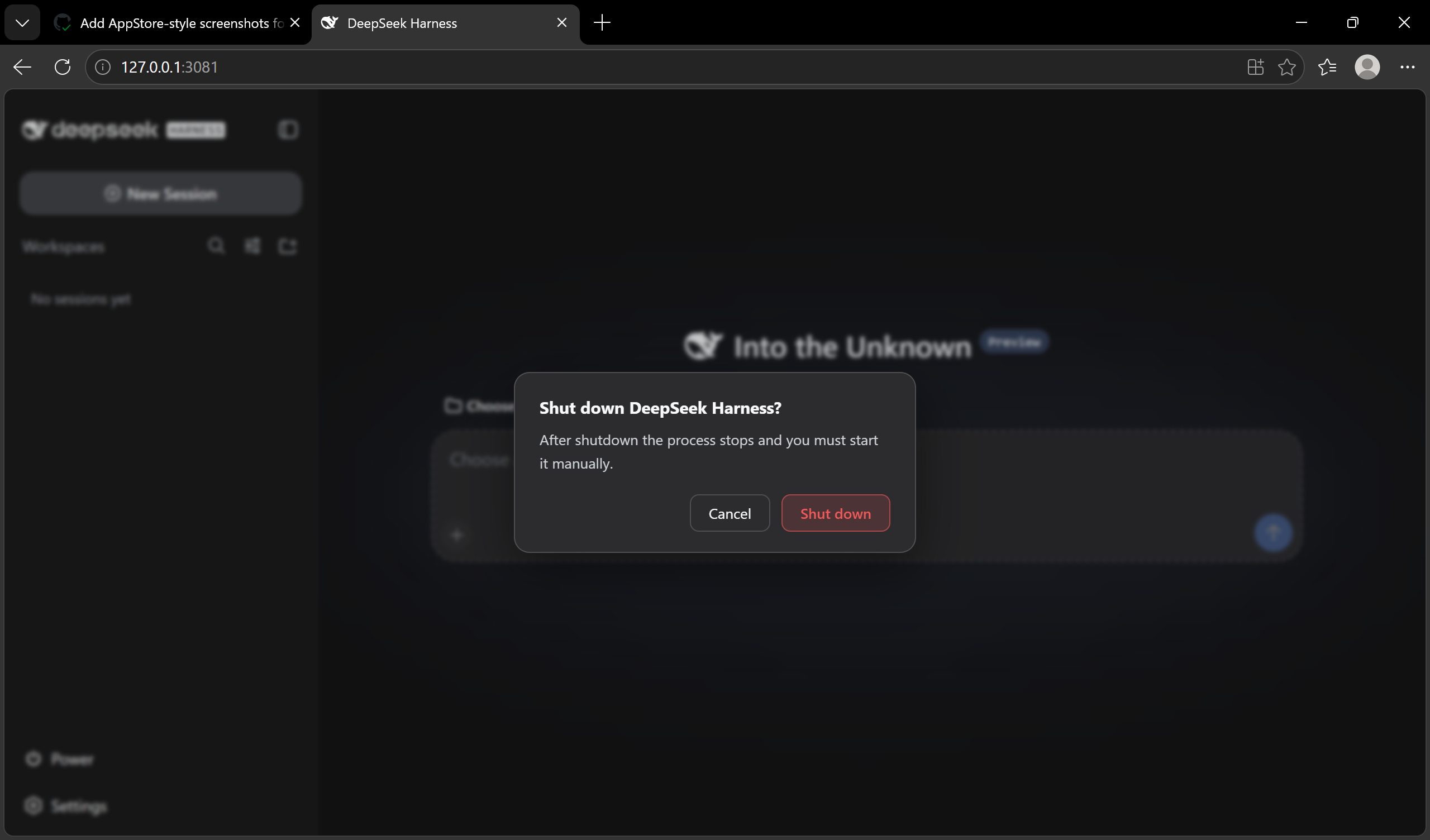
③ Shutdown confirm dialog — the default focus sits on Cancel; only an explicit confirm stops the process.
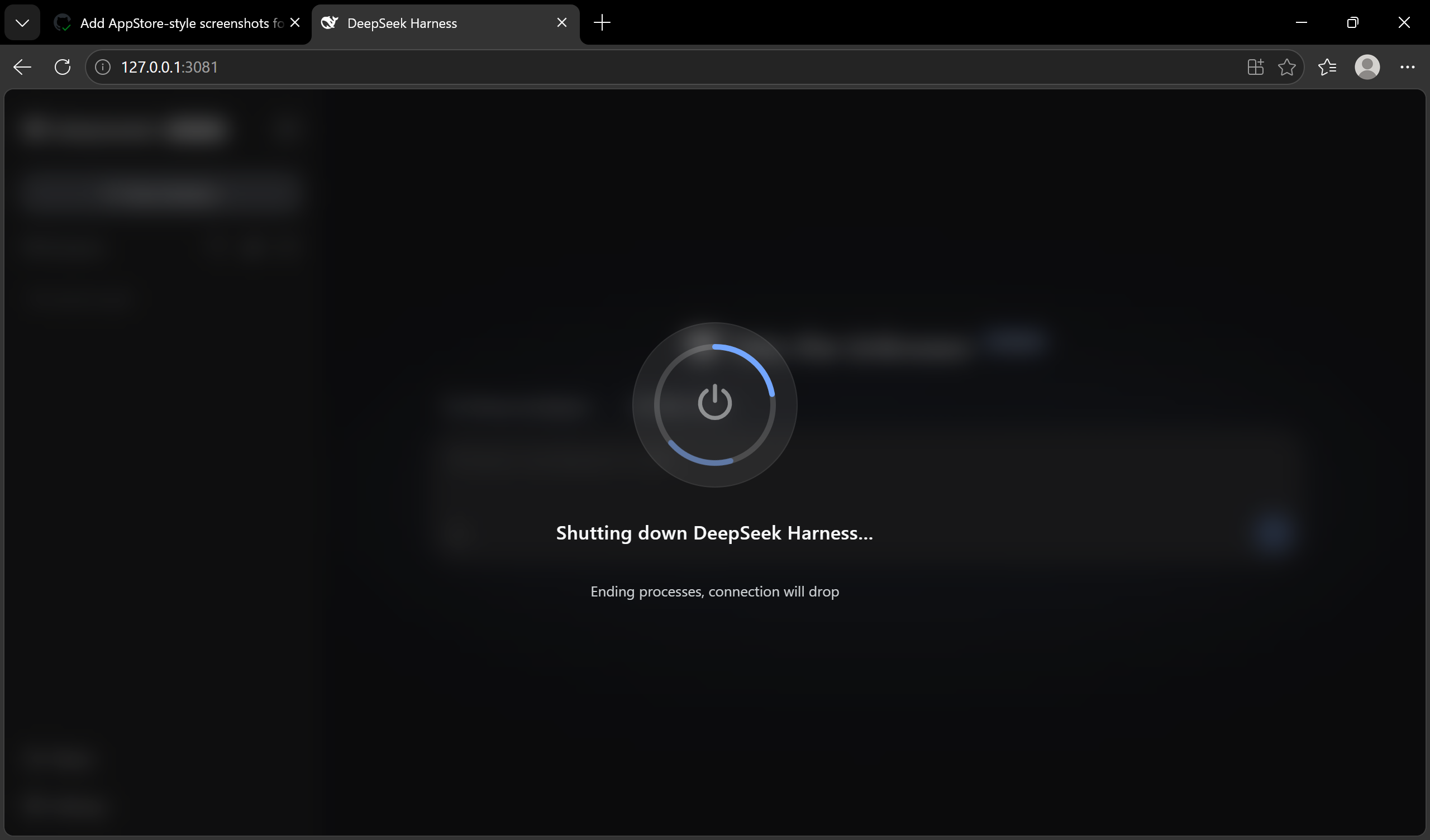
④ Shutdown progress overlay — shows the current stage while the process winds down.
⑤ Restart completed toast — after the auto reload, a notice confirms DSH is back.

Install
dsh plugin --profile web add "github:keyiadiannao/dsh-power-button#master"
Restart DSH; a power button appears in the sidebar footer. Requires Node ≥ 22.19.
Configuration
Configured through the profile's cordis layer (cordis.patch.yml or the settings UI):
| Key | Default | Meaning |
|---|---|---|
enableModelTool |
true |
Register the restart_harness model tool. Set false to keep restart on the GUI button and /restart only. |
maxDelayMs |
5000 |
Upper bound (ms) for the model tool's delayMs. The effective floor is 1000 ms. |
restartWakeMode |
quiet |
What the session that asked for a restart is told afterwards. quiet stages the notice for its next step without waking anything; notify also wakes that session once it is live, so the model reports the restart without a user message. Neither mode restarts anything on its own. |
- id: dsh-power-button
  config:
    enableModelTool: true
How it works
Restart is an explicit ARM → COMMIT → ACK handshake. The old process does not exit until a live successor owns the relaunch, because an exit with nobody left to relaunch is the one outcome the UI cannot recover from — every failure before the ACK keeps the old process running.
click power → Restart
[host]    POST /api/dsh-power-button/restart
          write the per-restart helper .cjs (0600: it embeds the relaunch argv)
          spawn `node <helper>` detached
[helper]  ARM  → status { stage: 'armed' }
[host]    wait for ARMED (5 s), then write the COMMIT file for this restartId
[helper]  ACK  → status { stage: 'committed' }
[host]    only now: unref the helper, flush live sessions (≤5 s),
          request exit after delayMs with a 15 s watchdog behind it
[helper]  wait for the old PID to exit, the port to free, the session logs to settle
          write the v2 marker, then spawn DSH with the same invocation and cwd
          poll /health until instanceId differs and restart.restartId matches
[client]  reload
Four invariants hold this together:
- The helper lives outside the process tree (
detached, a real.cjsfile — a multi-linenode -eis mangled by WindowsCreateProcess), so terminating DSH cannot kill it mid-flight. - Success is confirmed by a per-process
instanceIdthat must change, so a brief outage never fakes it. - The launcher's exit channel is read at
ctx.get('appExit'), never as a property: it is an optional host service this plugin does not inject, and a property read resolves toundefined— which would skip graceful disposal and hard-kill instead. - Exit is bounded end to end, and the bounds are derived rather than duplicated: graceful exit gets a 15 s watchdog, the pre-exit flush cap is 5 s, and the helper's patience for the old PID is computed from both, so they cannot drift into the helper giving up first.
- The successor's environment is re-read from the registry, not inherited: a process environment is a snapshot from its launcher, so a variable changed with
setxor System Properties would otherwise never reach the relaunched instance. The block is composed in the order Windows uses — the inherited block as the base layer, machine values over it, then user values shadowing those — and aREG_EXPAND_SZvalue is resolved against the block as it stands at its own stage, so a machine value cannot see a user-only name. That isolation is between registry layers, not a byte-exact replay of how Windows builds the block: names the launcher already carried stay visible at every stage, which is deliberate because some of them —SystemRooton a real machine — exist only in the process environment.PATHkeeps both halves (machine first) and each part is expanded according to its own type before duplicates are dropped. It is read throughreg export(UTF-16LE), so non-ASCII values survive on any console code page; the export is a transient file under the harness home that is deleted in the same call, and it inherits that directory's ACL exactly as.credentials.yamldoes — the file mode is not a privacy guarantee on Windows. A variable deleted from the registry still cannot be seen, and non-Windows platforms keep plain inheritance.
Shutdown posts /api/dsh-power-button/shutdown and stops without relaunching. It is irreversible, so the button and /shutdown both open a confirm dialog; the model is never given shutdown.
Safety
- Destructive POSTs go through the deployment's own browser-trust fence and authentication via
ctx.connection.requestRejection— the call the host's/apiroute uses./api/dsh-power-button/*is longer than the official/apiprefix, so longest-prefix matching never routes these requests through that fence; delegating keeps them under the operator's real policy, including LAN authorities derived from an all-interface bind and anytrustedHosts/--trusted-hostdeclaration. - On a host with no connection service (a profile without the web bundle) the plugin falls back to its own rules:
Hostmust be a loopback authority or one the host declared, plus the cross-site and full-authorityOriginchecks. That fallback is narrower than the official fence and can only refuse; it does not provide browser-session authentication. - A refusal answers with a stable
reasoncode and logs the observedHost/Origin/sec-fetch-site/ remote address.host-fenceandnot-authenticatedmean the deployment decided, not this plugin. - An at-most-once latch rejects duplicate transitions, so a concurrent second POST gets
409. - The model tool's
delayMsis floored at 1000 ms — the model cannot kill the process before its own turn settles. - The restart marker is consumed on boot, so a later ordinary launch never misreports a restart. Command lines are redacted in logs; helper and marker files are written
0600, the runtime directory0700.
Restart awareness
Three audiences, deliberately not one:
- The UI shows a localized "Restarted" toast. The restart identity stays on
/healthfor the process's whole life; acknowledging the toast clears only the pending flag. - The session that asked gets a notice shaped by
restartWakeMode—Agent.inject()whenquiet,Agent.followup()whennotify. Only a restart with a recorded causal session gets one: a GUI click records none and is never attributed to whichever conversation happens to be open. At most one notice per session is queued and it is deleted once delivered. - Every other session can call
restart_status, which reports whether a restart happened, its id, stage, the instances involved, timings, who asked, and whether the running process is the instance that restart produced.
The plugin never appends a model-visible event and never forges a turn: awareness is handed to the Agent API, whose inject() durably stages an agent/inbox/spliced record for the next legitimate step. Delivery is once per notice in normal operation; a crash between the inbox write and the deletion can repeat it, and the notice text is written so a repeat is harmless.
/health also reports appExit: "available" | "missing" — whether the launcher-provided exit channel actually resolves here, which turns a delayed restart into a one-request diagnosis. Both exit paths log the pre-exit flush tally (live / fulfilled / rejected / timedOut), so a refused or partial durable write is visible afterwards instead of looking like a clean exit.
Development
pnpm build            # tsdown: host + client bundle (committed to lib/)
pnpm typecheck        # tsc --noEmit over src
pnpm typecheck:tests  # the root tsconfig excludes tests/
pnpm test             # vitest: unit + process-level acceptance
pnpm check            # all of the above, in order
CI runs on Windows, Ubuntu and macOS: both typechecks, tests, build, a gate that the committed lib/ matches a fresh build byte for byte (a git install runs those artifacts), and a pnpm pack check that the tarball contains lib/ and cordis.patch.yml. A separate Linux job repeats the steps on Node 22.19, the floor engines.node declares.
tests/restart-runtime.spec.ts executes the exact helper the host generates as a real process against real TCP ports, and pins what unit tests cannot: the full relaunch chain, no relaunch without COMMIT, bounded spawn retries, the health gate refusing a stale instance, a --port 0 successor landing on the bound port, and the failure diagnoses (marker-write-failed, a still-moving session log). Tests isolate DSH_HOME via a vitest setup file, so they never touch your real ~/.dsh.
License & Attribution
MIT. The "detached helper relaunch" idea follows anweat/dsh-restart (MIT); the implementation is independently written (real .cjs file, no PowerShell, dynamic port), no code copied.
Related plugins
DSH-better-sidebar
 dsh-external
/DSH-better-sidebar
右侧侧边栏增强:文件预览/终端/Git,可拖拽自定义位置
dsh plugin --profile web add github:dsh-external/DSH-better-sidebarmirage#dsh
 strukto-ai
/mirage/typescript/packages/dsh
把文件系统与 bash 提供者换成 mirage 虚拟工作区:文件工具与 shell 命令作用于挂载的资源(RAM、S3、Redis、Slack、Gmail、Notion、Postgres)而非宿主磁盘,支持按挂载点设置读/写/执行模式、按命令选择沙箱(进程内 monty、pyodide、quickjs;远程 docker、e2b、daytona),并可在虚拟终端中安装 CLI(git、gh、slack、linear、ntn、gws,或自行注册的程序树)作为命令头词。
dsh plugin --profile web add github:strukto-ai/mirage#path:/typescript/packages/dshdeepseek-harness-desktop
 hairyf
/deepseek-harness-desktop
DeepSeek Harness Tauri 桌面版 | Only 5mb installer, zero environment setup. Windows / macOS / Linux.
dsh plugin --profile web add github:hairyf/deepseek-harness-desktopcc-safety-net
 kenryu42
/cc-safety-net
A coding agent CLI hook - block destructive commands and secret file access
dsh plugin --profile web add 'github:kenryu42/cc-safety-net#ae8af0330308ad0bc24b5389709060c7a07a6b8d'hol-guard
 hashgraph-online
/hol-guard
开源AI代理防病毒:运行时拦截风险工具、秘密访问、提示注入、恶意软件包、MCP服务器、插件和技能。
dsh plugin --profile web add github:hashgraph-online/hol-guarddsh-mobile
 saya-ch
/dsh-mobile
DeepSeek Harness 移动端适配与安全局域网访问插件,支持 Android App 和手机浏览器。
dsh plugin --profile web add github:saya-ch/dsh-mobile