
Skills
superpowers-dsh
laynechai/superpowers-dsh · ★ 164
 laynechai
Superpowers skills for DeepSeek Harness: TDD, debugging, planning, and collaboration skills adapted from obra/
安装
dsh plugin --profile web add github:laynechai/superpowers-dshGitHub 源码安装:首次需按提示配置 allowBuilds 构建授权后重试
For install and environment setup, plus plugin development tutorials, see DSH community docs ↗
README
Table of contents
- superpowers-dsh
- Contents
- Install & use in your DeepSeek Harness
- Simplest: one command
- Easiest: let the DeepSeek Harness agent install it
- Install from npm (recommended — one command)
- Install from GitHub
- Install from a tarball or a local folder
- Restart and verify
- Using another profile (headless / tui / custom)
- Uninstall
- Notes
- DSH version compatibility
- Support matrix
- Known compatibility notes
- How to re-verify compatibility
- Skills
- How it works
- Upstream sync
- Porting notes
- Adding your own skills
- License
English | 简体中文
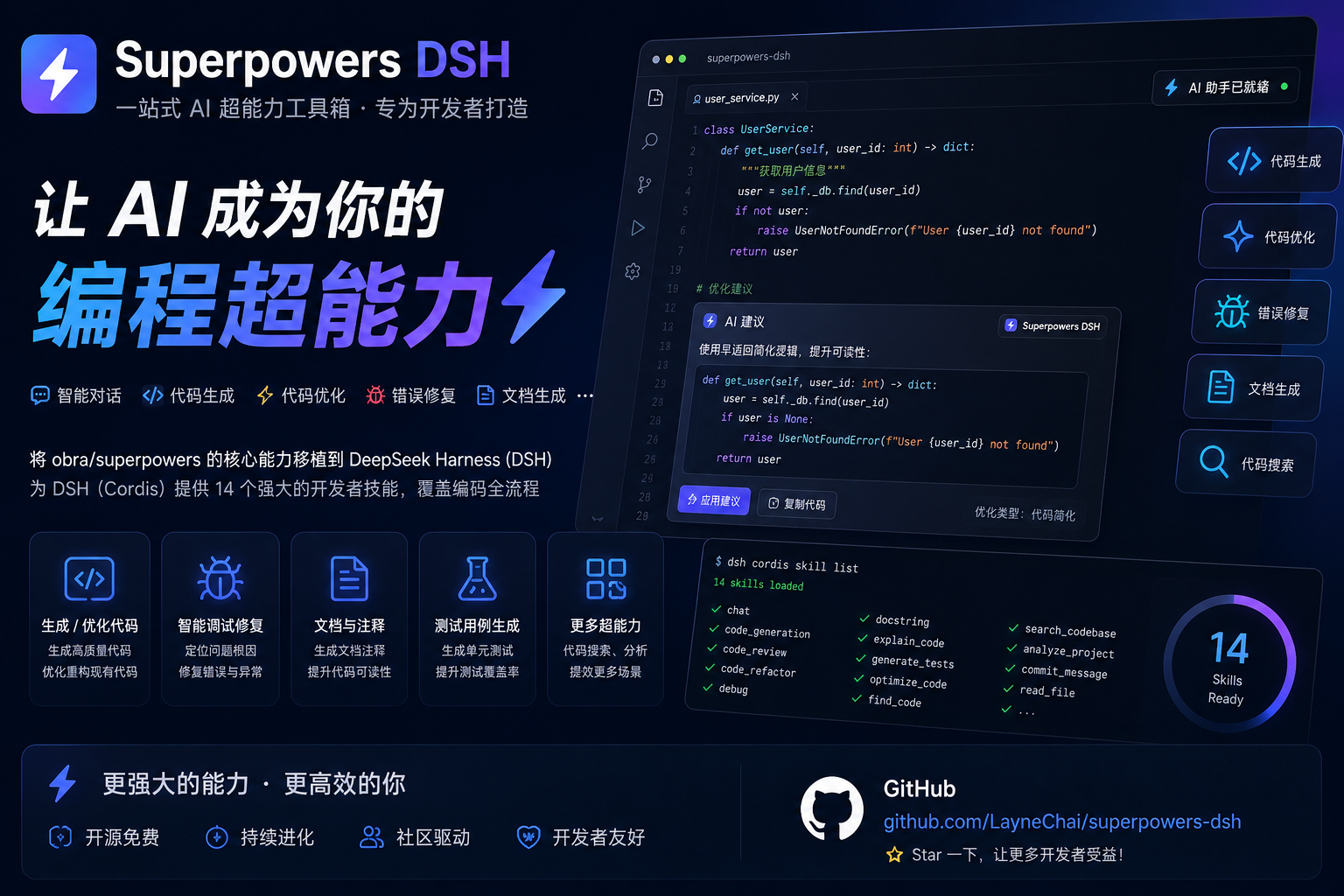
superpowers-dsh
Superpowers for the DeepSeek Harness: a plugin bundle that ports the core skills of obra/superpowers (the Claude-Code skills library: TDD, debugging, planning, collaboration patterns) to DSH's Cordis plugin architecture.
The plugin registers a skill provider into the host layer of the
ctx.skills registry, so every agent preset's scope chain merges these
skills. Skill bodies ship inside the package (skills/<name>/SKILL.md) and
are located from import.meta.url — an assembly fact of the package, never
user configuration.
Contents
- Install & use in your DeepSeek Harness
- DSH version compatibility
- Skills
- How it works
- Upstream sync
- Porting notes
- Adding your own skills
- License
Install & use in your DeepSeek Harness
A plugin bundle for DeepSeek Harness (DSH). Installing it registers the
15 skills below into the host skill registry, so every agent session in your
profile sees them in its skill catalog and can load them with the skill
tool. Skill content is synced from upstream obra/superpowers v7.0.1.
Simplest: one command
No global dsh install required. Run this from any directory:
npx @deepseek-ai/dsh plugin --profile web add github:LayneChai/superpowers-dsh
Then restart npx @deepseek-ai/dsh web (or dsh web) and refresh the browser.
Easiest: let the DeepSeek Harness agent install it
Open the DeepSeek Harness web UI, start a new conversation, and send this message:
Please install the plugin from this link: https://github.com/LayneChai/superpowers-dsh
The agent will run the install for you (dsh plugin --profile web add →
restart the profile → verify the skills registered), so you never have to
type a command. Afterwards you can ask it to run
dsh --profile web --dump-config and confirm a superpowers-dsh row is
present.
Install from npm (recommended — one command)
The package is published on npm as superpowers-dsh (synced to the
npmmirror mirror for mainland China):
dsh plugin --profile web add superpowers-dsh
Use the
dsh pluginform — a plainnpm install superpowers-dshinstalls the package as a library in the current directory but does not register it into any DeepSeek Harness profile, so the skills would never load.
Install from GitHub
# from anywhere
dsh plugin --profile web add https://github.com/LayneChai/superpowers-dsh.git
Install from a tarball or a local folder
# tarball (e.g. the release asset superpowers-dsh-0.1.0.tgz)
dsh plugin --profile web add C:\path\to\superpowers-dsh-0.1.0.tgz

# or the unpacked package folder (pnpm links it, so edits take effect on restart)
dsh plugin --profile web add C:\path\to\superpowers-dsh
Restart and verify
The bundle layer mounts at profile startup, so restart the profile (stop
and re-run dsh web / npx @deepseek-ai/dsh web, then refresh the browser).
To confirm the layer is composed:
dsh --profile web --dump-config # a `superpowers-dsh` row must be present
The skills then appear in the agent skill catalog (using-superpowers is the
entry-point skill) and are loadable with the skill tool.
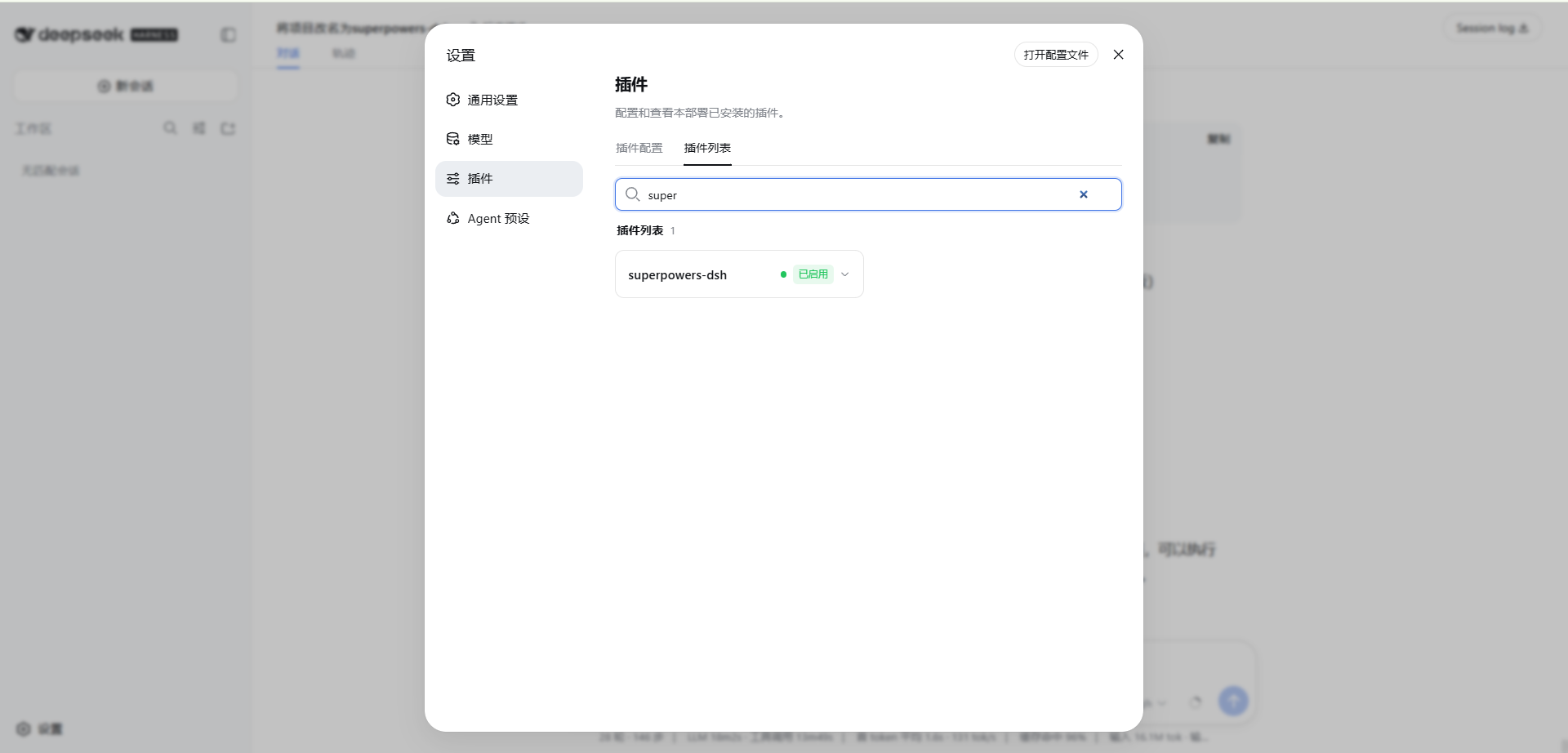
A successful install looks like this:
Using another profile (headless / tui / custom)
Point --profile at whichever profile you run:
dsh plugin --profile headless add superpowers-dsh
dsh --profile headless --dump-config
Uninstall
dsh plugin --profile web remove superpowers-dsh
# then restart the profile again
Notes
- Installers in mainland China can set the npm mirror first — it makes
dsh plugin add superpowers-dshfast:npm config set registry https://registry.npmmirror.com - A plugin installed from a folder or
file:spec is linked, not copied: changes to that folder take effect after the next profile restart. - Consumers need no npm account and no 2FA — installing is a plain package download.
DSH version compatibility
Bottom line: compatible with every DSH version published on npm, verified
end-to-end on DSH 0.2.0-rc.2 (the current latest). No known
incompatibilities.
Checked 2026-10-03. npm dist-tags: latest = next = 0.2.0-rc.2,
alpha = 0.2.1-alpha.1.
Support matrix
| Check | Result |
|---|---|
| DSH interfaces this plugin uses | ① ctx.skills.registerProvider(...) (skill provider registration) ② dsh.bundle.patch (a bundle mounting its own cordis.patch.yml) |
| Published versions carrying them | 31 released versions each of @deepseek-ai/dsh-skill and @deepseek-ai/dsh-app-boot |
| Per-version audit | 31 / 31 identical — from the first release 0.0.1-rc.1 through the newest 0.2.1-alpha.1, no signature or semantics changed |
| End-to-end run | lib/index.js mounted into the real SkillRegistry of local DSH 0.2.0-rc.2: list() returned 15 skills and every get() returned a body and a resourceBase |
| This plugin's version | 0.4.0 (skill content synced from obra/superpowers v7.0.1) |
| Runtime dependencies | None. Node built-ins only, so a DSH dependency-tree change cannot break it |
| Node.js | Verified on v22.22.2; DSH declares no engines, and neither does this plugin |
Known compatibility notes
- No known incompatibilities. Since
0.1.7-rc.2DSH has a plugin compatibility gate (evaluatePluginCompatibility): it only inspects the@deepseek-ai/dsh*peerDependencies a plugin declares and skips the whole bundle when a range does not match. This plugin declares no peerDependencies, so the gate never blocks it — which also means DSH does not version-check it for you, so re-run the audit below after a DSH upgrade. - Same-name precedence is deliberate: the plugin registers at
PACKAGED_SKILL_RANK = 550while DSH's bundled root isBUNDLED_SKILL_RANK = 600(lower wins), so your own skill wins a same-name collision. No in-box DSH skill shares a name with these. - Windows note: the bash helpers in the skill bodies need Git for Windows
(Git Bash); the Node helpers (
server.cjs,render-graphs.js) run everywhere. The prose invokes bundled scripts through their interpreter (bash scripts/...), so it does not depend on Unix executable bits. - The install method does not affect compatibility: npm, GitHub, and a linked local folder all load the same bundle declaration.
How to re-verify compatibility
One command re-runs every check above — including the real-registry mount — against the DSH you actually have installed:
node scripts/check-dsh-compat.mjs
# or point it at another node_modules, or set $DSH_NODE_MODULES
node scripts/check-dsh-compat.mjs D:\path\to\profile\node_modules
Output on this machine:
dsh SDK      : @deepseek-ai/dsh-skill 0.2.0-rc.2
mounted      : 15 skills listed and read through the real SkillRegistry
rank         : PACKAGED_SKILL_RANK=550 is below BUNDLED_SKILL_RANK=600

check-dsh-compat: OK — this plugin matches the installed DSH SDK
It checks, in order: that the SDK is present and which version it is → that the
installed SDK's own type declarations still declare the provider interface this
plugin implements (registerProvider, SkillProvider.list/get,
SkillCandidate, SkillResourceBase, the 'custom' source bucket) → that
lib/index.js really mounts into SkillRegistry and every skill reads back →
the rank relationship. Any failure exits 1 and names the contract that changed.
On a machine with no DSH installed (CI, a fresh container) there is nothing
to compare against, so it prints SKIPPED and exits 0 — that is "unchecked",
not "failed", so a publish pipeline is never blocked by a missing local DSH.
Pass an explicit directory or --require to make a missing SDK an error, or set
DSH_COMPAT_REQUIRE=1 node scripts/check-dsh-compat.mjs.
The conclusion holds for the DSH version it was verified against. On a newer DSH, run the command above first: if upstream changes the skill interface it names the exact break instead of letting skills disappear quietly.
Skills
| Skill | Purpose |
|---|---|
using-superpowers |
How to find and use skills; the entry-point skill |
brainstorming |
Find out what you actually want, and why, before anything gets built |
writing-plans |
Write comprehensive implementation plans from specs |
executing-plans |
Execute a plan inline (Native) in this session, one whole-branch review at the end |
subagent-driven-development |
Dispatch fresh subagents per task with reviews |
dispatching-parallel-agents |
Fan independent work out across parallel agents |
systematic-debugging |
Root-cause-first debugging discipline |
test-driven-development |
RED-GREEN-REFACTOR implementation loop |
verification-before-completion |
Evidence before success claims |
requesting-code-review |
Get rigorous review before merging |
receiving-code-review |
Verify feedback instead of blindly implementing it |
finishing-a-development-branch |
Integrate completed work safely |
using-git-worktrees |
Isolated workspaces for feature work |
writing-skills |
Author and validate new skills TDD-style |
diagnosing-superpowers |
Read a session's transcripts on disk and report what went wrong, with path:line evidence |
How it works
- Bundle layer —
cordis.patch.ymlinserts one row (- id: superpowers-dsh, name: superpowers-dsh) over the dsh-base layer. Later layers (the profile'scordis.patch.yml,--patchoverlays) can still address that row by id. - Provider —
lib/index.jscallsctx.skills.registerProvider(...)with a provider that:list()scans the package'sskills/directory for<name>/SKILL.mdbundles and returns candidates parsed from YAML frontmatter (name,description,whenToUse).get()reads the winning candidate's body on demand and returns a full skill definition withresourceBasepointing at the skill's directory, so relative references (scripts, prompt templates) resolve.
- Zero runtime dependencies — the plugin imports only Node built-ins and
consumes the injected
ctx.skillsservice interface.
Upstream sync
Currently synced upstream version: obra/superpowers v7.0.1 (recorded in
package.json as dsh.superpowersUpstream).
skills/ is generated output — do not hand-edit it. The sync lives in two
places; change those and re-run:
scripts/sync-from-upstream.mjs— copies the upstream skill tree and replays every DSH adaptation. Each adaptation is an asserted string rewrite, so if upstream rewords the anchor the run fails loudly instead of silently dropping an adaptation.port/overrides/— DSH-only files (using-superpowers/references/dsh-tools.md) copied over the synced tree.
# 1. Fetch the upstream release (git-over-https is blocked on some networks;
#    codeload works)
mkdir -p .upstream/superpowers
curl -L https://codeload.github.com/obra/superpowers/tar.gz/refs/tags/v7.0.1 \
  | tar -xz -C .upstream/superpowers --strip-components=1

# 2. Replay the sync
node scripts/sync-from-upstream.mjs .upstream/superpowers

# 3. Verify (provider lists every skill, frontmatter is valid, no dangling refs)
node scripts/verify-skills.mjs

# 4. Compatibility (replays the contract and the real-registry mount against
#    the DSH you have installed)
node scripts/check-dsh-compat.mjs
What this sync brought in from upstream (v7.0.1, 2026-10-21; still 15 skills, 68 → 78 files):
brainstormingretuned after feedback (#2560 / #2571): v7.0.0's opening — offer to skip the questions, then ask a generic "the moment you wished this existed" — felt formulaic fast, so two things changed. ① It digs for context before it asks anything: pointed at an existing project, a spec, a plan, or files, it reads them before its first message and does not ask what they already answer. ② Its questions build on your answers: once you've said what you want, it plays your request back with what it found in the project and asks about the one thing still open; later questions build on your answers and say what the answer would change. The skip offer now appears only when it started on its own — invoking brainstorming by name or/brainstormingno longer offers to skip.- The design doc can no longer be skipped: it presents two or three ways to build the thing, recommends one for you to pick, writes the design doc, and builds nothing until you approve it. Upstream measured 24 of 24 runs skipping the doc without asking before this change, 3 of 24 after.
- Three long skills were split so they survive compaction (#2563 / #2564 /
#2565, from #2481): after a compaction Claude Code re-attaches each skill cut
off at 20,000 characters, so anything past that point is gone for the rest
of the session — one reported session lost
subagent-driven-development's five-round fix limit and ran 18 fix rounds on a single task.subagent-driven-development: the fix loop, final review, report handling, resuming, preflight, batching, and cannot-verify guidance move intoreferences/(7 new files) and are read from disk at the step that needs them. SKILL.md 32,510 → 19,470 bytes.writing-skills: supporting docs, the SKILL.md template and discovery guidance, bulletproofing, and flowchart conventions move intoreferences/(newdiscovery.md,bulletproofing.md,flowcharts.md; the rest are existing files renamed intoreferences/). 26,615 → 16,754 bytes.executing-plans: drops its Example Workflow, which repeated rules stated above it. 20,454 → 18,164 bytes.- Upstream also added
tests/skill-size/test-skill-size.sh, which fails when anySKILL.mdreaches 20,000 bytes. All 15SKILL.mdfiles in this port are now under 20,000 bytes (the largest issubagent-driven-developmentat 19,470).
- Not applicable to DSH: the issue and PR templates now require who filed,
what the human partner asked for, and a human-written summary under 200 words
(#2569);
diagnosing-superpowersadds those two sections and switches to the Bug Report template; 18 historical plan docs underdocs/superpowers/plans/were deleted. All of it lives outsideskills/and never reaches this port.
DSH adaptation: v7.0.1 renamed
writing-skills/references/CLAUDE_MD_TESTING.mdintoreferences/, which brought it into the shipped tree. The whole file is scenario fixtures for testing how skill docs get discovered, and 14 of its lines send the agent to~/.claude/skills/— a directory that does not exist on DSH, so the fixtures would test nothing. The sync script gained asweeptransform that rewrites them all to$DSH_HOME/skills/.
The previous release (v7.0.0, 2026-10-10), kept for reference:
brainstormingwas rebuilt from scratch (#2463 / #2482 / #2483): the first message offers to skip the questions, then asks one open question about a real moment; it plays each part back in 200–300 words for correction, sizes the work in plain words once it understands (do it / agree it in chat / write a design document) with your override, and finds out which how-it-gets-made choices you want to own (platform, language, libraries, medium).- A builder check replaces the spec-document reviewer: adds
skills/brainstorming/builder-check-prompt.md(a fresh subagent reads the design as the person who'll build it and lists what it still needs to ask) and removesskills/brainstorming/spec-document-reviewer-prompt.md. One round of questions only. subagent-driven-development'sscripts/sdd-workspace: no longer overwrites a repo's own.superpowers/sdd/.gitignore(it writes the default only when none exists), and on Windows/Git Bash plan markers stay repo-relative instead of recording a machine-specific absolute path.executing-plans'sscripts/task-done: a test command that passes silently now records the task in the ledger as→ (no output); previously the emptygrep|tailexited 1 and a finished task looked unfinished.requesting-code-review: the base-SHA example usescut -d' ' -f1, because Claude Code substitutes$1in a skill body with an argument word.systematic-debugging: the multi-layer diagnostic example no longer prints the secret value it checks for.- Visual companion
scripts/server.cjs: fixesString.replacetreating$'/$&as replacement patterns; content is now inserted literally. - Everything else in the release is Antigravity / Hermes / Claude Code hook work, which does not apply to DSH (it has no hook system).
Porting notes
- Namespace prefixes removed:
superpowers:brainstorming→brainstorming(DSH skills are addressed by bare name). using-superpowersnow documents the DSHskilltool and points atskills/using-superpowers/references/dsh-tools.md, a full Claude-Code → DSH tool mapping (pwsh,subagent,workflow,goal, ...). Upstream's per-harness reference list (Claude Code / Codex / Gemini / Copilot / Pi / Antigravity / Hermes / Muse) collapses to the DSH file; the otherreferences/*-tools.mdfiles are not shipped.- Subagent references map to DSH's
subagent/subagent_fork. Upstream's named agent (superpowers:code-reviewer) does not exist here; dispatch the skill's own prompt template instead. - Upstream's
<SUBAGENT-STOP>gate is not kept: DSH subagents must follow the skills too (an implementer subagent has to run TDD). - Cross-harness paths become DSH paths:
~/.claude/skills/→$DSH_HOME/skills/,~/.superpowers/...→$DSH_HOME/...(default~/.dsh). diagnosing-superpowersgains DSH session-storage facts ($DSH_HOME/sessions/<cwd-slug>/session-<uuid>/session.*.jsonl.zstd, concatenated zstd frames that need frame-by-frame decompression).brainstorming's visual companion adds a Windows note: the Node server (scripts/server.cjs) runs everywhere; the.shhelpers are bash-only.- After the v7.0.0 rewrite, upstream itself names the companion as a bare
visual-companion.md, so this port's old rewrite ofskills/brainstorming/visual-companion.mdis gone (the sync script carries a NOTE; re-add it if a future release regresses to the path form). writing-skills/references/CLAUDE_MD_TESTING.mdentered the shipped tree with v7.0.1's rename (it used to sit underexamples/, which upstream never treated as shipped content). It is kept because it is the scenario suite for "how do you write skill docs so agents actually find them" — but 14 of its lines send the agent to~/.claude/skills/, a directory that does not exist on DSH, so the fixtures would test nothing. The sync script therefore rewrites them all to$DSH_HOME/skills/with onesweeptransform. Provenance lines in the same file that describe where a framework was extracted from (~/.claude/CLAUDE.md) are left alone: those are history, not instructions.
Adding your own skills
list() discovers any skills/<kebab-name>/SKILL.md in the package — it must
start with a YAML frontmatter block (name + description, optionally
whenToUse). No code change needed.
Note that skills/ is generated by the upstream sync: re-running
scripts/sync-from-upstream.mjs rebuilds it wholesale, so a skill dropped
there directly is deleted. Two safe places:
$DSH_HOME/skills/(user level) or the project's.dsh/skills/— unrelated to this package and the least effort;- or
port/overrides/<kebab-name>/SKILL.md— copied intoskills/on every sync, so it survives.
License
MIT. Skill content adapted from obra/superpowers (MIT), © Jesse Vincent and contributors.
Related plugins
Distilly(原 colleague-skill)
 titanwings
/colleague-skill
Distilly(原 Colleague Skill):把同事、亲友或名人的经验、判断与表达蒸馏成可复用的人物 Profile Skill。DSH 经 skills 目录原生发现(/distilly 调用),非插件加载。
mkdir -p ~/.dsh/skills && git clone https://github.com/titanwings/distilly ~/.dsh/skills/distillyskillhub-iflytek
 iflytek
/skillhub/plugins/dsh
Native SkillHub browsing and local skill management for DeepSeek Harness
dsh plugin --profile web add '@astron-team/skillhub-dsh@0.6.1'vibe-skills
 foryourhealth111-pixel
/vibe-skills
vibe 编码技能合集(含快速开始、CI 证明、发布说明与文档)
dsh plugin --profile web add github:foryourhealth111-pixel/vibe-skillsJ-Space-Cognition-Suite-V3.6
 Tiger3807861189
/J-Space-Cognition-Suite-V3.6
A model-agnostic inference-time control suite for deep reasoning, long-horizon work, tool use, verification, and recovery. 面向深度推理、长程任务、工具调用、验证与恢复的模型不可知推理时控制套件。
dsh plugin --profile web add github:Tiger3807861189/J-Space-Cognition-Suite-V3.6Aegis
 GanyuanRan
/Aegis
面向编码 Agent 的软件工程方法包,提供基线优先规划、系统化调试、提示词卫生、完成前验证,以及修复/退役双轨跟踪技能。
dsh plugin --profile web add github:GanyuanRan/Aegisex-skill
titanwingstitanwings/ex-skill
「分手了,可对方的打字方式还刻在你脑子里。每个语气、每次停顿都记得——只是再也收不到下一条了。」
dsh plugin --profile web add github:titanwings/ex-skill