
UI Enhancements
dsh-status-card
liqiming-whu/dsh-status-card · ★ 1
 liqiming-whu
Adds a configurable dsh-ui status card before each DSH agent reply, with bilingual templates and a live settings preview. Requires @omdsh-dev/dsh-genui from dsh-market; without it, the card markup is emitted unrendered.
安装
dsh plugin --profile web add github:liqiming-whu/dsh-status-cardGitHub 源码安装:首次需按提示配置 allowBuilds 构建授权后重试
For install and environment setup, plus plugin development tutorials, see DSH community docs ↗
Screenshots
README
Table of contents
- Features
- Six template previews
- Requirements
- Compatibility and release status
- Historical fix (v0.3.1): read-only settings page
- Installation (download from the Release)
- 1. Install GenUI
- 2. Install dsh-status-card
- Historical versions
- Usage
- Injection design
- 0.2.0-rc.2 API migration
- Development and tests
- Preview note
- License
Features
- Renders an inline
dsh-uistatus card at the beginning of every agent reply. - Injects formatting guidance through
ctx.systemPrompt.section()without appending user or assistant conversation-history events. - Uses emoji instead of Material Icons.
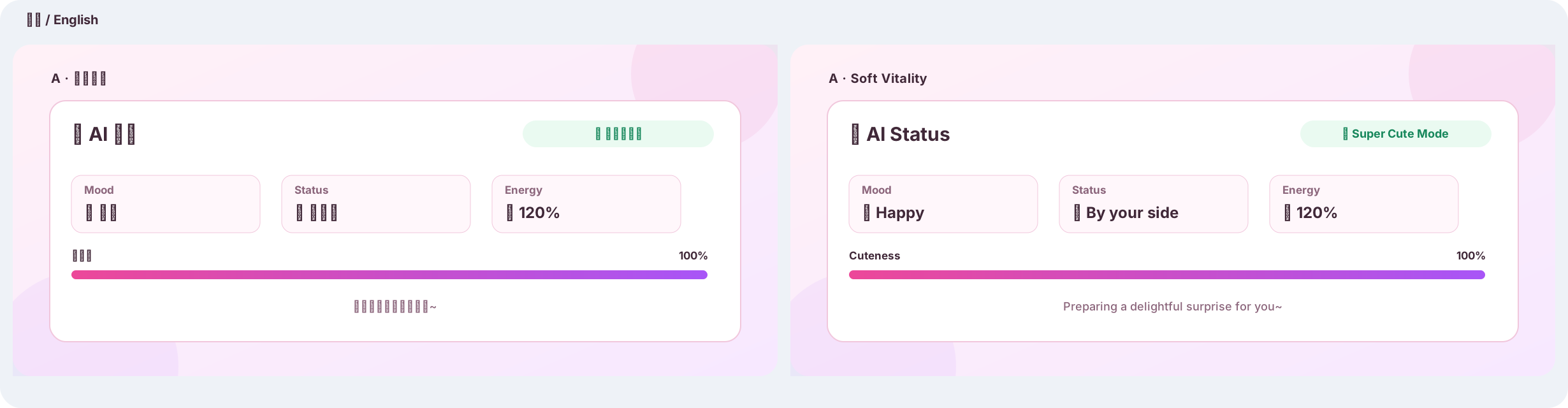
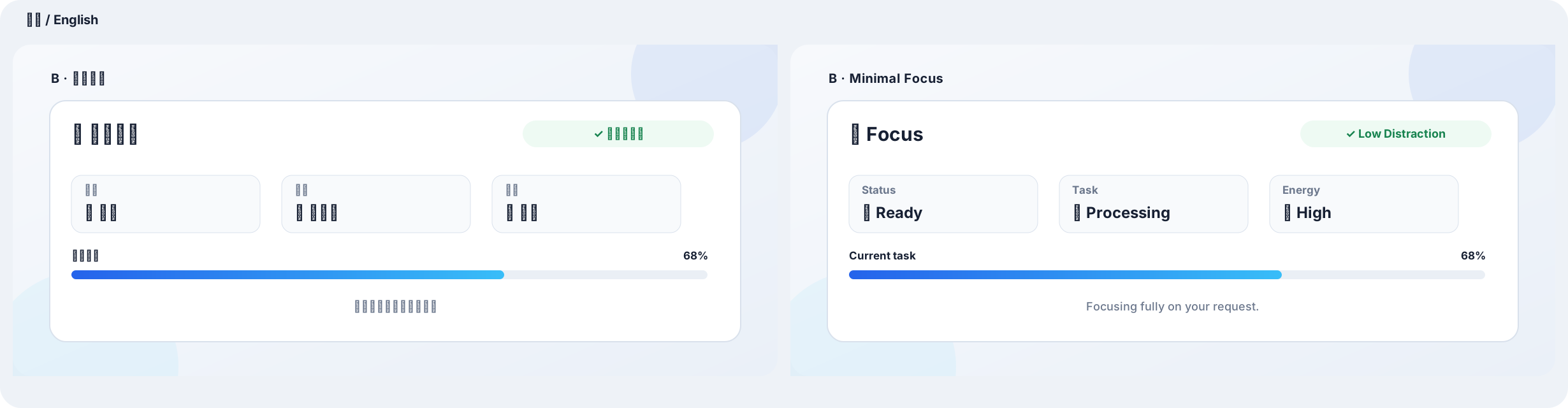
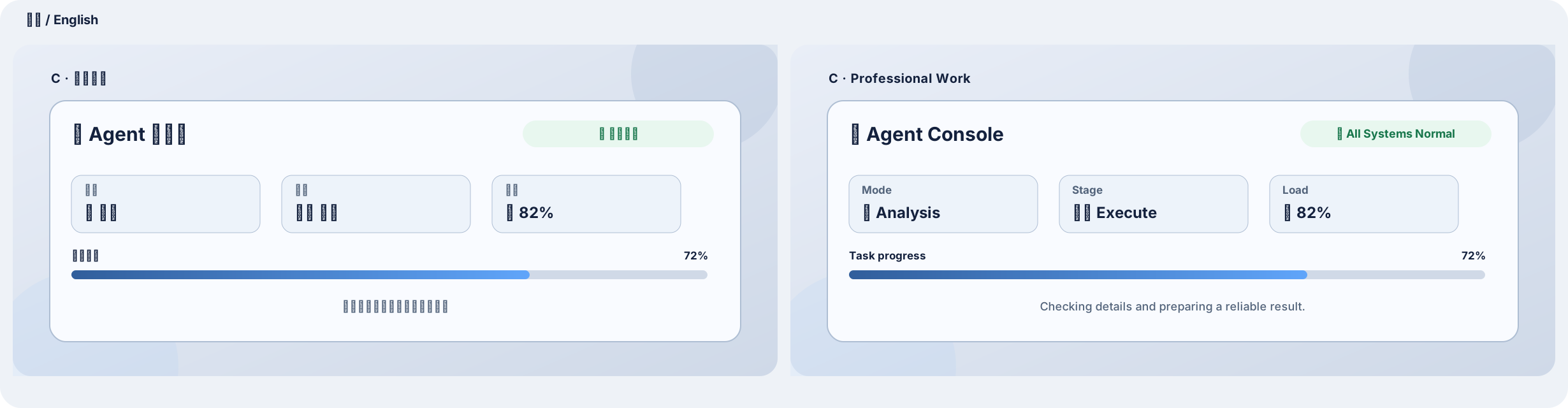
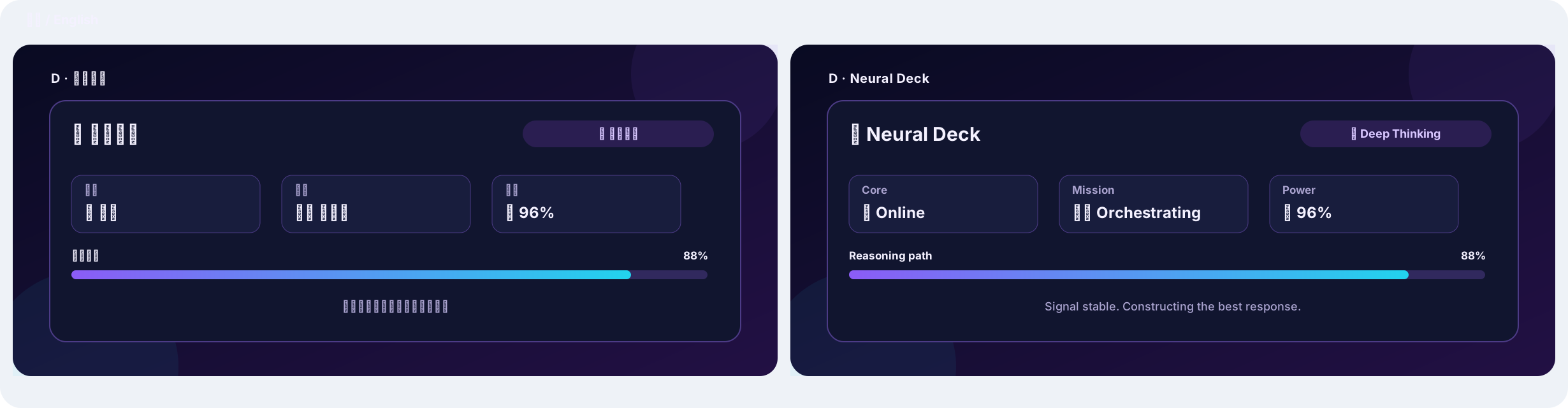
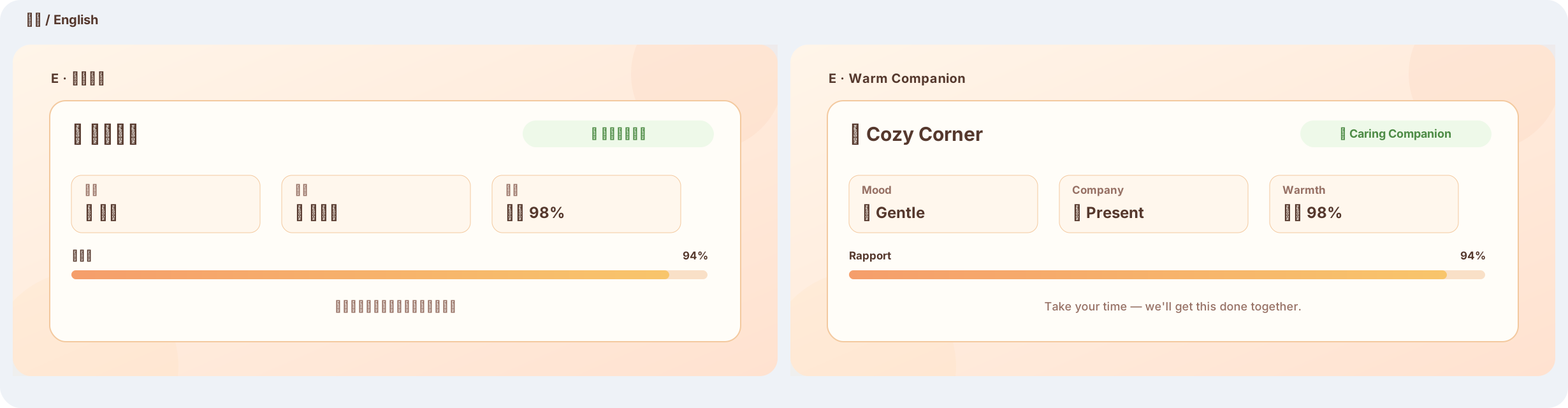
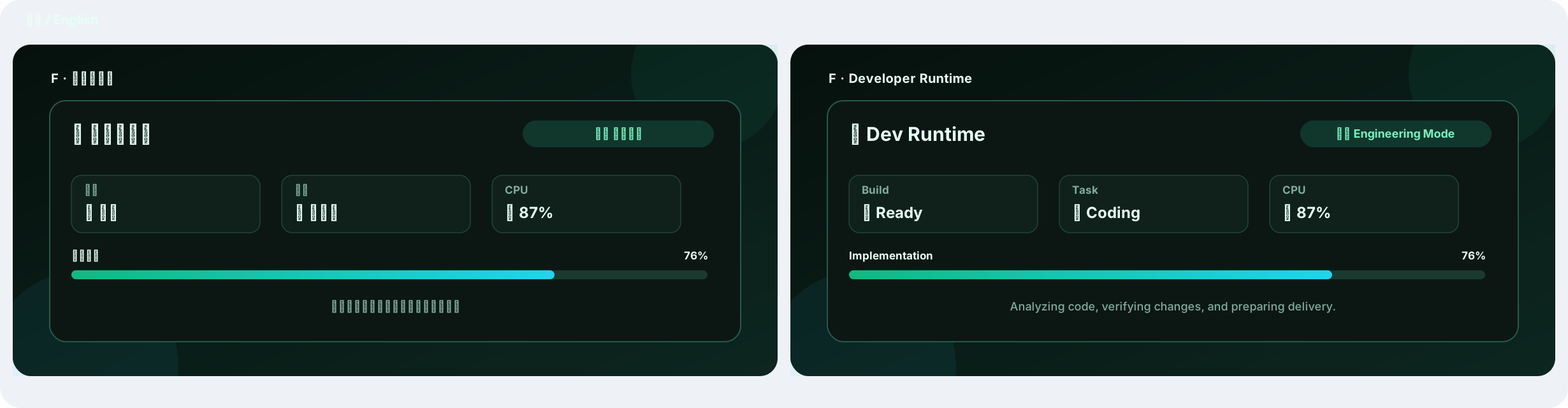
- Includes six templates: A Soft Vitality, B Minimal Focus, C Professional Work, D Neural Deck, E Warm Companion, and F Developer Runtime.
- Supports enable/disable, custom titles, and custom GenUI JSON templates.
- Provides a live settings preview and custom-template validation.
- Automatically detects the browser's preferred language: languages beginning with
zhuse Chinese for settings, built-in templates, and system-prompt injection; all other languages use English. - Limits custom templates to 64 KiB and requires a non-empty
itemsarray.
Six template previews
These images reflect the current A–F templates' structure, copy, status values, and visual intent. Cards in agent replies are rendered by GenUI using the active interface theme.
Requirements
- A DSH 0.2.x runtime whose relevant
@deepseek-ai/dsh-*packages satisfy>=0.2.0-rc.2 <0.3.0-0(including0.2.0-rc.2and0.2.1-rc.2). This is v0.3.2's declared dependency range; see the validation limits below. - Node.js satisfying
^22.19.0 || >=24.0.0andpnpmsatisfying>=11.7.0 <12available onPATH(the project specifiespnpm@11.19.0). - A runtime-compatible version of
@changfenhuang/dsh-genuiseparately installed and enabled in the profile you actually run (webfordsh web,desktopfor the desktop app). Its source repository is omdsh-dev/dsh-genui; its package name in the dsh-market plugin marketplace is@changfenhuang/dsh-genui. The previously recorded local version 0.11.3 is historical installation information, not evidence of validation across all DSH 0.2.x hosts.
This plugin's dsh.client.inject declares @changfenhuang/dsh-genui, @deepseek-ai/dsh-client-ui-settings, and @deepseek-ai/dsh-client-ui-renderer. GenUI is not automatically fetched as a pnpm dependency; it remains a separate runtime prerequisite for rendering status-card fences.
Without GenUI, the status-card formatting instruction is still injected, but
dsh-uifences in the conversation cannot render. Install and enable a GenUI version compatible with the current runtime first.
Compatibility and release status
The current recommended version is the published v0.3.2: Release v0.3.2, published on 2026-10-20, provides dsh-status-card-0.3.2.tgz. This Release does not provide a dsh-status-card.tgz alias; use the versioned asset.
- Declared dependencies: relevant DSH peerDependencies now use
>=0.2.0-rc.2 <0.3.0-0, and the removed@deepseek-ai/dsh-client-ui-slotspeerDependency has been dropped. Other peer requirements remain@deepseek-ai/cordis ~4.0.4,@deepseek-ai/schemastery ~3.18.4, andreact ^18.0.0 || ^19.0.0; see package.json for the full configuration. - Local validation: the Release notes record passing TypeScript checks and all local tests against DSH 0.2.1-rc.2 devDependencies. The earlier v0.3.1 local migration targeted 0.2.0-rc.2.
- Real-host validation: the declared range and local test results do not establish end-to-end validation across all DSH host configurations or guarantee compatibility for every DSH/GenUI combination.
The current version continues to use Config fields and ConfigForms rather than the old Settings API. GenUI must still be installed and enabled separately.
Historical fix (v0.3.1): read-only settings page
The following issues were fixed in v0.3.1, and v0.3.2 retains those fixes. This is historical context, not a list of known issues in the latest version.
- Symptom: after installation, the "Enable reply status card" checkbox and the template dropdown in the settings page were all greyed out and could not be operated.
- Root cause:
customTemplatepreviously usedz.transform. DSH projects every volatile field into a serialized form schema for the browser (the host-sideplainSchemadoesnew z(schema.toJSON())and thenform.toJSON()again); once the callback is revived throughnew Functionit no longer carriestoJSON, so the second serialization drops it entirely, the browser decode reportscallback is not a function, that namespace snapshot never reaches ready, and the page becomes read-only. - Fix 1:
customTemplateis a plainz.string()again; validation of custom JSON now happens in the settings pageparseCustomTemplatebefore saving, with a defensive fallback in the injection layer (an invalid template falls back to the bootstrap template and never breaks prompt injection). - Fix 2: the client no longer uses "decode state ready" as its editability criterion and looks only at the snapshot's
writable(always true for this entry on the host side), so a single field's decode failure can no longer lock the whole page. - Conclusion / rule: do not use
z.transformfor volatile settings fields. - Fix 3 (template spacing):
rownodes in the templates no longer carrygap. GenUI'srowschema accepts onlyitems/wrap/spacerand fixes row spacing at 12px (--dsl-g-gap-md; onlycolsupportsgap), so the previousgap: 8was silently ignored and produced an unknown-field warning. The settings-page preview now matches GenUI too:row/gridare fixed at 12px,colreads its owngap, and the spec rootgapdefaults to 16px. - Regression test: the test calls
@deepseek-ai/dsh-settings' ownvolatileForm/projectForm/plainConfigto reproduce the host projection, then decodes it the way the browser does and asserts that decoding succeeds; it also walks every built-in template and asserts that norownode carries agap.
Installations still running a version from before the fix need a plugin upgrade (v0.3.2 below is recommended), followed by restarting dsh web / the desktop app and a browser hard refresh; settings changes themselves still take effect immediately with no new conversation required.
Installation (download from the Release)
1. Install GenUI
Open the dsh-market plugin marketplace and install the package name @changfenhuang/dsh-genui; alternatively, use the command line:
dsh plugin --profile web add @changfenhuang/dsh-genui
2. Install dsh-status-card
Download dsh-status-card-0.3.2.tgz from Release v0.3.2, then install it from the download directory:
dsh plugin --profile web add ./dsh-status-card-0.3.2.tgz
The desktop app uses the profile name desktop (web for dsh web). In both the GenUI and status-card installation commands above, replace --profile to match how you run DSH, and enable both plugins in that same profile.
You can also build from the v0.3.2 tag's source. The tgz produced by pnpm pack is not guaranteed to be byte-identical to the Release asset: checkout line-ending settings, Node/pnpm versions, and platforms can affect the result. The earlier byte-for-byte re-verification of v0.3.1 is not a validation result for v0.3.2.
git clone https://github.com/liqiming-whu/dsh-status-card.git
cd dsh-status-card
git checkout v0.3.2
pnpm install
pnpm pack
dsh plugin --profile web add ./dsh-status-card-0.3.2.tgz
Restart dsh web or the desktop app after installation and hard-refresh the browser page.
Historical versions
v0.3.1 is the historical version targeting DSH 0.2.0-rc.2 and includes the settings-page fixes described above; earlier versions such as v0.2.1 also remain in the repository. Install v0.3.2 as the current recommendation. Consult Releases for the historical assets actually available.
Usage
Open Settings → Status Card to enable the card, change its title, select template A–F, edit strict custom GenUI JSON, and inspect the live preview before saving.
The browser reads navigator.languages (falling back to navigator.language) and writes the detected locale to the plugin Config. Preferred languages beginning with zh select Chinese; every other language selects English. The settings UI switches immediately, and the matching system prompt and templates are used for subsequent model requests.
The Client uses ConfigForms from @deepseek-ai/dsh-client-ui-settings/client and retrieves the form through ctx.configForms.get('status-card'). Settings are persisted in the profile patch by plugin entry id, not in an independent Settings namespace.
Settings changes and synchronized browser-locale changes take effect immediately on subsequent model requests, including in existing conversations; no new conversation is required. Installing the plugin still requires restarting dsh web or the desktop app and hard-refreshing the browser. Previously generated replies are not changed retroactively.
Injection design
The plugin registers a system-prompt section through ctx.systemPrompt.section(). Every user-setting field in Config is marked .volatile(). During each prompt assembly, the Host reads current values through entry.field.get() (field stands for the relevant setting field) and builds the status-card instruction instead of caching an installation-time configuration snapshot. sectionOrder remains a plain number rather than a volatile setting field.
0.2.0-rc.2 API migration
- Remove the old
installSettingsSection,settingsNamespace, andsettingsScope; manage settings through Config / ConfigForms. - Replace the old
dsh-client-runtime/web-reactusage: the Client Context type comes from@deepseek-ai/cordis(peer~4.0.4), and the type-only importimport type {} from '@deepseek-ai/dsh-client-ui-renderer/client'provides slots Service declaration augmentation. Do not use a side-effect import, which would leave a prohibited cross-plugin runtime require in the browser bundle. - The
ConfigFormtype comes from@deepseek-ai/dsh-client-ui-settings/client. The migration originally targeted0.2.0-rc.2; v0.3.2 uses the DSH peer range>=0.2.0-rc.2 <0.3.0-0and pins the corresponding devDependencies to0.2.1-rc.2.
It does not call agent.inject(), register systemPrompt.context(), or append user/message / assistant/message events, so the formatting instruction does not accumulate in conversation history.
Development and tests
git clone https://github.com/liqiming-whu/dsh-status-card.git
cd dsh-status-card
pnpm install
pnpm run check
pnpm pack
Tests cover non-history prompt injection, the Web settings bundle, the host projection and browser decode regression for volatile fields (volatileForm / projectForm / plainConfig), templates A–F, custom JSON validation, client-bundle purity, and Host/browser builds.
Preview note
The settings preview is implemented locally rather than importing GenUI client values across plugin boundaries, preserving DSH client-bundle purity. Real conversation dsh-ui fences are rendered by GenUI.
License
Related plugins
dsh-web(原 dsh-web-ui)
 zhu1090093659
/dsh-web-ui
dsh-web(原 dsh-web-ui):任务看板、git 图、右侧面板、远程移动端 UI、桌宠、实时 token 统计与皮肤中心的全家桶。仓库已更名 zhu1090093659/dsh-web,根目录声明 dsh.bundle.patch,支持根 Git 入口安装。
dsh plugin --profile web add github:zhu1090093659/dsh-webdsh-web-all 聚合包(原 dsh-web-ui-all)
zhu1090093659zhu1090093659/dsh-web-ui/packages/dsh-web-ui-all
旧整包路径 packages/dsh-web-ui-all 已随仓库更名 dsh-web 迁移:现聚合目录为 packages/dsh-web-all,npm 聚合包 @linxin666/dsh-web-all。与总仓根 Git 入口是同一产品的两种整包方式,不重复计数。
dsh plugin --profile web add @linxin666/dsh-web-all@latestdsh-TUI
 ccch1mneyyy
/dsh-TUI
Claude Code 风格全屏终端 UI:像素鲸鱼顶栏、实时工作状态行、思考流式展开。
dsh plugin --profile web add github:ccch1mneyyy/dsh-TUIdsh-cc-tui
ccch1mneyyyccch1mneyyy/dsh-cc-tui
一个美观且实用的 Claude Code 风格 TUI 插件:像素鲸鱼顶栏、双流光大字、实时工作状态行、思考流式展开、双击 Esc 时间回溯、蓝白上下文进度条 + TPS 仪表。 零核心改动,纯插件挂载。安装插件即可启用,卸载后不会留下核心补丁。 献给钟爱tui的各位极客们 A beautiful, practical Claude…
dsh plugin --profile web add github:ccch1mneyyy/dsh-cc-tuideepseek-balance-whale-widget
 meteornox
/deepseek-balance-whale-widget
DSH 小鲸鱼余额挂件(DeepSeek Balance Whale Widget)
dsh plugin --profile web add github:meteornox/deepseek-balance-whale-widgetDSH-better-sidebar
 omdsh-dev
/DSH-better-sidebar
侧边栏完整工作台:内置文件渲染编辑、终端、Git 与子代理,支持三方插件注册新 Tab。
dsh plugin --profile web add github:omdsh-dev/DSH-better-sidebar