
Plugin Markets & Managers
dsh-plugin-manager
nonentity303/dsh-plugin-manager · ★ 12
 nonentity303Curated
Plugin manager with a rescue center: grouped enable/disable by necessity, multi update sources (npm / dshfind market / GitHub), browser-first downloads with an auto-install folder, P2P fallback, pre-boot self-check and broken-bundle quarantine.
Manifest details
安装
dsh plugin --profile web add github:nonentity303/dsh-plugin-managerGitHub 源码安装:首次需按提示配置 allowBuilds 构建授权后重试
For install and environment setup, plus plugin development tutorials, see DSH community docs ↗
README
Table of contents
- 🧭 Why this manager exists: the official page does the basics, this one covers the rest
- Capability comparison
- "Why the old manager died" — and why this one is alive
- ✨ Highlights
- 📋 Feature overview (v0.9.1)
- Plugin page (sidebar "Plugin manager")
- Plugin list
- Transactional uninstall, history and scenarios
- Updates and downloads
- Market
- Rescue
- 🧰 Standalone rescue toolchain
- Requirements
- Engine compatibility matrix (engine × manager)
- 🔐 Permissions and data scope
- Install
- Why dsh plugin --profile web add and not npm install in the directory?
- Rescue quick reference
- How it works
- Development and tests
- FAQ
- License
- 中文
A local plugin manager for DeepSeek Harness (DSH): a standalone plugin page (visual plugin management) plus a standalone brick-rescue toolchain.



Community plugin — not an official DSH package. npm:
dsh-plugin-manager-pro· GitHub: nonentity303/dsh-plugin-manager · Cross-platform (Windows / macOS / Linux).Published release 0.9.1 (npm
latest); the repo'spackage.jsonversionis now0.9.1-rc2— a pre-release shipped under thenextdist-tag (npm i dsh-plugin-manager-pro@next) that does not movelatest; the previous published release is 0.9.0 (npm + GitHub Releases, 2026-09-30). Check what is published any time withnpm view dsh-plugin-manager-pro version; tags: https://github.com/nonentity303/dsh-plugin-manager/tags. ⚠️ A brand-new release is blocked by pnpm's 24 h cool-down (minimumReleaseAge) — pin the version explicitly if it does not install (see "Install" below).
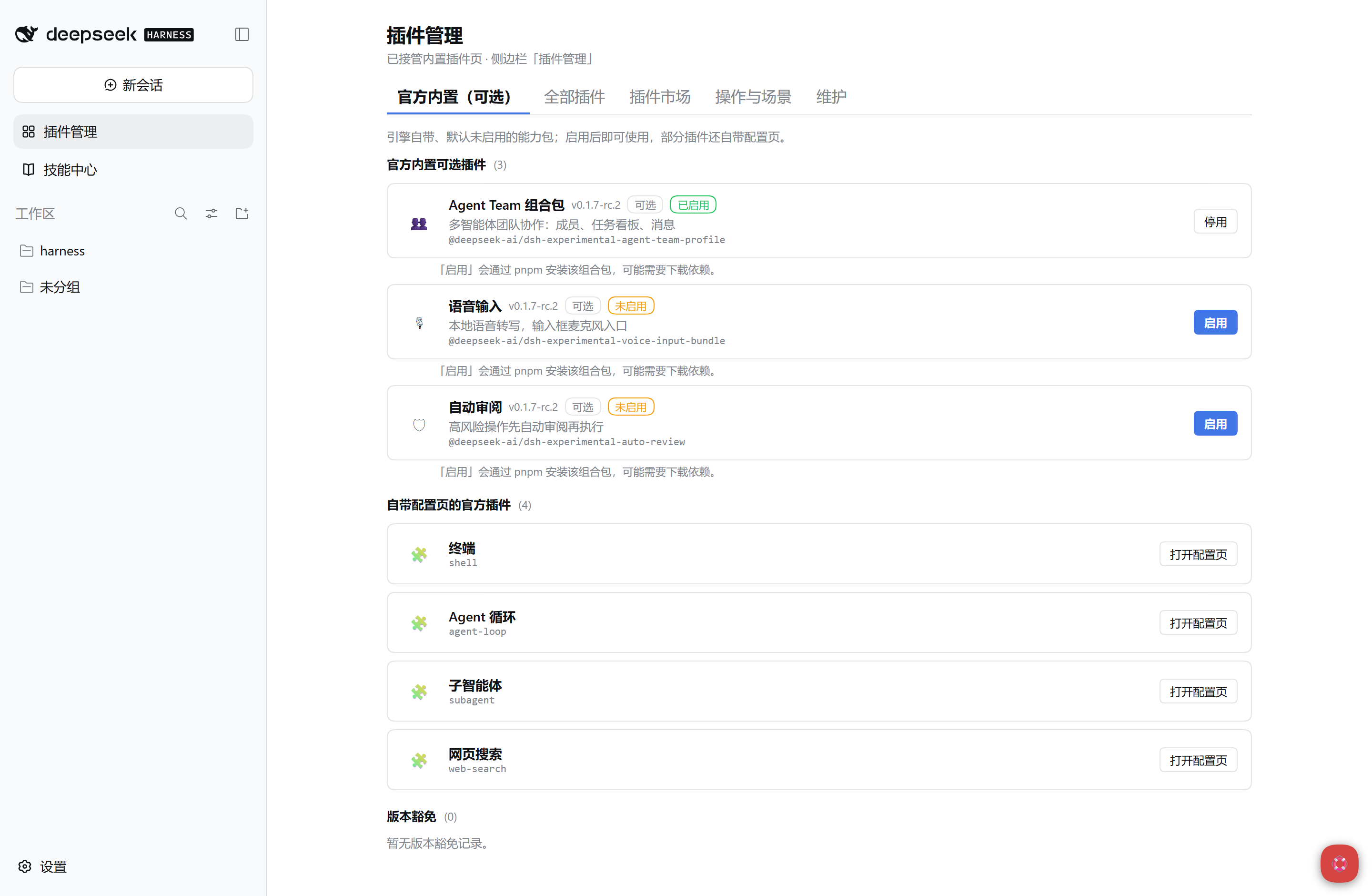
Figure 1 · the 0.9 standalone plugin page (captured in an isolated rehearsal environment on DSH 0.1.7-rc.2, 2026-09-28): the sidebar entry "Plugin manager" and the five section tabs — Official built-ins (optional) · All plugins · Market · Operations & scenarios · Maintenance. Source image: docs/images/pm-090-official2.png.
🧭 Why this manager exists: the official page does the basics, this one covers the rest
Since DSH 0.1.6 the plugin manager is part of the engine itself: a host service @deepseek-ai/dsh-plugin-manager (a new id: plugin-manager row in the dsh-base bundle) plus a client page @deepseek-ai/dsh-client-ui-plugin-manager.¹³
This manager is not "one more plugin list". It takes over that page and adds what the official one does not do: a complete install/uninstall loop (impact preview → transactional uninstall → rollback on failure → one-click undo), operation history and named scenarios, and rescue when the engine itself will not start.
Capability comparison
| Capability | Official built-in page (DSH 0.1.7) | LX2000WASD/dsh-web-plugin-manager (discontinued) | This manager (0.9.1) |
|---|---|---|---|
| Starts on DSH 0.1.7 | ✅ shipped with the engine | ❌ breaks the profile since 0.1.6 (loader entry id collision)¹ | ✅ verified on 0.1.7-rc.2: rehearsal + clean-environment install⁴ |
| Transactional uninstall (impact preview → backup → remove → pre-boot self-check → rollback) | ❌ only bundle layer add/remove (installBundle / removeBundle); no preview, no undo³ |
⚠️ can uninstall (incl. bundles) but not transactionally: failures only say "restart to take effect", recovery means editing cordis.patch.yml by hand¹ |
✅ full loop, plus one-click undo⁴ |
| Automatic rollback | ⚠️ restores profile files when a bundle install/remove fails³ | ⚠️ quality gate + rollback for install/update; none for uninstall¹ | ✅ rollback on uninstall and on "auto-install from the downloads folder"⁴ |
| Standalone rescue (works when the engine is down) | ❌ the rescue page is served by the engine, so it dies with it⁵ | ❌ no standalone daemon/launcher; its own "known limitations" say the auto-restart chain can hang and needs manual recovery¹ | ✅ 3081 launcher + 3082 rescue service, independent of the main process⁴ |
| Operation history / undo | ❌ | ❌ not in its feature list or CLI¹ | ✅ last 20 operations, one-click undo⁴ |
| GitHub Releases | — (released with the engine) | 0 | 11 (incl. v0.9.0 with a tgz asset)² |
Sources (each one verifiable):
- Competitor README (announcement + feature list + known limitations + CLI): https://raw.githubusercontent.com/LX2000WASD/dsh-web-plugin-manager/master/README.md (mirror if raw is unreachable: https://cdn.jsdelivr.net/gh/LX2000WASD/dsh-web-plugin-manager@master/README.md) · repo https://github.com/LX2000WASD/dsh-web-plugin-manager. It contains
TypeError: duplicate loader entry id: plugin-managerand "do not install on 0.1.6-alpha.2 or later". - GitHub API, measured 2026-10-03: competitor
releases→[](https://api.github.com/repos/LX2000WASD/dsh-web-plugin-manager/releases); this repo → 11 releases, latestv0.9.0(2026-09-30) with assetdsh-plugin-manager-pro-0.9.0.tgz(https://api.github.com/repos/nonentity303/dsh-plugin-manager/releases). - Official page capability surface (0.1.7-rc.2) = the 12 remote methods of
@deepseek-ai/dsh-plugin-manager:listPlugins/listBundles/registries/inspect/setPluginEnabled/setBundleEnabled/installBundle/waitForInstall/cancelInstall/removeBundle/listVersionExemptions/setVersionExemption(https://www.npmjs.com/package/@deepseek-ai/dsh-plugin-manager); the page itself is https://www.npmjs.com/package/@deepseek-ai/dsh-client-ui-plugin-manager. There are no impact preview, history/undo, scenarios or rescue methods. - This repository:
cordis.patch.yml(disable the built-in page, insert our own row id),lib/index.js(uninstall transaction, history, sidecar),bin/rescue-daemon.mjs·bin/open-boot.mjs·bin/dsh-boot.mjs(matchingpackage.jsonbin); 0.1.7-rc.2 evidence indocs/releases/RELEASE_NOTES_0.8.3-1.mdanddocs/releases/0.9.0.md. /rescueis registered by our host code through the engine'swebServer— hence it dies with the engine. That is exactly why the standalone services exist (bin/rescue-daemon.mjsheader, docs/ARCHITECTURE.md).
"Why the old manager died" — and why this one is alive
Since DSH 0.1.6 a third-party manager hits the same wall: declare a loader entry id that the official bundle already uses and the profile crashes on startup:
TypeError: duplicate loader entry id: plugin-manager
The leading competitor LX2000WASD/dsh-web-plugin-manager (measured 2026-10-03: 68 stars / 3 forks / last push 2026-09-20 / 0 releases) left the field that way: in 2026-09 it announced end-of-maintenance on its README front page ("for DSH <= 0.1.5-rc.2", "do not install on 0.1.6-alpha.2 or later").¹
This manager hit the same pit and survived — by not fighting over the id:
| What it does | Where |
|---|---|
① Disable the built-in page row: - id: ui-plugin-manager / disabled: true |
cordis.patch.yml (in the package) |
② Insert its own row with its own id plugin-manager-pro — never the official plugin-manager |
cordis.patch.yml |
③ Register into main (key=plugins) and sidebar.panellist (id=plugins) and declare the 7 plugins.* child slots the built-in page used to own (so third-party config cards have a real home) |
src/client.jsx |
Verified on DSH 0.1.7-rc.2: the engine boots cleanly, the sidebar shows "Plugin manager" and all five sections — that is Figure 1.
Which version should I install? DSH 0.1.6 or later → 0.9.1 (to try the pre-release:
npm i dsh-plugin-manager-pro@next= 0.9.1-rc2, shipped under thenextdist-tag, does not movelatest); old engines (before 0.1.6) → 0.8.2. Full matrix under "Requirements".
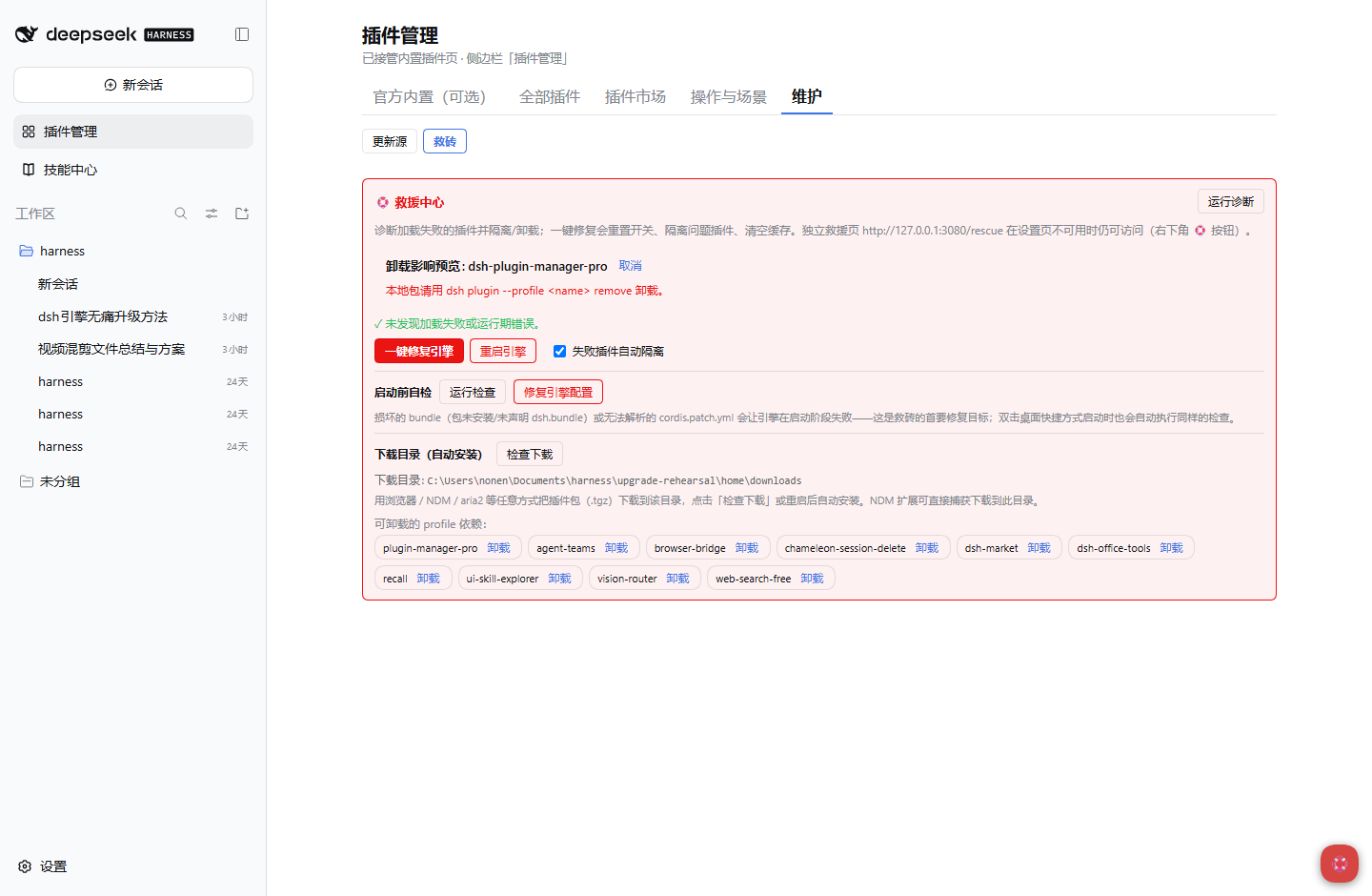
Figure 2 · the impact preview of a transactional uninstall (rehearsal environment, 2026-09-28): what will be removed and what is affected, before package.json is touched; the same "diagnostics" card also carries the rescue entries (Repair engine / Restart engine / Pre-boot self-check / auto-quarantine failing plugins). Source image: docs/images/pm4-uninstall-preview.png.
✨ Highlights
- Standalone plugin page (v0.9.0): a first-level sidebar entry "Plugin manager" instead of a tab inside Settings — see plugins, install, configure, uninstall and rescue on one page, in five sections: Official built-ins (optional) · All plugins · Market · Operations & scenarios · Maintenance.
- Third-party config entries have a home (v0.9.0): after taking over the built-in page, plugin-registered config cards still work — one summary line in the row, and the plugin's own full config card when expanded.
- Transactional uninstall (v0.8): impact preview (dependents / entries / toggle rows) → backup → remove → pre-boot self-check → automatic rollback on failure; one-click undo afterwards.
- Operation history + scenarios (v0.8): the last 20 operations are undoable; save a plugin combination as a named scenario and switch with a change preview.
- Rescue decoupled from the engine (v0.7+): with the engine down, the 3081 launcher (with a built-in rescue page) and the 3082 rescue service still self-check, repair and start it.
- Browser as launcher: set your home page to
http://127.0.0.1:3081/(http://localhost:3081/works the same way) — opening the browser runs self-check → repair → start → jumps to the main UI. - Local write endpoints are guarded (v0.9.1): same-origin
Origin(same-host, same-port allowlist:127.0.0.1/localhost/[::1]) + one-time token + single-flight, so a third-party page cannot start/stop anything;--statusalso appends ahealth.logline (7 days / 1000 lines). - Multi-source update aggregation: npm registry / dshfind / GitHub / custom mirrors queried in parallel, with rate-limit circuit breaking and the highest version winning.
📋 Feature overview (v0.9.1)
Plugin page (sidebar "Plugin manager")
Five sections, switching keeps your scroll position:
| Section | Contents |
|---|---|
| Official built-ins (optional) | Engine-provided bundles that are disabled by default (one-click enable/disable) + official plugins with their own config page + version exemptions |
| All plugins | Plugin list: search, collapsible groups, origin filter, enable/disable, inline config, inline uninstall, version & origin, manual origin override |
| Market | dshfind curated catalog (browse by category / search / sort), one-click install; falls back to GitHub search when offline |
| Operations & scenarios | Transactional uninstall with impact preview, pre-uninstall health check, operation history undo, scenarios |
| Maintenance | Update sources, pre-boot self-check, rescue center entries, downloads folder |
Plugin list
- Collapsible groups by necessity (🔴 required / 🟡 recommended / 🟢 optional) with enable counters and update badges; search expands automatically.
- Origin classification: built into the architecture vs user-installed (
dsh plugin add/ market), with filter chips and row badges. - Manual origin override per row (npm / GitHub / local / built-in), persisted.
- Status at a glance: 🔴 error/needs attention · 🟡 update available · ⚪ disabled · 🟢 enabled, plus name, summary, necessity, installed→latest version, origin and a toggle.
- Automatic one-line summaries from a built-in catalog, or from
README.zh.md/package.json.description/README.md. - Architecture protection: rows the web layer deliberately disables (e.g.
tool-fs) and UI skeleton plugins cannot be toggled (🔒 with a reason). - Third-party config cards (v0.9.0): entries registered through
plugins.row.config(per row) andplugins.bundle.config(per bundle) are rendered inline; plugins without a config registration get no empty button.
Transactional uninstall, history and scenarios
- Impact preview: dependents (reverse
dependencies/peerDependenciesgraph), entries to be removed, toggle rows to be cleaned, bundle declarations. - Pre-uninstall health check (v0.9.1): a verdict line (safe / caution / risky + one-line reason) and three checks — ① broken dependencies (high for
dependencies/peerDependencies, info for optional/recommended; downgraded when the dependent is itself depended on) ② patch residue incordis.patch.yml(report only — never auto-deleted) ③ service / port conflicts (dsh.services/service/provides/ports). - The transaction: back up
package.json+cordis.patch.yml(.rescue-bak-*) →pnpm remove+ drop bundles/toggle rows → run the pre-boot self-check → roll back on any failure (restore backups + reinstall dependencies). Directories locked by Windows are queued inpendingRemovalsand retried on the next start. - Before uninstalling the manager itself, the package's own
bin/open-boot.mjs --uninstallis called first (older versions have no such flag → recorded as "skipped", never blocking). - Operation history: the last 20 operations (uninstall / toggle / quarantine / scenario / reset), one-click undo, persisted across restarts.
- Scenarios: save the current enable/disable state under a name and apply it later, with a change preview first.
Updates and downloads
- Parallel multi-source lookups; highest version wins, ties picked at random.
- Circuit breaking: GitHub API 403/429 cools down for 10 minutes; full refresh runs 8 concurrent queries and results are cached for 30 minutes (a cache hit returns instantly; refresh duration depends on your network and the number of enabled sources).
- Download order: ① native browser download (hidden iframe, capturable by download managers) → ② external downloader → ③ built-in fallback (HTTP / aria2c / P2P magnet·torrent).
- Auto-install from the downloads folder: drop
.tgz/.tar.gzinto$DSH_HOME\downloads; manifest validation + pre-boot self-check, rollback on failure and a.failedstamp so it is not retried forever.
Market
- Catalog endpoint
https://the community catalog/plugins.json(CATALOG_URLinlib/index.js) with localized descriptions / stars / categories; entry count changes upstream; 10-minute host cache. Falls back to GitHubtopic:dsh-pluginsearch when offline. - Zero round-trips: the catalog is fetched once; search / category chips / sort / paging happen client-side.
- One-click install: npm-backed entries install straight from the registry; GitHub repos go through the built-in downloader; two-step confirmation; ✓ badge when installed.
- Post-install validation:
dsh.bundle/dsh.clientmanifests are verified and rolled back if broken; pnpm hoist drift andminimumReleaseAgetraps are recovered automatically.
Rescue
- Standalone rescue page
/rescue: self-contained HTML that talks straight to the host gateway, usable even when the UI is broken (diagnose / quarantine / repair / restart / uninstall). - Floating rescue button (🛟, bottom right) as an entry point when the settings page is broken.
- Auto-quarantine: optional (off by default) and only for plugins that fail repeatedly; UI skeleton and infrastructure entries are protected and never disabled automatically.
- Pre-boot self-check:
verifyProfile/fixProfile— broken bundles can take the engine down at boot; one-click check and quarantine repair. - Runtime quarantine: when a plugin is incompatible with the engine, the loader can take the whole tree down (a static check cannot see it) — open-boot / rescue-daemon / dsh-boot parse the boot log, quarantine the failing entry and retry; quarantine rows are backed up and reversible.
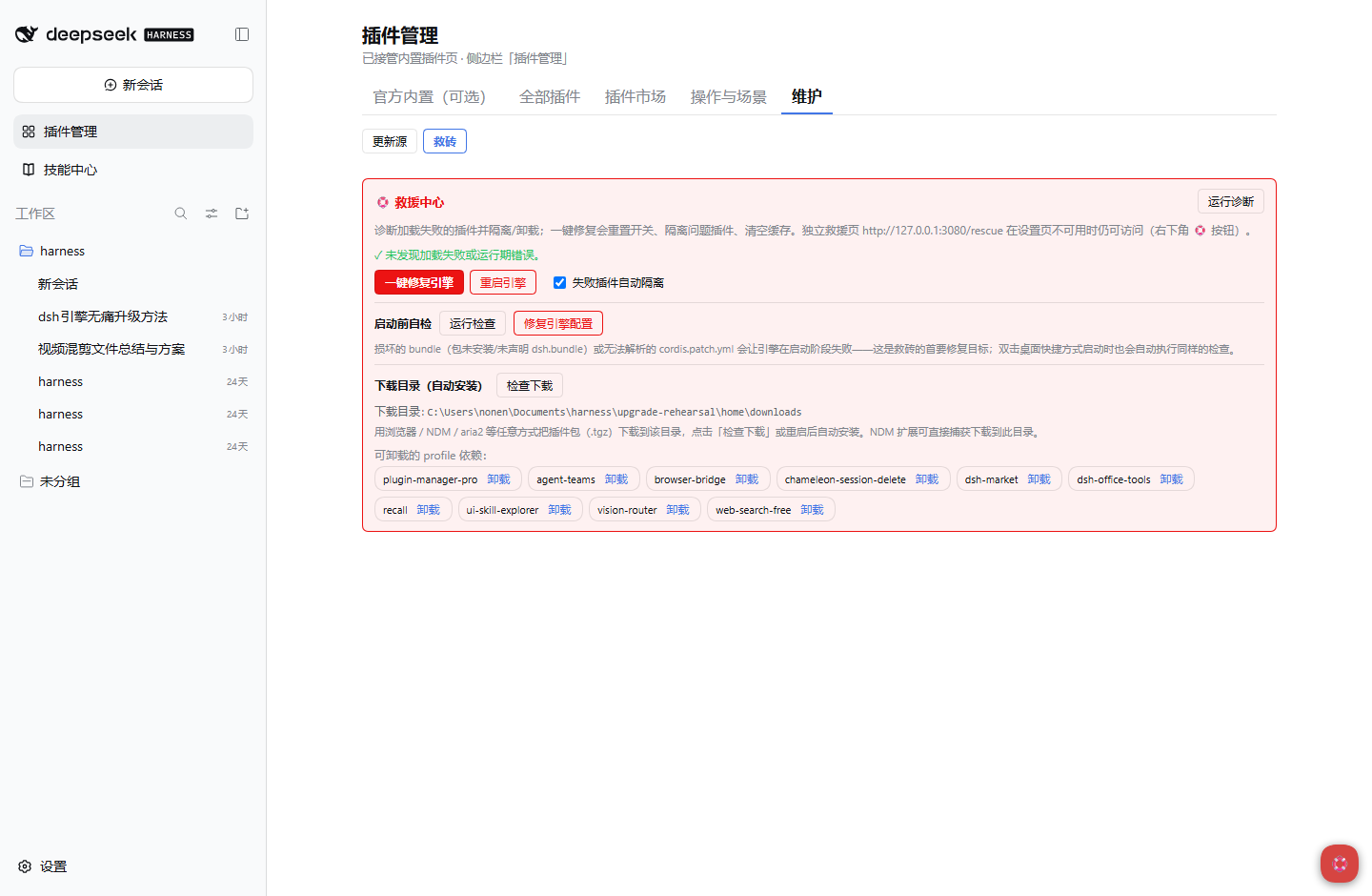
Figure 3 · the rescue side (same rehearsal environment, 2026-09-28): the "diagnostics" card in Maintenance with Repair engine, Restart engine, Pre-boot self-check, auto-quarantine failing plugins, and the list of uninstallable profile dependencies. Source image: docs/images/pm-maintenance-rescue.png.
🧰 Standalone rescue toolchain
A classic rescue page is registered by the engine — when the engine is down, so is the rescue page. Since v0.7 the rescue capability runs independently of the main process. No new dependencies (plain Node + the existing
yaml).
| Tool | What it does | Usage |
|---|---|---|
bin/open-boot.mjs |
The single web entry + resident supervisor (3081): / is the "open the browser and it starts" page, /rescue is the rescue page (with /rescue/api/*). Set it as your home page (127.0.0.1 / localhost / [::1] are equivalent as long as the port matches). It stays hidden and only pops a visible progress window when the engine really needs starting (--no-window disables that). Health = HTTP handshake + identity fingerprint; write endpoints are guarded by Origin + one-time token; --uninstall cleans everything (stop supervisor → remove autostart → remove shims → clear pid; exit codes 0 = completed / 1 = error / 2 = ownership unconfirmed — nothing stopped, pid file kept) |
npx dsh-pm-launcher |
bin/rescue-daemon.mjs |
Independent backup rescue service (default port 3082): self-contained rescue page + verify/fix/start/stop/status API, no engine dependency. stop first verifies pid and port ownership ({"force":true} to force). No longer competes with the 3081 launcher (an occupied port is a hard error, never a silent port shift) |
npx dsh-pm-rescue |
bin/dsh-boot.mjs / .cmd |
Steam-style boot sequence: verify → auto-quarantine broken plugins → start → wait for health. --repair-only (self-check + repair only, no start), --pause, --help; exit codes 0 = ready / 1 = failed to start / 2 = repair incomplete. Immediate failures (bad command, port conflict) return at once with the absolute log path |
npx dsh-pm-boot (double-clickable equivalent on Windows: bin\dsh-boot.cmd inside the package) |
Resident launcher and autostart
| Command | Effect |
|---|---|
npx dsh-pm-launcher --supervise [--interval 60] [--heartbeat-min 10] |
Resident supervisor: quietly keeps 3081 alive; a lock port (port+1000) guarantees a single instance; only a failed HTTP handshake triggers a start — healthy instances are never killed. Writes four kinds of log lines (state change / heartbeat / exit / uncaught exception) to profile/open-boot-supervisor.log |
npx dsh-pm-launcher --ensure |
One-shot: make sure the port has this launcher (exit 0/1) |
npx dsh-pm-launcher --status |
Status self-check + health trail: launcher (handshake + identity) / supervisor (lock port ownership) / engine (3080 handshake) / pid file / cwd / logs and last heartbeat; exit 0 = launcher healthy. Reports the occupying pid when the port belongs to someone else. Appends a health.log line every run (7 days / 1000 lines kept) |
npx dsh-pm-launcher --install-autostart |
Install autostart (Windows): writes HKCU\...\Run\DSHWebFront plus open-boot-autostart.vbs (silent resident on login) and open-boot-ui.vbs (ensure 3081 then open the browser). The wrapper scripts are pure ASCII and self-resolve their path, so non-ASCII user names or profile paths with spaces no longer break |
npx dsh-pm-launcher --uninstall-autostart / --autostart-status |
Remove / inspect autostart (shim presence, supervisor liveness, whether the port is this launcher). Idempotent (exit 0) when nothing is installed |
npx dsh-pm-launcher --uninstall |
Uninstall loop (R13): stop this profile's supervisor (three-fold ownership check: pid file + lock port port+1000 + process image; refuses and never touches other processes) → delete all DSHWeb* Run values (including the legacy DSHWebRescue) → delete both .vbs shims → clear .open-boot.pid (logs kept). Exit codes: 0 = completed (including a confirmed "nothing to clean") / 1 = error / 2 = ownership unconfirmed (netstat/tasklist probes unavailable: no process stopped, pid file kept, never reports "uninstall complete"). Still idempotent; the engine on 3080 is left alone. The manager calls it before uninstalling itself |
npx dsh-pm-launcher --help / npx dsh-pm-boot --help |
Show usage (unknown flags are reported, not silently ignored) |
After installation the three commands come from the bin field of package.json (dsh-pm-launcher / dsh-pm-boot / dsh-pm-rescue). npx works without installing, and you can always run the file inside the package (path is independent of cwd):
node "$DSH_HOME/profiles/web/node_modules/dsh-plugin-manager-pro/bin/open-boot.mjs" --status
- Shared modules:
lib/preflight.mjs(standalone self-check/repair, same logic as the host'sverifyProfile/fixProfile),lib/enginectl.mjs(engine probing/start/stop/pid management + the write-endpoint guards). - Troubleshooting: engine will not start → ① open
http://127.0.0.1:3081/(http://localhost:3081/is equivalent) → "check → repair → start"; ②npx dsh-pm-boot --repair-onlyto see the quarantine list; ③npx dsh-pm-launcher --statusfor the real state of launcher/supervisor/engine plus the lasthealth.logline; ④ interactive start withnpx dsh-pm-boot. - Full command/exit-code tables, the four
--uninstallsteps and a troubleshooting table: docs/LAUNCHER.md. Architecture and slot contract: docs/ARCHITECTURE.md.
Health semantics and the safety of "stop engine": ready = HTTP handshake succeeded and the response carries a DSH identity fingerprint (a bare TCP listener is never considered healthy). So when 3080, 3081 or 3082 is occupied by something else, the tools fail loudly instead of pretending to be ready and never shift ports silently.
stopEngine()runs three checks first (pid alive / process image is node·dsh / the port owner matches the recorded pid) and refuses otherwise, explaining why on the rescue page (a "force stop" button — orPOST /api/stop {"force":true}— is available there). Pid files:.rescue-daemon.pid(engine) and.open-boot.pid(launcher), both JSON.Working directory: the engine and launcher use a stable cwd (your home directory by default; override with
--cwd <dir>orDSH_ENGINE_CWD). Early versions put the cwd inside the package, which locked the directory during self-update/uninstall (ERR_PNPM_EPERM).
Requirements
- Windows 10/11 · macOS · Linux (
/rescueand the three CLI tools are cross-platform;--install-autostartis Windows-only, on macOS/Linux use--supervisewith your own service manager). - Node.js ≥ 18 · DeepSeek Harness
dsh(global or via npx) ·pnpm(required bydsh pluginand the update features).engines.nodeinpackage.jsonis the only statement of record (currently>=18.0.0). Note: 0.9.1 fails to load on Node 18/20 (a top-level named import ofnode:module'sfindPackageJSON, which only exists since Node 22.14 → link-timeSyntaxError, the whole plugin never loads); on Node 18/20 use 0.9.1-rc2 or newer — it uses a namespace import + runtime feature detection + a fallback resolver, guarded by the static gatenode tools/dev/compat-scan.mjs --root .(measured on this version:blocker=0, exit 0; on the published 0.9.1 tarball:blocker=1).
- The engine version decides which manager version you install (table below) — installing the wrong one means no plugin page, or a profile that will not start.
Engine compatibility matrix (engine × manager)
| Your DSH engine | Manager version | Status | Verified | Notes / sources |
|---|---|---|---|---|
| 0.1.7-rc.2 | 0.9.1 (published) · 0.9.1-rc2 (pre-release, next dist-tag) |
✅ works | 0.9.0: 2026-09-28 rehearsal + clean-environment install; 0.9.1: all four test suites green; 0.9.1-rc2 (pre-release): launcher suite independently verified 448 checks / 418 OK / 30 SKIP(env) / 0 FAIL, exit 0 (2026-10-07; all 30 SKIPs are sandbox boundaries, not product failures); static compat gate compat-scan on the candidate tarball exit 0 / blocker 0 (the published 0.9.1 tarball reports blocker 1 / exit 2); it also carries the performance fixes (client bundle 792,931 → 255,903 B, host hot-snapshot median 18.8 → 1.1 ms); the count of record is the output of node test-launcher.mjs --strict (it moves with the tree) |
Isolated rehearsal environment (separate DSH_HOME + ports): engine boots cleanly, sidebar "Plugin manager", all five sections (Figures 1–3 come from it). Sources: docs/releases/0.9.0.md, docs/releases/0.9.0-verify.md, docs/releases/RELEASE_NOTES_0.8.3-1.md, docs/RELEASING.md |
| 0.1.6 and later (incl. 0.1.6-alpha.2) | 0.9.1 (recommended) / 0.9.1-rc2 (pre-release) | ✅ recommended (takes over the built-in page) | 0.1.7-rc.2 verified; 0.1.6-alpha.x not tested individually | The official page became part of the engine in 0.1.6; the ui-plugin-manager row our cordis.patch.yml disables is exactly that page (@deepseek-ai/dsh-client-ui-plugin-manager) |
| 0.1.0-rc.6 ~ 0.1.5 (engines before 0.1.6) | 0.8.2 | ✅ works (legacy "Settings → Plugins" tab) | 0.8.2 released 2026-09-04; the pre-upgrade baseline on this machine was engine 0.1.1-rc.2 + 0.8.x | 0.8.x and 0.9 are two different clients (docs/releases/0.9.0.md ⑤); the 0.1.5 line was not tested individually |
| 0.1.7-rc.2 | 0.8.2 / early 0.8.3 builds | ❌ plugin never activates | measured in the 2026-09-28 rehearsal | Two independent causes: ① since 0.1.7 the typert strict codec must provide a create() factory; ② dsh.client.inject referenced @deepseek-ai/dsh-client-runtime, removed in 0.1.7. Fixed in 0.8.3-1 and 0.9.x |
| 0.1.6 and later | any third-party manager that declares the same loader entry id (e.g. LX2000WASD 0.6.x) | ❌ profile will not start | competitor announcement, 2026-09 | TypeError: duplicate loader entry id: plugin-manager (the official dsh-base row id is plugin-manager); this manager uses its own id plugin-manager-pro |
| Already on 0.9.x with an engine before 0.1.6 | rollback: dsh plugin --profile web add dsh-plugin-manager-pro@0.8.2 |
⚠️ recovery path | — | see the rollback command under "Install" |
One line: newer engines want 0.9.1; only very old engines (before 0.1.6) need 0.8.2. The 0.1.6 boundary is the only certain one; the transitional 0.1.6-alpha.x versions were not tested individually. On Node 18/20 (or to try the pre-release) install
0.9.1-rc2:npm i dsh-plugin-manager-pro@next— 0.9.1 fails to load on Node 18/20, which is the first blocker this pre-release fixes (seedocs/releases/0.9.1-rc2.md). The "verified" records come from the rehearsal environment, the clean-environment install report and the real-machine install archive (docs/releases/0.9.0-verify.md; developer workspaceupgrade-rehearsal/,audit/install-090/— the latter two are not part of the npm package). The process is repeated for every engine patch release perdocs/RELEASING.md.
🔐 Permissions and data scope
What does it actually touch? Everything it reads or writes stays inside your local profile directory and the update sources you configure: no account, no cloud, no telemetry. Every write is preceded by a
.rescue-bak-*backup and goes through an atomic "temp file + rename".
| Data | Purpose | Leaves the machine? |
|---|---|---|
~/.dsh/profiles/<name>/package.json |
read the installed plugin list (dependencies / dsh.bundle / dsh.client); written back by install/uninstall/scenario operations (backed up first) |
No |
~/.dsh/profiles/<name>/cordis.patch.yml |
read/write enable-state and quarantine rows (only rows carrying the Managed by dsh-plugin-manager-pro marker; backed up first) |
No |
~/.dsh/profiles/<name>/plugin-manager.json (sidecar) |
operation history (last 20), scenarios, manual origin overrides, pending removals, update-source config | No |
~/.dsh/profiles/<name>/node_modules/** |
read the dependency graph and package summaries; uninstall/quarantine deletes package directories via pnpm (Windows file locks are queued for the next start) |
No (pnpm talks to the registry during install/uninstall) |
~/.dsh/profiles/<name>/vendor/downloads/*.tgz |
archive staging for browser downloads; archives still referenced by dependencies are never deleted | No |
$DSH_HOME/downloads/* |
"auto-install from the downloads folder" scans archives and writes .installed / .failed stamps |
No |
Local npm global root (Windows %APPDATA%\npm, macOS/Linux npm root -g and common paths) |
read-only: locate the engine-provided @deepseek-ai/* packages and extract plugin summaries |
No |
Update sources: npm registry (registry.npmjs.org by default), dshfind, GitHub, mirrors you add (e.g. registry.npmmirror.com) |
query versions and download archives | Queries only (GET metadata / archives) — no local data is uploaded |
GitHub API: api.github.com, raw.githubusercontent.com, codeload.github.com |
read releases and repository package.json, download tgz |
same |
Catalog the community catalog/plugins.json |
market catalog (10-minute host cache) | same |
Loopback ports 3080 / 3081 / 3082 (+ lock 4081 = 3081+1000) |
main UI / launcher + rescue page / backup rescue service / single-instance lock — bound to 127.0.0.1 only |
No (never leaves the machine) |
Windows registry HKCU\...\Run\DSHWebFront + profile open-boot-autostart.vbs, open-boot-ui.vbs |
written only when you explicitly run --install-autostart; cleaned by npx dsh-pm-launcher --uninstall-autostart (or --uninstall) |
No |
Profile .rescue-daemon.pid, .open-boot.pid, rescue-daemon.log, open-boot-supervisor.log, health.log |
pids, logs and the self-check trail (health.log keeps 7 days / 1000 lines) |
No |
What it never touches: conversation content,
settings.yaml,.credentials.yaml(API keys) — there is no code path reading them inlib/.
Install
Install from npm (
dsh plugin … addis pnpm underneath and reuses the engine-provided@deepseek-ai/*).
# 1) recommended (engine >= 0.1.6)
dsh plugin --profile web add dsh-plugin-manager-pro

# 2) right after a release (or during the 24 h cool-down) — pin the version, always reliable
dsh plugin --profile web add dsh-plugin-manager-pro@0.9.1

# 2b) pre-release: try 0.9.1-rc2 (shipped under the `next` dist-tag, does not move `latest`; use this on Node 18/20)
dsh plugin --profile web add dsh-plugin-manager-pro@0.9.1-rc2
# equivalent npm form: npm i dsh-plugin-manager-pro@next

# 3) offline tarball (downloaded from the GitHub Release page, or built with npm pack)
dsh plugin --profile web add ./dsh-plugin-manager-pro-0.9.1.tgz

# old engines (0.1.0-rc.6 ~ 0.1.5), or when 0.9.x does not take effect: roll back to the legacy UI
dsh plugin --profile web add dsh-plugin-manager-pro@0.8.2

# restart the web engine to load the client bundle
dsh web
Does not install / still shows the old UI? Two usual causes: ① the engine loads client bundles at startup — restart
dsh web; ② pnpm 11's 24 h cool-down (minimumReleaseAge, default 1440 minutes) refuses versions published today unless you pin them (you can also adddsh-plugin-manager-pro@0.9.1tominimumReleaseAgeExcludein the profile'spnpm-workspace.yaml).
After installing: the sidebar shows the first-level entry "Plugin manager" (the built-in page is disabled and taken over by this package's patch). 🛟 in the bottom right opens the rescue center; the engine-hosted rescue page is http://127.0.0.1:3080/rescue.
Why
dsh plugin --profile web addand notnpm installin the directory?
- This is a plugin for the DSH engine and needs modules the engine provides (
@deepseek-ai/*).dsh plugin adduses pnpm, and the profile disablesautoInstallPeers, so the engine's copy is reused instead of being installed twice.- The engine's
@deepseek-ai/*packages are pre-release versions on npm (-rc.*/-alpha.*) with a messy version history (e.g.dsh-home-pathslatestis stuck at0.0.1-rc.3while engines ship0.1.7-rc.2). Installing this package with npm makes npm resolve those pre-release ranges with its own peer rules — behaviour differs per npm version (a warning, or a hardERESOLVE). That is a fact about the engine's packages, not a defect of this plugin; this package's own runtime dependencies are justyamlandzod.- If your npm config is strict about pre-release peers, add
--legacy-peer-deps.- Conclusion: always install into a profile with
dsh plugin … add;npm installis only for the devDependencies of this repository (see "Development and tests").
Uninstall:
dsh plugin --profile web remove dsh-plugin-manager-pro   # calls --uninstall below to clean autostart/supervisor/shims first
npx dsh-pm-launcher --uninstall-autostart                # Windows: remove autostart (idempotent)
npx dsh-pm-launcher --uninstall                          # optional: remove every launcher trace (stop supervisor + delete DSHWeb* + shims + pid)
Rescue quick reference
| Situation | What to do |
|---|---|
| Engine is fine, UI is broken | http://127.0.0.1:3080/rescue (rescue page / 🛟 button) |
| Engine will not start | http://127.0.0.1:3081/rescue (the launcher's rescue page; / is the "open and it starts" page; http://localhost:3081/… is equivalent) → check → repair → start. Independent backup entry: npx dsh-pm-rescue (port 3082) |
| Want "open the browser and it starts" | Set your home page to http://127.0.0.1:3081/ (http://localhost:3081/ is equivalent — same host and port); make it resident with npx dsh-pm-launcher --install-autostart |
| Want 3081 resident without windows | npx dsh-pm-launcher --supervise (silent; a visible window appears only when the engine must be started; --no-window disables it) |
| Want the state of 3080/3081/3082/4081 | npx dsh-pm-launcher --status (launcher identity / lock ownership / engine handshake / pid files / last heartbeat) and one health.log line |
| Remove every launcher trace | npx dsh-pm-launcher --uninstall (exit codes 0 = completed / 1 = error / 2 = ownership unconfirmed: nothing is stopped and the pid file is kept — re-run from a session where netstat/tasklist work; the engine on 3080 and the logs stay) |
| Port 3081 serves someone else's page | The port belongs to another process: --status reports the pid; kill it or change --port and update your home page (the tool never shifts ports silently) |
| Command-line check & start | npx dsh-pm-boot (start) or npx dsh-pm-boot --repair-only (check + repair only); on Windows double-click bin\dsh-boot.cmd inside the package |
| Installed but the UI is still old | The engine loads client bundles at startup — restart dsh web (or let the launcher restart the engine) |
| Toggling a plugin does not change anything | The engine applies entries at startup: the change is written immediately but needs an engine restart (the UI tells you when) |
How it works
- Host (
lib/index.js): reads live Cordis loader state (enabled / runtime phase / error) and exposes remote methods through the Typert gateway (list / setEnabled / update / verifyProfile / fixProfile / marketCatalog / …). Convergence is judged from real engine fields (Entry.disabled/_initTask/fiber.state) and honestly reports "restart required" instead of pretending. - Plugin page takeover (
src/client.jsx+cordis.patch.yml): registers intomain(key=plugins) andsidebar.panellist(id=plugins), disables the built-inui-plugin-managerrow and declares the 7plugins.*child slots; the three that third-party plugins really use (plugins.row.config/plugins.bundle.config/plugins.item) have real render exits — an unregistered key never produces an empty button. - Toggle persistence: rows written into the profile's
cordis.patch.yml, always carrying theManaged by dsh-plugin-manager-promarker so user-owned patch rows are never touched. - Update aggregation (
lib/aggregate.js+compare-versions.js): parallel sources → highest version → random tie-break; 10-minute circuit breaking on 403/429; full pre-release support. - Downloader (
lib/downloader.js): streaming HTTP; magnet/.torrent prefer an external downloader (cross-platform where/which) → built-in webtorrent → manual import. - Cross-platform (
lib/platform.js): npm global root via%APPDATA%\npmon Windows,npm root -gplus common paths and nvm directories elsewhere (10-minute cache). - Standalone rescue (
lib/preflight.mjs+lib/enginectl.mjs): plain-Node self-check/repair and engine lifecycle shared by all three CLI tools; port split: 3081 launcher (single web entry with/rescue), 3082 backup rescue service, 4081 supervisor lock. - Local write-endpoint guards (v0.9.1,
lib/enginectl.mjs:newApiToken/allowedOriginsOf/guardWriteRequest/createSingleFlight): the local write endpoints (POST /api/boot,/rescue/api/start|fix|stop) require a same-originOrigin— the same-host, same-port allowlist127.0.0.1/localhost/[::1], never derived from theHostheader (localhost:3081and127.0.0.1:3081are equivalent; another port is not) — plus a page-injected one-time token (X-DSH-PM-Token, 48 hex chars, never written to disk, rotated on every start); a missingOrigin(local tools) still requires the token, otherwise 401. Boot/start are single-flighted (a concurrent second request gets 409), so a third-party web page cannot start/stop anything. Read endpoints (GET /api/status|verify) stay open for local tools. - Health trail:
--statusappendsOK|FAIL boot=…@3081 engine=…@3080toprofile/health.log(7 days / 1000 lines). - Protected entries: the manager itself, loader infrastructure, webserver/connection/ui-layout etc. cannot be toggled; the rescue and auto-quarantine protection sets share one source, and auto-quarantine additionally needs repeated failures.
- Deep dive: docs/ARCHITECTURE.md (process diagram, slot contract, sidecar fields, uninstall transaction) and docs/LAUNCHER.md (command/exit-code tables).
Development and tests
npm install                                  # if npm blocks the esbuild install script: npm approve-scripts esbuild
npm run build                                # bundle the browser side → lib/client.js
npm test                                     # build + bundle + render + integration + launcher
node test-launcher.mjs --strict               # launcher tests (random ports + temp profile, never touches a real profile/registry)
node tools/test-host-fixes.mjs                # host-side regression assertions
npm run check:vendor                          # vendor consistency (per-file sha256 inside the tgz == working tree)
npm run pack                                  # build + npm pack
node tools/dev/gen-changelog.mjs              # regenerate CHANGELOG.md from docs/releases/*.md
node tools/dev/gen-changelog.mjs --check      # verify CHANGELOG.md is up to date (exit 1 when stale)
Docs: docs/RELEASING.md (release flow), docs/ARCHITECTURE.md, docs/LAUNCHER.md, CHANGELOG.md (generated) and docs/releases/.
FAQ
| Symptom | Cause & fix |
|---|---|
| Installed but the UI is still the old one / no new page | Client bundles load at engine startup: restart dsh web (or let the launcher restart the engine) |
| Plugin state does not change after toggling | The engine applies entries at startup: written to config immediately, effective after an engine restart |
dsh plugin add says "Already up to date" |
pnpm caches tarballs by version: bump the version before adding again |
Engine will not start (broken bundle in package.json) |
Open http://127.0.0.1:3081/rescue → check → repair → start; or npx dsh-pm-boot --repair-only |
No /rescue on 3081 |
0.9.0 and earlier only had the rescue flow on the launcher's / (or on the 3082 service). 0.9.1 serves /rescue and /rescue/api/* on 3081 — upgrade the plugin |
| Worried a third-party page can trigger start/stop | It cannot: write endpoints require a same-origin Origin — same host and the same port only, i.e. 127.0.0.1 / localhost / [::1], never derived from the Host/Referer header — plus a one-time token (X-DSH-PM-Token; a missing Origin still needs it, otherwise 401), and they are single-flighted (403 / 401 / 409) — see docs/LAUNCHER.md §4 |
Browser reports waiting for service: remote.xxx |
A client inject must not include its own remote (deadlock); inject only keeps ["slots","locale","remote"] |
| A third-party plugin has no ⚙ config entry | Since 0.9.0 entries are generated for its registered slots; if the plugin has not adopted the 0.1.7 slots yet, report it to the plugin author |
| P2P magnet links will not download | Install aria2c (auto-detected) or webtorrent, or import the file manually into your download manager |
License
MIT. The patch-persistence approach is inspired by hrhgit/deepseek-harness-plugin-manager (MIT).
中文
中文说明(主文档):README.md — 与本文的功能清单与命令保持一致。
Related plugins
dsh-market
 dsh-market
/dsh-market
装在 DSH 里的插件市场:设置页内逛/搜全部社区插件,按分类筛选,确认后一键安装,已装插件一目了然。
dsh plugin --profile web add dshmarketdsh-web
 zhu1090093659
/dsh-web
DeepSeek Harness Web GUI 插件全家桶。皮肤、宠物与社区插件索引已拆分为独立仓库(dsh-skins / dsh-pet / dsh-community-plugins),本仓通过 npm 包内置它们。
dsh plugin --profile web add 'github:zhu1090093659/dsh-web#bb85e53c311eea95c14a261dd1689a6a1dd0ce6a'awesome-dsh-plugins
 AdamPlatin123
/awesome-dsh-plugins
前部索引仓库(Radar):自动扫描发现的所有 dsh 插件候选;经测试合格的将移入后序精选目录仓库
dsh plugin --profile web add github:AdamPlatin123/awesome-dsh-pluginsdsh-plugin-shop
 LivXue
/dsh-plugin-shop/packages/dsh-plugin-shop
Browse, install, enable, and update plugins for DeepSeek Harness.
dsh plugin --profile web add 'dsh-plugin-shop@0.9.0'dsh-plugin-hub
 dshplugin
/dsh-plugin-hub
DeepSeek Harness 社区插件市场:收录 4,603 个 DSH plugin,人工精选验证 4,300
dsh plugin --profile web add github:dshplugin/dsh-plugin-hubmarketingdashboard
 theBigGavin
/marketingdashboard
面向金融与产业研究的一屏式实时行情大屏:A股/港股/美股指数、大宗商品、美债收益率、板块热点、主力资金流、7×24 快讯、产业链自选股、AI 大模型 Token 追踪。A real-time market research cockpit on a single screen: CN/HK/US indices, commodities, treasury yields…
dsh plugin --profile web add 'github:theBigGavin/marketingdashboard#2d71054d76bb78b82ddb7818af4bdff49a6179a7'