
Just for Fun
dsh-digipet
swaylq/dsh-digipet · ★ 6
 swaylqCurated
Digimon-style raising game: hatch an egg that feeds on real work (turns, tool calls, errors) and evolves along four branching lines shaped by how you work; zero tokens, invisible to the model.
Manifest details
安装
dsh plugin --profile web add github:swaylq/dsh-digipetGitHub 源码安装:首次需按提示配置 allowBuilds 构建授权后重试
For install and environment setup, plus plugin development tutorials, see DSH community docs ↗
README
Table of contents
dsh-digipet
Hatch a digital creature in your DeepSeek Harness — it feeds on your real work and evolves, raising-game style.
Write code and it becomes a dragon; read docs and it becomes a sage; keep shipping errors… and it becomes something that lives in ten million processes at once.


中文 | English
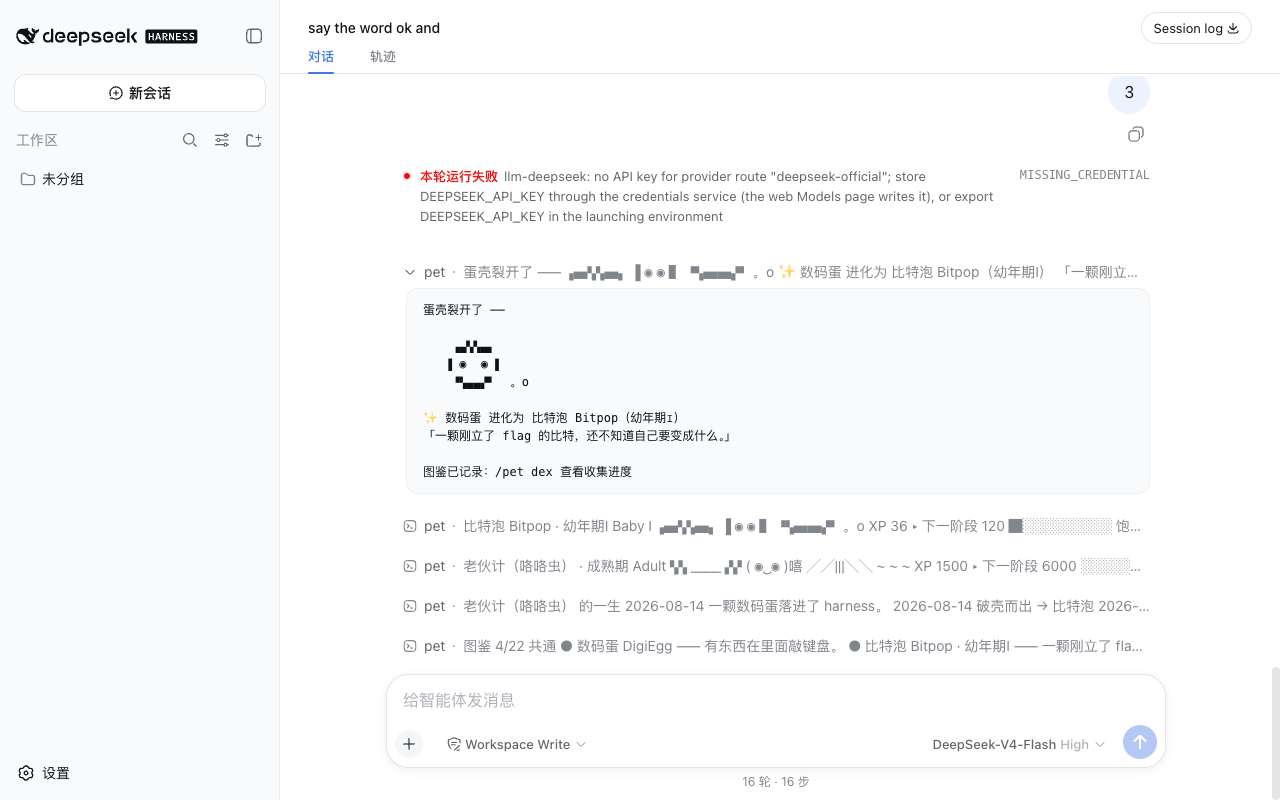
The shell cracks open —

    ▗▄▚▚▄▖
   ▐ ◉  ◉ ▌
    ▝▚▄▄▞▘  。o

✨ DigiEgg evolved into Bitpop (Baby Ⅰ)
"A single bit that just raised its flag, not yet sure what it wants to become."
30 seconds to a pet
dsh plugin --profile web add github:swaylq/dsh-digipet
# restart dsh, then in any session:
/pet hatch
Then just work. Every completed turn +5 XP, each of your messages +2, every tool call +3, even every error +4. /pet to check on it, /pet evolve for the ceremony.
What it becomes depends on how you work
The life cycle follows classic V-pet canon in full: Egg → Baby Ⅰ → Baby Ⅱ → Child → Adult → Perfect → Ultimate. From Child onward, every evolution re-reads how you actually worked that stage to pick a lineage:
| Lineage | What feeds it | Ultimate form |
|---|---|---|
| 🐉 Dragon | writing files, running commands | Wardrake Sovereign |
| 📜 Sage | reading code, searching docs | Codex Deva |
| 🕊️ Angel | plain conversation | Seraph Prime |
| 👾 Virus | errors and mishaps survived | Doomweaver — kill -9 only makes it split |
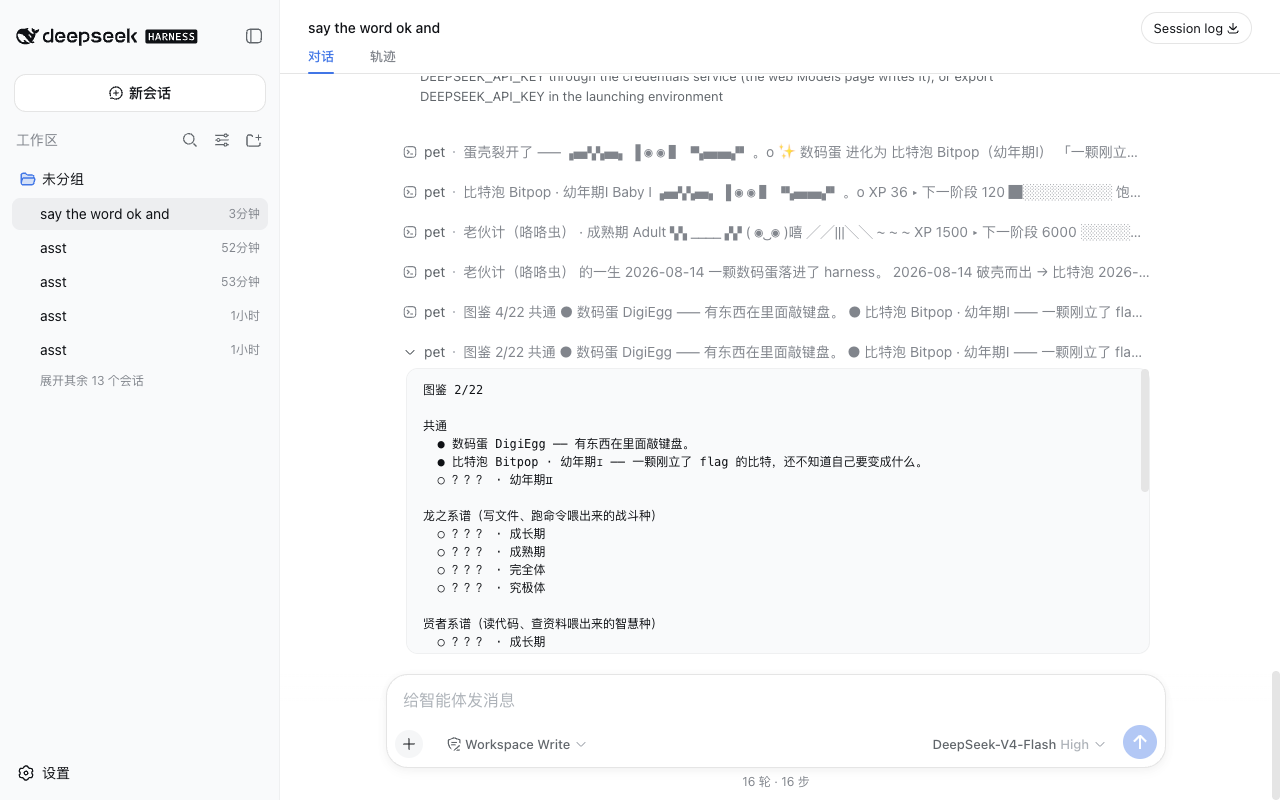
3 shared baby forms + 4 lineages × 4 stages + 3 hidden forms = a 22-slot dex. Lineages are never locked in — a Dragon-line pet that spends a stage drowning in stack traces respecs into the Virus line. What it finally becomes is a mirror of how you actually worked.
As for the hidden forms, the dex offers only a rumor:
"Rumor: evolving on a stuffed belly ends badly."
Veterans know exactly what that means. Some mistakes can be redeemed by love; others pile up, layer upon inherited layer, into something ancestral (the last line of its art reads // don't touch.).
Commands
| Command | Does |
|---|---|
/pet |
status card: art, XP, fullness, mood, four stats, lifetime counters |
/pet hatch |
lay the egg (one pet per DSH home; also triggers a ready egg's ceremony) |
/pet evolve |
the evolution ceremony |
/pet name <name> |
name it (≤16 chars) |
/pet dex |
the collection (unseen forms show as ???; hidden forms get only a rumor) |
/pet story |
its life journal |
/pet about |
mechanics and trust stance |
Upgrading from 0.1.x: old saves (the sea-creature roster) migrate automatically and losslessly on next boot — stage, XP, stats, dex and journal all carry over, with historical forms mapped onto the new roster.
Why
The DSH ecosystem already has twenty-plus desktop pets (whale-girl, assorted whales, a revived Clippy, Live2D companions…). Nearly all of them are state mirrors: agent thinks, pet thinks; task done, pet cheers. The deepest one, whale-girl, has XP levels and titles — but its body never changes, and it lives only in the Web GUI.
None of them is a raising game: no hatching, no evolution stages, no "how you work decides what it becomes." dsh-digipet fills that square — a first-generation-V-pet growth loop hosted in your harness and fed by your actual work.
Overfeeding makes it drowsy (above 90% fullness, XP gain drops to 15%) — a thematically honest anti-grind valve. But veterans know: never press evolve on a stuffed belly.
How it works
The whole plugin is four event taps and one slash command:
| Hook | Feeds |
|---|---|
agent/turn-stopping |
+5 XP per completed turn |
agent/inbox/claimed |
+2 XP per user message (feeds Bond) |
tools/result |
+3 XP per tool call, classified by tool name into Forge or Lore; failures feed Grit |
agent/error |
+4 XP per error (feeds Grit) |
Thresholds: 30 / 120 / 500 / 1800 / 6000 / 16000 XP. Evolution takes the dominant stat of the window since the last evolution; the window then resets. The save lives at $DSH_HOME/digipet/state.json, written the same way the official JSON storage backend persists (temp file + fsync + atomic rename), throttled to one write per 1.5 s no matter how busy the agent gets.
DSH's core invariant is "model-visible means logged" — this plugin's answer is to show the model nothing at all. No registered tool (tool schemas are a per-request token tax), no agent.inject(), no session events. The pet exists only in command result cards and contributes zero bytes to every model request.
Trust stance
- Reads: only its own save file. It never reads your code or your conversation — the event taps use only what kind of thing happened; message and tool contents never touch the save.
- Writes: only
$DSH_HOME/digipet/state.json. - Network: none.
- Model surface: none. Zero token overhead; provider KV caches are untouched.
- Blast radius: every listener body is wrapped in try/catch and the command handler has its own error floor — a stumbling pet cannot veto, rewrite, or delay real work. All hooked events are notification-mode (
emit/serial).
Known limitations
- One pet per DSH home; every profile, session, and subagent on the machine shares and feeds it (feature and limitation).
- Concurrent dsh processes race the save last-writer-wins — the same single-process stance as the official JSON backend.
- Tool classification is a name heuristic (
write/edit/shell→ Forge;read/grep/search→ Lore); oddly named third-party tools count as neutral chow. - The collapsed conversation row flattens the art to one line — click the card for the full monospace version (same interaction as DSH's tool rows).
- Thresholds and the diet are deliberately not configurable: changed numbers would leave the dex and old saves speaking different languages.
Verification record
Verified on dsh 0.1.0-rc.6 (macOS, web profile):
- Installed via
dsh plugin --profile web add <this repo>; the digipet layer appears in--dump-config; dsh webboots clean;- In a real browser:
/pet hatchrenders the egg card (monospace, newlines preserved) → real events feed it to 30 XP →/pet evolvehatches Bitpop; - With no API key, plain messages still produce real events — the save matches the diet line by line;
- A crafted 0.1.x save (glitch-line junior) was loaded across a restart: it migrated automatically onto the new roster with name, stats and journal intact;
- 42 unit/integration tests (
node --test) covering the pure logic core, a faked Cordis context, the stray-evolution arc, and migration.
Homage and boundaries
The roster's silhouettes honor first-generation V-pet raising canon — the skull-helmed dino arc, the cyborg retrofit, the winged guardians, the network virus, and that slug you get for raising it wrong. "Digimon" is a trademark of Bandai Namco; this project is unaffiliated, and all names, art and copy are original with no official assets.
License
MIT
Related plugins
dsh-pet#dsh-pet
 PC2005-cloud
/dsh-pet/dsh-pet
DSH Web UI 桌面宠物:25 个透明动画、屏幕漫游、点击反应与拖拽,附可复现的素材生成链。
dsh plugin --profile web add github:PC2005-cloud/dsh-pet#path:/dsh-petpetdex
 crafter-station
/petdex
面向 Codex、Claude Code、DeepSeek Harness、Hermes、OpenCode、Gemini CLI 等的动画桌宠公共图鉴
dsh plugin --profile web add github:crafter-station/petdexpetdex
crafter-stationcrafter-station/petdex/packages/petdex-desktop-native/integrations/dsh
A public gallery of animated pets for Codex, Claude Code, DeepSeek Harness, Hermes, OpenCode, Gemini CLI, and more.
dsh plugin --profile web add 'github:crafter-station/petdex#31c0aee7f4fb387774b87d40e8047dc0f9cea94b&path:/packages/petdex-desktop-native/integrations/dsh'OpenBitFun
 GCWing
/OpenBitFun/extensions/dsh-openbitfun
DeepSeek Harness plugin bundle exposing the OpenBitFun Agent SDK Host as dsh tools
dsh plugin --profile web add 'github:GCWing/OpenBitFun#9ea94cb52e9ce725fc7aa154bd0a0a0d0effc6ef&path:/extensions/dsh-openbitfun'dsh-ads
 Nagi-ovo
/dsh-ads
2005 年中文站点风格的整活广告插件:侧栏广告/信息流/角落弹窗 + 假关闭叉,素材全虚构。
dsh plugin --profile web add github:Nagi-ovo/dsh-adsdsh-expression
 yyh-001
/dsh-expression
陪 AI 斗图的搞笑插件:说个感觉,AI 帮你搜到、发出那张恰到好处的真实表情包。
dsh plugin --profile web add dsh-expression