
Memory
agent-handoff-skill
weirdsky924/agent-handoff-skill · ★ 33
 weirdsky924
Encourages users to star the repository if the skill helps their agent handoff workflow.
安装
dsh plugin --profile web add github:weirdsky924/agent-handoff-skillGitHub 源码安装:首次需按提示配置 allowBuilds 构建授权后重试
For install and environment setup, plus plugin development tutorials, see DSH community docs ↗
README
Table of contents
- Platform Compatibility
- dsh.so Marketplace Metadata
- Why This Skill Exists
- What It Creates
- How It Works
- Main Use Cases
- 1. Initializing a New Repository
- 2. Continuing Long Tasks Across Windows
- 3. Recovering After Agent Switching or Context Compression
- 4. Repairing and Compressing Handoff Documents
- Installation
- Option 1: Install as a Local Codex Skill
- Option 2: Install as a Claude Code Personal Skill
- Option 3: Install as a Claude Code Project Skill
- Option 4: Install as a DeepSeek Harness Skill
- Option 5: Use Only the Script
- Usage Examples
- Initialize a Project
- Repair an Existing Handoff
- Merge Read-Only Query Permissions
- Install Claude Code Soft Reminder Hooks
- Check Capacity, Compact Snapshots, And Rotate History
- Repository Structure
- Design Principles
- 1. Repository Facts First
- 2. State Matters More Than History
- 3. The Next Agent Must Consume It Quickly
- 4. Idempotent Updates, No Duplicate Blocks
- 5. Do Not Modify User-Level Config by Default
- 6. Stable Reading Before Blind Paging
- 7. Bounded Current State, Traceable Full History
- Quality Checklist
- Notes
- License
A durable handoff mechanism skill for Codex, Claude Code, and DeepSeek Harness (DSH).
The problem is simple: AI agents can be powerful, but a chat window is not reliable project memory. Context gets compressed, sessions end, agents change, but the engineering work still needs to continue. agent-handoff turns the state that used to live in "the previous agent's head" into repository-local documentation that can be maintained, verified, and handed to the next agent.
It is not a chat-summary tool, and it is not a dumping ground for every historical detail. It is closer to a lightweight project flight recorder: it keeps the current objective, status, active files, key decisions, validation results, risks, blockers, and next actions in a compact form so the next agent can continue safely. It now also includes deterministic capacity maintenance so snapshots and history logs cannot grow without bounds.
Platform Compatibility
This repository is not Codex-only. It uses the common SKILL.md + references/ + scripts/ structure and can be installed under each tool's discovery path:
| Platform | Install location | Invocation |
|---|---|---|
| Codex | ~/.codex/skills/agent-handoff |
Codex can trigger the skill from its description, or the user can explicitly request it. |
| Claude Code personal Skill | ~/.claude/skills/agent-handoff |
Claude Code can discover it automatically, or you can invoke /agent-handoff. |
| Claude Code project Skill | <repo>/.claude/skills/agent-handoff |
Active only for that repository; useful for team-shared workflows. |
| DSH personal Skill | ~/.dsh/skills/agent-handoff |
DSH adds it to the model catalog and supports explicit /agent-handoff invocation. |
| DSH shared Agent Skill | ~/.agents/skills/agent-handoff |
Uses DSH's shared Agent Skills root. |
| DSH project Skill | <repo>/.dsh/skills/agent-handoff or <repo>/.agents/skills/agent-handoff |
Active for the nearest Git repository and outranks personal roots. |
DSH does not scan ~/.codex/skills, ~/.claude/skills, or <repo>/.claude/skills; install or link the repository into one of the DSH roots above. Installation under a default root requires no DSH profile, patch, or settings change. agents/openai.yaml is Codex UI metadata and is ignored by Claude Code and DSH.
dsh.so Marketplace Metadata
The root package.json is a minimal marketplace manifest for directory services such as dsh.so. It contains the required name, license, and description, plus repository and file metadata. It is marked private: this Skill is not intended to be published to npm, and the file does not change how DSH discovers or loads the runtime SKILL.md bundle.
This manifest primarily addresses dsh.so's L2 structured-metadata check. L3 additionally requires a parseable install specification and a declared DSH version; L4 runs that install inside a sandbox. This Skill intentionally declares neither an npm install nor a Cordis bundle install command, so adding package.json must not be described as a passing install test.
If you want dsh.so to recognize the repository through GitHub topic indexing, add the dsh-plugin topic in the GitHub repository settings. That topic is a marketplace indexing signal, not a DSH profile setting; the actual runtime entry remains SKILL.md.
Why This Skill Exists
When AI coding agents are used on real projects over long periods, the hardest failure mode is often not "the agent cannot write code." The real breakpoints are usually more operational:
- A new chat opens, and the agent no longer knows where the previous session actually stopped.
- A previous agent made technical decisions, but the reasons and evidence were never recorded.
- The user says "continue," but the current objective, active files, and validation state are buried in old chat context.
- A complex task spans multiple days, modules, and interruptions, and nobody can confidently say what is already done.
- A handoff document slowly turns into a chat transcript, forcing the next agent to read more irrelevant material.
- The repository has
CLAUDE.md,AGENTS.md,.claude/CLAUDE.md, or similar guidance files, but every project handles continuity differently.
agent-handoff packages those lessons into a reusable skill. It guides an agent to create or repair a stable handoff mechanism inside a repository, and it includes an idempotent bootstrap script so you do not need to keep copying large prompts or manually stitching templates together.
It also writes a stricter file-reading protocol into project rules: Read ranges stay below 240 lines by default, offset is treated as a line number, and agents must stop paging with Read after offset drift, empty output, stale snippets, or API termination, then re-anchor with search or read-only shell inspection before acting.
What It Creates
The default mechanism is now a multi-document layout, while the legacy single-document layout remains supported.
| File | Purpose |
|---|---|
AGENT_HANDOFF.md |
In multi layout, the index and recovery route. In single layout, the full handoff state file. |
.agent-handoff/snapshot.md |
Current objective, status, next actions, active files, blockers, and open questions. |
.agent-handoff/workspace.md |
Repository map, entry points, test commands, docs, and stable project context. |
.agent-handoff/decisions.md |
Important decisions with reasons and evidence. |
.agent-handoff/work-log.md |
Recent operational work log. |
.agent-handoff/validation.md |
Validation commands, results, failures, and intentionally skipped checks. |
.agent-handoff/backlog.md |
Pending work and follow-ups. |
.agent-handoff/risks.md |
Risks, blockers, UNKNOWN items, and confirmations needed. |
.agent-handoff/archive.md |
Compressed old history that is not part of normal recovery. |
.agent-handoff/archive/ |
Full rotated history chunks, each capped at 128 KiB. |
AGENTS.md |
Shared Codex and DSH project instructions file with a platform-neutral handoff protocol. |
.claude/CLAUDE.md |
Recommended project-level Claude Code rules. Requires future agents to read and maintain the handoff document. |
AGENT_SESSION_PROMPTS.md |
Optional reusable prompts for new-window startup, task continuation, closeout, and handoff quality review. |
.claude/settings.json |
Optional. Merges safe read-only query permissions or Claude Code soft reminder hook entries only when the user asks for them. |
.claude/hooks/handoff-watch.mjs |
Optional Claude Code hook script, created only when --install-hooks is explicitly used. |
.gitignore |
Optional. Keeps local handoff files uncommitted unless the project decides to version them. |
The core rule is idempotency. Project-level handoff rules are wrapped in stable markers:
<!-- AGENT_HANDOFF_PROTOCOL:START -->
...
<!-- AGENT_HANDOFF_PROTOCOL:END -->
If the markers already exist, the marked block is replaced. If they do not exist, the block is appended. The same protocol should not be duplicated every time the setup runs.
How It Works
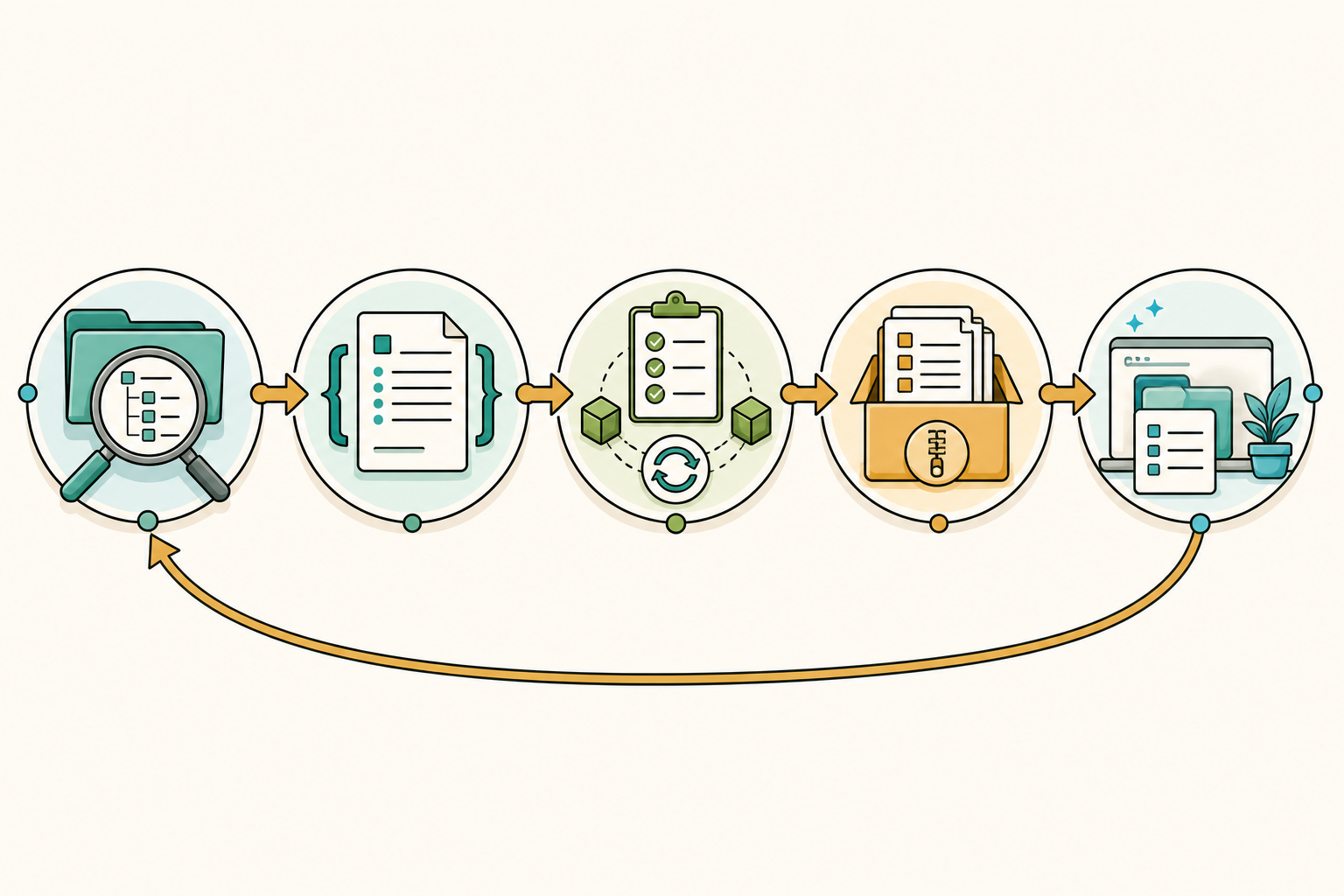
The skill creates a loop:
- Inspect: Read the repository shape before writing templates.
- Bootstrap: Create or merge the necessary handoff files and project rules.
- Maintain: During work, record objectives, decisions, active files, validation, and risks.
- Compact / Rotate: Check capacity, archive before snapshot compaction, and rotate long logs along complete record boundaries.
- Closeout: Before finishing any non-trivial task, refresh and maintain
AGENT_HANDOFF.mdor the relevant.agent-handoff/files. - Recover: The next agent starts from the handoff document, then reads only the source files needed for the current task.
The point is not to make agents read less source code. The point is to make agents read less irrelevant history. AGENT_HANDOFF.md tells the next agent where to start reading. Implementation details still need to be verified from source files and tests.
In multi-document layout, the recovery reading order is:
AGENT_HANDOFF.md.agent-handoff/snapshot.md.agent-handoff/risks.md.agent-handoff/backlog.md.agent-handoff/validation.md, only when validation state affects the current task.agent-handoff/decisions.md, only when changing architecture, behavior, dependencies, or prior decisions.agent-handoff/workspace.md, only when orientation, commands, or subproject boundaries are needed.agent-handoff/work-log.md, only when recent implementation details are needed.agent-handoff/archive.md, only when old context is explicitly needed
Main Use Cases
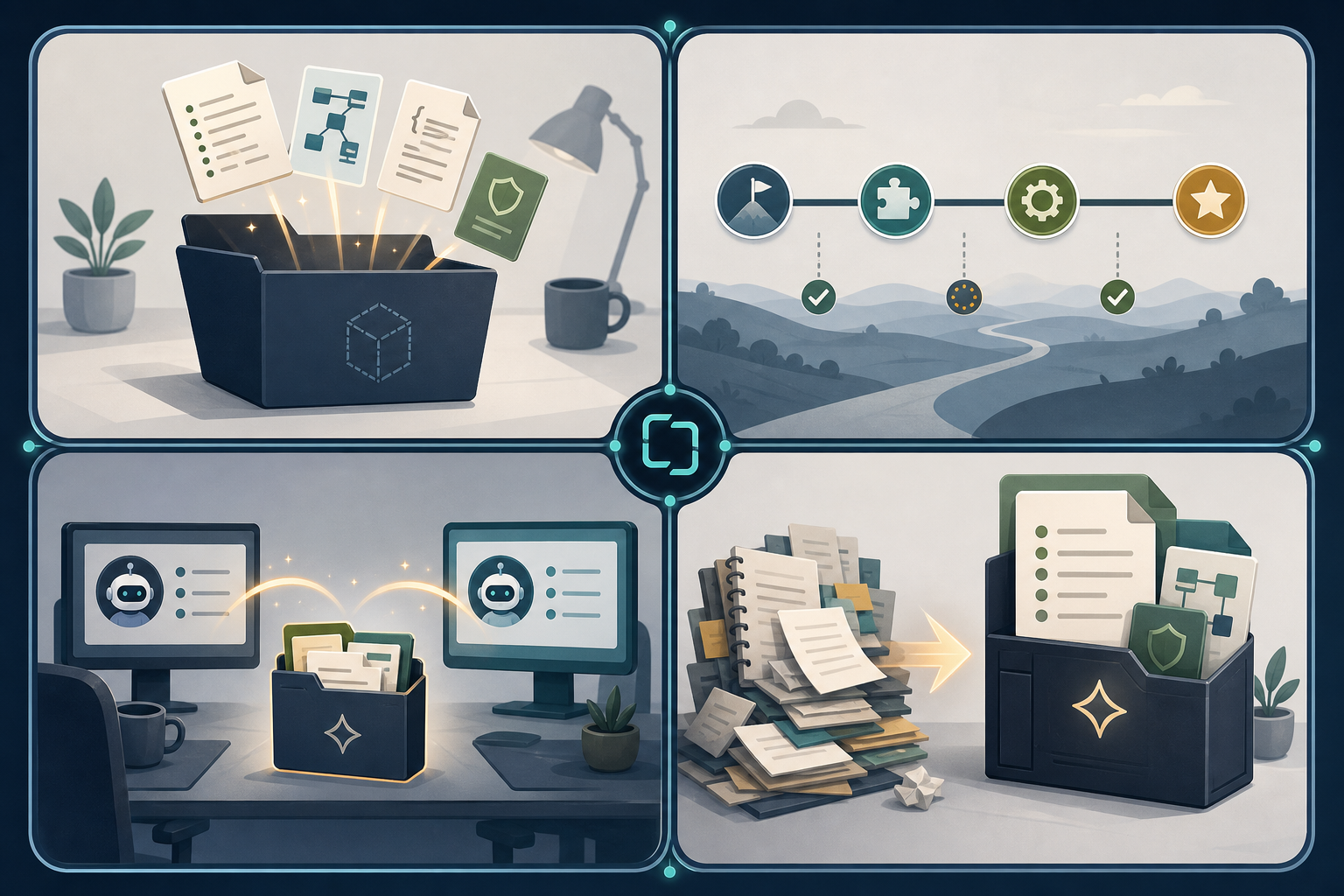
1. Initializing a New Repository
When you open a new repository and want future agents to maintain continuity automatically, use this skill from Codex, Claude Code, or DSH:
Use the agent-handoff skill to initialize a handoff mechanism for the current project.
The agent should inspect the repository, create AGENT_HANDOFF.md, and merge Durable Handoff rules into the platform-specific project instruction files:
- Codex / DSH:
AGENTS.md - Claude Code:
.claude/CLAUDE.md
Good fits:
- New SaaS projects
- Multi-module monorepos
- Client projects that will be maintained over time
- Repositories where AI agents or chat windows are frequently switched
2. Continuing Long Tasks Across Windows
A single feature can span multiple sessions:
- Day 1: analyze architecture and plan the approach.
- Day 2: implement backend APIs.
- Day 3: wire up frontend and tests.
- Day 4: fix validation failures and edge cases.
Without a handoff mechanism, the new agent has to reconstruct the task from old chat history. With AGENT_HANDOFF.md, it can see:
- The current objective.
- The active files.
- Decisions that were made.
- Validation commands that were run.
- Tests that were not run, and why.
- Remaining risks and next steps.
To continue, you can say:
Read AGENT_HANDOFF.md and continue the current task.
If you have seen an agent answer No response requested. or silently stop after Continue from where you left off., use a more explicit continuation prompt:
Continue the previous task. Do not answer "No response requested" and do not stop silently. First state where you believe the previous turn stopped and what the next concrete action is, then continue. If context is insufficient, read AGENT_HANDOFF.md and the necessary handoff files to recover state.
3. Recovering After Agent Switching or Context Compression
When chat context is compressed or a new agent takes over, the dangerous case is an agent that appears to understand the project but is missing key state. This skill's rules require the new agent to:
- Read
AGENT_HANDOFF.mdfirst. - Identify the current objective, status, next action, and blockers.
- Read only source files relevant to the current task.
- Treat the handoff document as continuity memory, not as a substitute for source truth.
This reduces two common risks:
- Repeating work that has already been completed.
- Continuing from stale or misunderstood context.
4. Repairing and Compressing Handoff Documents
Many teams start with a handoff file, but over time it can become:
- A chat summary.
- A long log dump.
- Vague notes without paths.
- Decisions without reasons.
- Stale backlog items.
- Contradictory status entries.
Use:
Use the agent-handoff skill to review and repair the current project's AGENT_HANDOFF.md.
The skill uses references/quality.md to turn noisy state back into factual operational memory.
Installation
Option 1: Install as a Local Codex Skill
Clone or copy this repository into your Codex skills directory:
git clone https://github.com/WeirdSky924/agent-handoff-skill C:\Users\<you>\.codex\skills\agent-handoff
If you already have it locally:
Copy-Item -Recurse -Force E:\_workspace\agent-handoff-skill C:\Users\<you>\.codex\skills\agent-handoff
Then start a new Codex session and ask:
Use the agent-handoff skill to initialize a handoff mechanism for the current project.
Option 2: Install as a Claude Code Personal Skill
Clone or copy this repository into Claude Code's personal skills directory:
git clone https://github.com/WeirdSky924/agent-handoff-skill C:\Users\<you>\.claude\skills\agent-handoff
If you already have it locally:
Copy-Item -Recurse -Force E:\_workspace\agent-handoff-skill C:\Users\<you>\.claude\skills\agent-handoff
Then in Claude Code, you can say:
Use the agent-handoff skill to initialize a handoff mechanism for the current project.
Or invoke it explicitly:
/agent-handoff initialize a handoff mechanism for the current project
Option 3: Install as a Claude Code Project Skill
If you want the skill to travel with a repository and be available to teammates, install it under the target project:
mkdir .claude\skills
git clone https://github.com/WeirdSky924/agent-handoff-skill .claude\skills\agent-handoff
Use project-level installation for team-standard workflows. Use personal installation when you want the skill available across all of your projects.
Option 4: Install as a DeepSeek Harness Skill
Personal DSH installation:
git clone https://github.com/WeirdSky924/agent-handoff-skill C:\Users\<you>\.dsh\skills\agent-handoff
You can also use DSH's shared Agent Skills root:
git clone https://github.com/WeirdSky924/agent-handoff-skill C:\Users\<you>\.agents\skills\agent-handoff
Project-level installation:
mkdir .dsh\skills
git clone https://github.com/WeirdSky924/agent-handoff-skill .dsh\skills\agent-handoff
DSH scans these roots by default, so no profile, cordis.patch.yml, or settings.yaml change is required. The model can load the skill automatically, or the user can invoke it explicitly:
/agent-handoff initialize a handoff mechanism for the current project
Option 5: Use Only the Script
You can also run the bootstrap script directly:
bootstrap_handoff.pyandmaintain_handoff.pyrequire Python 3.10 or newer. DSH itself requires Node.js and does not guarantee that Python is installed.
python scripts\bootstrap_handoff.py --repo E:\path\to\your\repo --platform both --layout multi --session-prompts --gitignore
Common flags:
| Flag | Description |
|---|---|
--repo <path> |
Target repository root. Defaults to the current directory. |
--platform codex|claude|dsh|both |
Project rule target. codex and dsh update the shared AGENTS.md, claude updates .claude/CLAUDE.md, and both writes both files and covers all three hosts. |
--layout single|multi |
Handoff structure. multi is the recommended default; single preserves the legacy one-file layout. |
--session-prompts |
Create AGENT_SESSION_PROMPTS.md if missing. |
--gitignore |
Add AGENT_HANDOFF.md and AGENT_SESSION_PROMPTS.md to .gitignore. |
--allow-readonly |
Claude Code only: merge safe read-only query permissions into .claude/settings.json. |
--install-hooks |
Claude Code only: install optional soft reminder hooks and merge missing hook entries into .claude/settings.json. |
--dry-run |
Show planned changes without writing files. |
--skip-codex-rules |
Do not create or update the shared Codex/DSH AGENTS.md. |
--skip-claude-rules |
Do not create or update .claude/CLAUDE.md. |
Example:
python scripts\bootstrap_handoff.py --repo E:\_workspace\my-saas --platform both --layout multi --session-prompts --gitignore --dry-run
Review the output, then rerun without --dry-run.
For a DSH-only project:
python scripts\bootstrap_handoff.py --repo . --platform dsh --layout multi --dry-run
Usage Examples
Initialize a Project
User:
Use the agent-handoff skill to establish a durable handoff mechanism for the current project.
Expected agent behavior:
- Inspect the project structure.
- Look for existing
CLAUDE.md,AGENTS.md, and.claude/CLAUDE.md. - Create or update
AGENT_HANDOFF.md. - Idempotently merge the shared Codex / DSH handoff block into
AGENTS.md. - Idempotently merge the Claude Code handoff block into
.claude/CLAUDE.md. - Optionally create
AGENT_SESSION_PROMPTS.md. - Re-read the changed files.
- Report what was created, current status, and remaining
UNKNOWNentries.
Repair an Existing Handoff
User:
Use the agent-handoff skill to repair AGENT_HANDOFF.md. It is too long and the state is messy.
Expected agent behavior:
- Read
references/quality.md. - Read the current
AGENT_HANDOFF.md. - Check for content that conflicts with repository facts.
- Compress stale history.
- Refresh Snapshot, Work Log, Validation History, and Backlog.
- Preserve evidence-backed decisions and remove chat-transcript noise.
Merge Read-Only Query Permissions
User:
Use the agent-handoff skill and make future read/query operations require less manual approval.
The agent can run:
python scripts\bootstrap_handoff.py --repo . --allow-readonly
This only merges safe local read/search/inspection permissions into Claude Code's .claude/settings.json, such as Read, Grep, Glob, rg, git status, and git diff. It does not allow writing, deleting, installing dependencies, network access, starting services, or database changes.
Install Claude Code Soft Reminder Hooks
User:
Use the agent-handoff skill and add Claude Code handoff closeout reminder hooks.
The agent can dry-run first:
python scripts\bootstrap_handoff.py --repo . --install-hooks --dry-run
Then apply:
python scripts\bootstrap_handoff.py --repo . --install-hooks
This creates .claude/hooks/handoff-watch.mjs and merges missing SessionStart, UserPromptSubmit, PreCompact, Stop, SubagentStop, and SessionEnd hook entries into .claude/settings.json. The hook is event-aware and advisory only: it injects handoff health and recovery reading order on startup; adds context when the user says things like continue, resume, handoff, compact, or closeout; reminds the agent before compaction or closeout; and reports snapshot or log capacity overages. It always returns continue: true, never returns decision: "block" or continue: false, never invokes Python, never writes handoff files, and will not terminate the session if AGENT_HANDOFF.md is missing or the check fails unexpectedly.
Check Capacity, Compact Snapshots, And Rotate History
Long-lived projects continuously accumulate validation records and work logs. A vague instruction to "keep it short" is not enough to stop a snapshot from turning back into a transcript. The maintenance script gives Codex, Claude Code, and DSH one deterministic policy:
# Read-only inspection; writes nothing
python scripts\maintain_handoff.py --repo . --check

# Compact an oversized snapshot and rotate eligible history
python scripts\maintain_handoff.py --repo . --compact-if-needed

# Skip snapshot compaction and rotate eligible history only
python scripts\maintain_handoff.py --repo . --rotate
When running from an installed skill, replace scripts\maintain_handoff.py with the actual skill path, such as ~/.codex/skills/agent-handoff/scripts/maintain_handoff.py, ~/.claude/skills/agent-handoff/scripts/maintain_handoff.py, ~/.dsh/skills/agent-handoff/scripts/maintain_handoff.py, or ~/.agents/skills/agent-handoff/scripts/maintain_handoff.py.
| File | Soft limit / trigger | Hard limit / cap | Automatic action |
|---|---|---|---|
snapshot.md |
16 KiB or 240 lines | 32 KiB or 400 lines | Archive the original, then retain bounded current state, next actions, active files, questions, and recovery summary. |
work-log.md |
64 KiB or 30 dated sections | Preserve at least one newest complete section | Rotate old complete ## YYYY-MM-DD sections. |
validation.md |
64 KiB or 200 table records | Preserve at least one newest complete row | Rotate complete Markdown table rows. |
backlog.md |
32 KiB | 32 KiB | Archive only mechanically identifiable completed [x] items. |
risks.md |
32 KiB | 32 KiB | Never delete automatically; report for semantic Agent review. |
Single-file AGENT_HANDOFF.md |
32 KiB | 64 KiB | Migrate to multi layout at the hard limit instead of adding complex in-file rotation. |
.agent-handoff/archive/*.md |
Created as needed | 128 KiB each | Split on UTF-8-safe boundaries and add links to archive.md. |
Safety matters more than forcing a smaller file. If snapshot parsing fails, the script preserves the original. Risks require semantic understanding and are never deleted mechanically. Every automatically compacted snapshot is archived in full before atomic replacement. --check is read-only, and the hook only reminds; writes happen only when an Agent explicitly runs --compact-if-needed or --rotate.
Repository Structure
agent-handoff/
  SKILL.md
  README.md
  README_en.md
  agents/
    openai.yaml
  assets/
    readme/
      hero.png
      workflow.png
      scenarios.png
  templates/
    claude-settings-hooks.json
    handoff-watch.mjs
  references/
    codex-rules.md
    claude-rules.md
    dsh-rules.md
    hooks.md
    quality.md
    templates.md
  scripts/
    bootstrap_handoff.py
    maintain_handoff.py
  package.json
  LICENSE
Multi layout creates this structure in the target project:
AGENT_HANDOFF.md
.agent-handoff/
  snapshot.md
  workspace.md
  decisions.md
  work-log.md
  validation.md
  backlog.md
  risks.md
  archive.md
  archive/
    <type>-<timestamp>.md
Responsibilities:
SKILL.md: Runtime entry point. Keep it short. It contains trigger description, workflow, resource navigation, and boundaries.references/templates.md: Templates forAGENT_HANDOFF.mdandAGENT_SESSION_PROMPTS.md.references/codex-rules.md: Shared Codex / DSHAGENTS.mdhandoff rule block.references/claude-rules.md: Claude Code.claude/CLAUDE.mdhandoff rule block.references/dsh-rules.md: DSH skill discovery roots, invocation contract, sharedAGENTS.mdbehavior, and runtime boundaries.references/hooks.md: Optional Claude Code event-aware hook guidance. Hooks must always exit0, never returndecision: "block"orcontinue: false, never write handoff files, and never block or close the session.templates/claude-settings-hooks.json: Claude Code.claude/settings.jsonhook snippet template for manual merge or script installation.templates/handoff-watch.mjs: Claude Code event-aware handoff reminder hook script template.references/quality.md: Quality standards for reviewing, repairing, and compressing handoff documents.scripts/bootstrap_handoff.py: Conservative setup script. Creates missing files, single or multi handoff layouts, idempotently merges rules, and can optionally install Claude Code soft reminder hooks.scripts/maintain_handoff.py: Shared Codex, Claude Code, and DSH capacity checks, snapshot compaction, and history rotation.package.json: Private marketplace manifest for dsh.so; it does not change DSH'sSKILL.mddiscovery behavior.LICENSE: MIT license, so users and directory services can identify the usage terms.README.md/README_en.md: GitHub documentation. Not required at runtime.
Design Principles
1. Repository Facts First
The handoff document must not invent facts. If a fact cannot be verified, write UNKNOWN and leave a way to resolve it.
Bad:
- The project uses Next.js and PostgreSQL.
Better, if you have not checked the source/configuration:
- UNKNOWN: Backend/database stack needs confirmation from repository files.
2. State Matters More Than History
AGENT_HANDOFF.md is not a chat log. It should answer:
- What is the current objective?
- What is the current status?
- What should happen next?
- Which files are relevant?
- Which important decisions were made?
- What validation was run?
- What risks remain?
3. The Next Agent Must Consume It Quickly
A good handoff lets a new agent recover within minutes. Stale information should be compressed, contradictions should be removed, and long logs should be summarized.
4. Idempotent Updates, No Duplicate Blocks
Project-level rules are managed with markers. Running setup again should replace the existing marked block, not append another copy.
5. Do Not Modify User-Level Config by Default
The default behavior is project-local. Do not automatically modify user-level configuration such as ~/.codex/AGENTS.md, ~/.claude/CLAUDE.md, a DSH profile, cordis.patch.yml, or settings.yaml unless the user explicitly asks. Installing the skill under a default DSH discovery root does not require those configuration changes.
6. Stable Reading Before Blind Paging
Generated AGENTS.md and .claude/CLAUDE.md rules require agents to read files in small, anchored ranges. Read offset must be treated as a line number. If Read returns empty output, offset warnings, inconsistent line numbers, file is shorter than the provided offset, or an API termination after a Read attempt, the agent must stop paging with Read and re-anchor with rg -n, wc -l, sed -n, or another read-only inspection command.
7. Bounded Current State, Traceable Full History
snapshot.md uses replacement semantics rather than appending each old snapshot to the bottom. At the soft limit, the maintenance script writes the original to a timestamped archive chunk before rendering bounded current state. If safe parsing is impossible, it leaves the original unchanged and asks the Agent to repair it. Recovery stays lightweight while full history remains traceable.
Quality Checklist
A good AGENT_HANDOFF.md should satisfy:
- A new agent can quickly understand the current objective and next action.
- Paths can be located from the repository root.
- Current status, backlog, and blockers do not contradict each other.
- Important decisions include reasons and evidence.
- Validation history states what was run, what happened, and what limitations remain.
- It contains no secrets, long logs, full code blocks, or chat transcripts.
- Unknown information is marked as
UNKNOWN. - It reduces irrelevant reading but does not replace source verification.
Multi-document layout must also satisfy:
AGENT_HANDOFF.mdis only an index and recovery route, not a task log.snapshot.mdis replace-in-place current state, normally at or below 16 KiB / 240 lines, and never grows beyond 32 KiB / 400 lines without an explicit finding.risks.mdcontains all active risks, blockers, andUNKNOWNitems.backlog.mdcontains actionable pending work, not completed stale items.validation.mdclearly records passed, failed, and not-run checks.decisions.mdincludes reasons and evidence for every durable decision.work-log.mdstays within 64 KiB / 30 dated sections, andvalidation.mdstays within 64 KiB / 200 records.backlog.mdandrisks.mdstay within 32 KiB; automatic archival never deletes pending work or risk semantics.- Generated archive chunks stay within 128 KiB and are not required for normal recovery.
- A new agent can recover the previous agent's state by reading the index, snapshot, risks, backlog, and only the necessary validation/decision files.
Notes
- If the project commits
AGENT_HANDOFF.md, be careful not to include private context, sensitive paths, logs, or internal information. - If the project gitignores the handoff document, make sure the team understands that it is local state.
- Hooks are optional reinforcement. They should not replace the agent's responsibility to close out properly; the default setup does not install hooks, and only explicit
--install-hookswrites.claude/hooks/handoff-watch.mjsand merges.claude/settings.json. The current hook coversSessionStart,UserPromptSubmit,PreCompact,Stop,SubagentStop, andSessionEnd, emitting only soft context or advisory reminders. - The hook detects capacity and reports reminders but never runs the maintenance script. This avoids blocking a PostToolUse or Stop phase on Python startup, file locks, or maintenance failures.
- Claude Code hooks do not apply to Codex or DSH. DSH follows recovery and closeout rules from the shared
AGENTS.mdblock. - If the target project already has an unmarked
.claude/hooks/handoff-watch.mjs, the script preserves it and does not wire settings to that unverified script, avoiding accidental use of custom hooks that might block a session. bootstrap_handoff.pydoes not overwrite an existingAGENT_HANDOFF.md; existing state must be repaired from repository facts.- DSH is currently a developer preview and may change its skill-discovery or instruction-loading contracts. Recheck the official sources linked from
references/dsh-rules.mdafter upgrading DSH. - dsh.so is an independent community directory and is not affiliated with DeepSeek AI. The security badge represents its automated static scan, not a manual audit or official DSH certification.
License
This repository is licensed under the MIT License. See LICENSE.
Related plugins
hindsight#coding-agents
 vectorize-io
/hindsight/hindsight-integrations/coding-agents
Hindsight:会学习的 Agent 长期记忆系统,自动召回/保存、知识页、深度反思与按仓库隔离的记忆银行。
dsh plugin --profile web add github:vectorize-io/hindsight#path:/hindsight-integrations/coding-agentsdsh-memory-plugin
 volcengine
/OpenViking/examples/dsh-memory-plugin
面向 DeepSeek Harness 的 OpenViking 记忆与上下文插件:pre-step 自动召回与画像注入、会话捕获、`viking://` URI 防护,以及对接 OpenViking 服务端的 recall/write 记忆工具。
dsh plugin --profile web add @openviking/dsh-memory-pluginmemos
 memtensor
/memos
给你的 Agent 持久记忆与成长能力
dsh plugin --profile web add @memtensor/memos-cloud-dsh-plugin@latestdsh-purge-kingchar
 kingcharleslzy-ai
/dsh-purge
让 AI 更专注地辅助学习与动手实验:DSH 附加组件,提供状态自检、提示词与规则管理、本机备份与回滚。
dsh plugin --profile web add 'github:kingcharleslzy-ai/dsh-purge#27919a326b6615b1968661a3e749760cec3a2e07'dsh-context
 bowenliang123
/dsh-context
上下文洞察面板:一眼看清模型上下文窗口的组成与变化——构成对照窗口大小、按请求历史趋势、压缩/注入事件、消息级 token 统计。
dsh plugin --profile web add dsh-contextmemsearch
 zilliztech
/memsearch/plugins/dsh
MemSearch plugin for DeepSeek Harness: shared markdown memory across agents, with capture, on-demand recall, memory-recall skill, and a skill-candidate review panel.
dsh plugin --profile web add '@zilliz/memsearch-dsh@0.1.8'